
When the Diagnosis Becomes the Disease
The journalism industry spent a decade telling the public local news is in crisis. The Pew data suggests the public heard the message and drew the wrong conclusion.

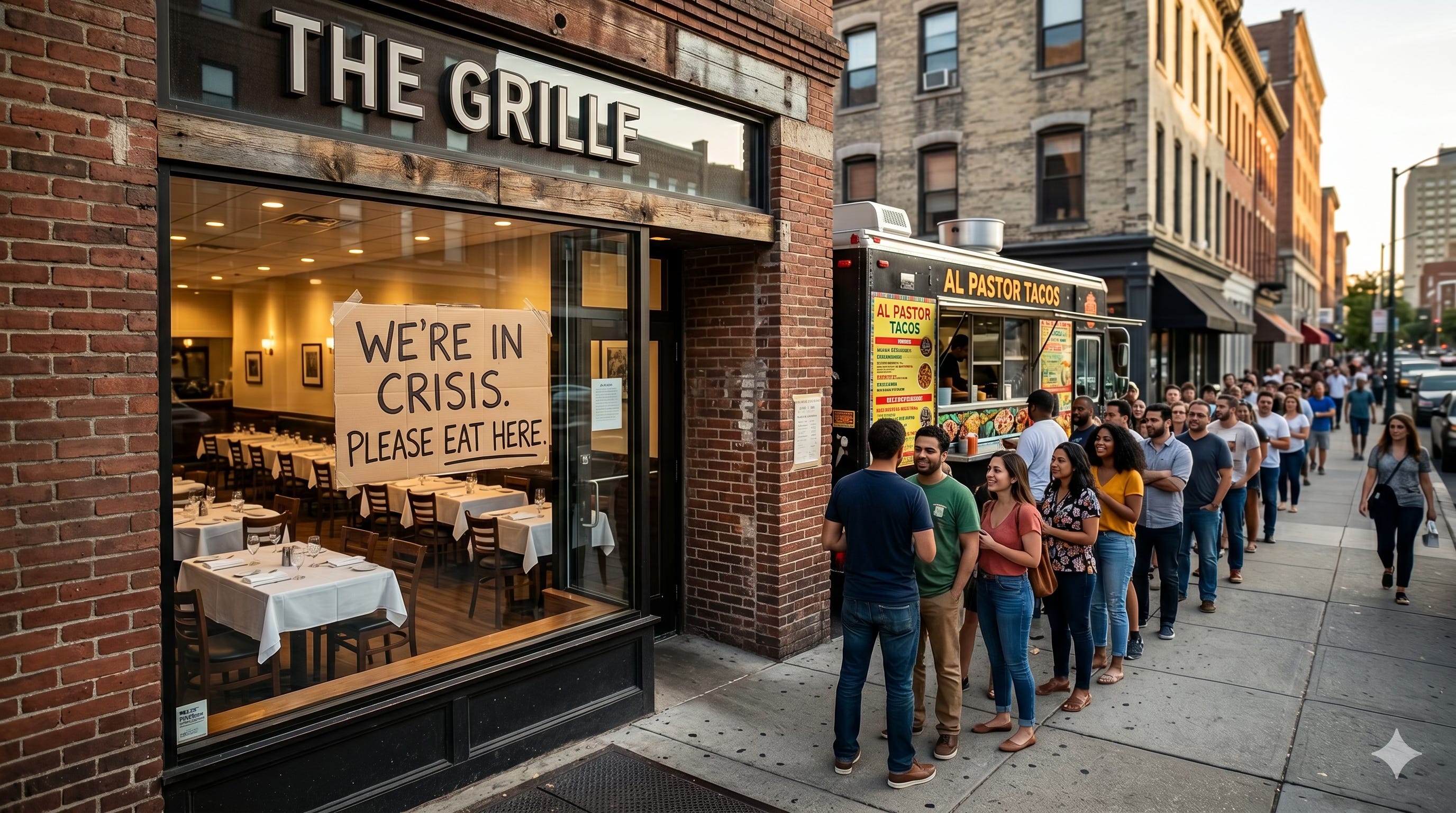
The journalism industry has spent nearly a decade telling the public that local news is in crisis. New data from the Pew Research Center suggests the campaign is working. More Americans than ever believe their local news outlets are in financial trouble. The data also suggests something far less comfortable: it might not matter. And it might be making things worse.
The Pew-Knight Initiative’s latest local news fact sheet tracks a set of numbers the industry has been watching since 2018. The headline finding, and the one that generated the most attention, is that 39% of Americans now say their local news outlets are not doing well financially. That is up from 24% in 2018 and 33% a year earlier. The trend is moving in the direction the industry wanted.
Here is what happened over that same period and the years just before it.
The share of Americans who follow local news very closely dropped from 37% in 2016 to 21% in 2025, a decline that began before the crisis campaign hit full stride and accelerated through it. The share who say local news is extremely or very important to their community fell from 44% to 34%. That is a ten-point decline in a single year. And the share who actually paid for local news in the past year fell from 14% to 12%.
Read those numbers together, and a pattern emerges that nobody in the industry seems eager to discuss. Awareness of the crisis went up. Every measure of engagement, perceived value, and willingness to pay went down. Not flat. Down.
A Quick Disclaimer: These thoughts are mine alone. They don’t necessarily reflect the official position of my colleagues or the leadership at the American Press Institute. While my work at API deeply informs how I see the industry, Backstory & Strategy is my space for thinking out loud and poking at the frameworks we all have to navigate.
The Campaign That Worked (and Didn’t)
The effort to raise public awareness about the state of local news has been substantial, sustained, and well-funded. Northwestern’s Local News Initiative has documented the loss of newspapers across the country. The Pew-Knight Initiative has tracked audience behavior across multiple survey waves. Press Forward launched with hundreds of millions in philanthropic commitments. Rebuild Local News has advocated for federal policy intervention. “News deserts” entered the mainstream vocabulary. None of this work is bad. Much of it is excellent. The research is rigorous. The advocacy has moved real money.
But the theory of change underneath all of this was never just “raise awareness.” It was: raise awareness, and people will act. They will subscribe. They will donate. They will show up. The awareness was supposed to be an input to behavior change.
The Pew data now lets us test that theory. The answer is no. The people who got the message did not change their behavior.
The reasons Americans give for not paying for local news have barely moved since 2018. Half say they can find what they need for free. About three in ten say they are not interested enough. One in ten says it is too expensive. One in ten says the quality isn’t worth it. These numbers are almost identical to what they were seven years ago, before the crisis campaign began in earnest.
These are not awareness answers. They are product-market answers. People are not saying, “I didn’t know you were struggling.” They are saying “I found an alternative,” or “I don’t value this enough,” or “what you’re offering isn’t good enough.” Crisis messaging does not address any of those responses. It can’t. It wasn’t designed to. This is a mission problem, not a capacity problem.
And that is precisely the problem. The crisis narrative is a B2B message. It was built for philanthropists and policymakers. It works in that room. But it leaked into the consumer channel, and in the consumer channel, it is poison. A message that moves a billionaire donor to write a seven-figure check is the same message that tells a potential ten-dollar-a-month subscriber that the product is dying. The industry has a segmentation failure, not a messaging failure. The message is fine. It is just being heard by an audience it was never meant to reach.
What Every Other Industry Already Knows
There is an assumption embedded in the crisis narrative that deserves more scrutiny than it gets: that telling consumers an institution is in financial distress will make them want to support it. The crisis communications profession has spent decades studying this assumption. It is wrong.
Research led by scholars at the University of Chicago Booth School of Business has demonstrated that when consumers become aware that an institution is in financial trouble, their response is not to rally in support. It is to disengage. Birge, Parker, Wu, and Yang found that customer anticipation of financial distress can become self-fulfilling: the more consumers believe a firm is likely to fail, the more their behavior makes failure likely. The researchers called this a “death spiral.” They showed it was driven not by the institution’s actual financial position but by the consumer’s perception of it.
Their research focused on retail, where the mechanism is consumers waiting for liquidation sales. In news, the dynamic is different, but the direction is the same. Why would you invest your time, your attention, and your money in building a habit around something that keeps telling you it might not exist in six months? In news, the death spiral isn’t about waiting for a discount. It is about avoiding the investment entirely.
Every crisis PR professional in the country knows this intuitively. When Silicon Valley Bank tried to reassure its customers by being transparent about its financial pressures in March 2023, it triggered a $42 billion bank run in a single day. Andy Gilman, CEO of the crisis communications firm CommCore, analyzed the SVB stakeholder letter for Fortune and concluded that the bank’s own language “screams ‘We’re in trouble’” and “probably added fuel to the fire.” The bank’s attempt at transparency became the accelerant.
The journalism industry does not lack access to this expertise. Brian Tierney, the former co-owner and publisher of the Philadelphia Inquirer, has spent his post-newspaper career building one of the country’s most respected crisis communications firms. He currently serves as Vice-Chair of the Poynter Foundation Board. His entire professional philosophy is built around helping organizations replace fear-based narratives with possibility-driven ones. At the center of his framework is a question he calls deceptively simple: “What if we won?”
That question is the exact inverse of the one the journalism industry has been asking for a decade. The industry’s question has been: “Do people know we’re losing?” Tierney’s career is built on the premise that this is precisely the wrong story to tell. And yet the institution whose foundation board he helps lead exists to serve an industry that cannot stop telling it.
If this argument is landing for you, it’s probably landing for someone in your network, too. Share it with a colleague who’s been sitting in those rooms where “crisis” is the opening line of every deck.
The Substitution Nobody Noticed
While the industry was narrating its own decline, consumers were solving the information problem for themselves. The Pew data on where Americans actually get local information tells this story with uncomfortable clarity.
Use of online forums and discussion groups for local news grew from 38% to 52% between 2018 and 2025. Use of online-only news sources nearly tripled, from 15% to 42%. The share getting local information directly from government agencies rose from 30% to 40%. And in 2025, Pew measured news influencers for the first time and found 36% of Americans already using them as a source.
The crisis narrative assumes that when local journalism declines, people experience a void. A news desert. An absence that, once recognized, they will want to fill by supporting the institutional press.
But the data doesn’t show a void. It shows a market. People are getting local information from sources that are not newsrooms: Facebook groups, Nextdoor, government websites, influencers, and newsletters. The “desert” framing was always a supply-side description. From the demand side, the landscape looks less like a desert and more like a road where traffic rerouted while the old bridge was being mourned instead of rebuilt.
The rerouted traffic is moving, but the road is more dangerous. The substitutes are not equivalent. A Nextdoor thread is not an investigative report. A city council’s Facebook page is not accountability journalism. But the industry is selling vitamins using hospital imagery, while most people are just looking for a snack. “Support us because you have no alternative” doesn’t land with someone who feels informed enough already. Telling them the old option is dying doesn’t make them come back. It confirms the decision they already made.
Where are you seeing this substitution play out? Are there communities in your coverage area where the Facebook group or the Nextdoor thread has become the de facto local news source? I’m collecting examples. Drop a comment or hit reply.
The Uncomfortable Question
The journalism industry has now spent the better part of a decade investing in a single strategic theory: that if Americans understood local news was in crisis, they would act to save it. Significant resources have gone into proving and publicizing the crisis. Research centers have been funded. Coalitions have been built. Reports have been published. The word “crisis” has become so central to the industry’s self-description that questioning it feels almost like disloyalty.
This is not a condemnation of the research or the people doing it. The work is rigorous, and the problems it documents are real. The critique is narrower and more specific: the industry built a message for one audience and let it reach another. It never segmented. It never asked whether the story that opens wallets in a foundation boardroom closes them at the kitchen table.
The data now offers something it didn’t a few years ago: a track record. And the track record says that awareness of the crisis has grown steadily while every metric that actually matters, attention, willingness to pay, and perceived importance, has declined. Not despite the awareness campaign. During it.
The question the industry keeps asking is: Do Americans know local news is in crisis? After a decade, the answer is increasingly yes. The question it has not asked, and the one the Pew data is quietly answering, is whether knowing that makes people more likely to subscribe, or less.
The data suggests less. And if Tierney’s question is the right one, if “What if we won?” is really where momentum begins, then maybe the industry needs to stop telling people what it is losing and start showing them what it makes possible. Not crisis. Not obligation. Not guilt. Utility. Belonging. Ambition. The story of a product worth paying for, told by people who believe it will be here next year.
Nobody subscribes to a sinking ship. But people will line up for a lifeboat that knows where it is going.
If this piece was forwarded to you, or if a colleague dropped it in Slack, consider subscribing. Backstory & Strategy is where I unpack the strategic assumptions the journalism industry runs on, and occasionally poke holes in the ones that aren’t working.
I work hard to get the facts and citations right, but I’m one person working across a lot of data. If you spot an error, reply directly or drop a note in the comments. I’ll correct it promptly and transparently.