

A Quick Disclaimer: Backstory & Strategy is a personal, independent publication. The views, analysis, and commentary expressed here are strictly my own and do not represent the official position, strategy, or endorsement of the American Press Institute, its leadership, or its board. This is my personal space for analyzing the media landscape, testing new frameworks, and thinking out loud.
“If they can’t make money, how will you?”
A potential funder asked me that in early 2006. I had left a decent-paying job at the Courier-Post in Cherry Hill to launch a weekly newspaper for South Jersey’s Jewish community, and I was making the rounds with my pitch. “They” were the Philadelphia Inquirer and Daily News. Across the river, Knight Ridder’s shareholders had pushed the company onto the market, and the region’s biggest newspapers were being shopped to whoever would buy them.
I was a data person even then. I walked into those meetings with spreadsheets, market research and charts, convinced that if the facts and figures were strong enough, any funder would open their wallet. Then one of them answered all of it with a single sentence about a newspaper across the river.
I spent about a year on that paper, building stacks of research, sitting with dozens of industry experts and community leaders, and spending every penny I had.
I knew it was over the day the COBRA bill arrived and there wasn’t enough left in the bank account to cover it. I had asked my wife to put up with a lot that year. Going without health insurance was one request I wasn’t willing to make. So I walked away.
Twenty years later, I finally have the data to answer that funder’s question.
If this was forwarded to you, or a colleague dropped it in Slack, consider subscribing. Next time, I’ll show where journalism is still hanging on beyond what the market would pay for, which is where the next news deserts are most likely to come from.
What the count doesn’t tell us
Medill’s State of Local News report, released this month, counted 238 U.S. counties with no local news source and another 1,478 with only one. Put those together, and more than half the counties in the country have little or no local news.
Those are the most cited numbers in our business, and for good reason. Medill’s team does the slow, county-by-county work of finding out what’s left, and its Watch List does a credible job of predicting which counties are likely to lose what they have.
But counting what’s left is a different question from asking what a place can afford. The funder in 2006 wasn’t asking how many papers South Jersey had. The question was whether a newcomer could raise enough to pay for one more.
My paper was aimed at a community rather than a county, and Camden County has never lacked for news outlets. But that question travels. People have argued for years that most local markets can’t support a newsroom. As far as I can find, nobody has measured it county by county, across the whole country.
So I did.
What the market can pay for
I built a modeling tool of my own to answer the question that funder was really asking: could a new operation, starting today, raise enough from its own community to pay for journalism? For every county in the country, it estimates what a lean, digital-only newsroom, with no press and no delivery routes, could expect to collect from local readers, local business sponsors and local foundations. Then it holds that total up against what it costs to employ one reporter in that state, at the median wage plus benefits.
Part of the reason was that I wanted to do research that goes deeper than what the field has already shared, past the count of what’s left and into what a place can actually support.
It’s a deliberately narrow test. It doesn’t measure what an established weekly with decades of subscribers and advertisers brings in. It measures what the local market would hand a newcomer, which was exactly my problem in 2006. I’ll get to what that leaves out in a moment, because that turns out to be the whole story.
The cost side is generous, too. For a one-person operation, the model counts the reporter’s salary, benefits, and payroll taxes, and nothing else: no software, no liability insurance, no accounting, no marketing. A real one-person newsroom costs more than its paycheck, so the true picture is bleaker than the numbers below.
Here’s what it found.
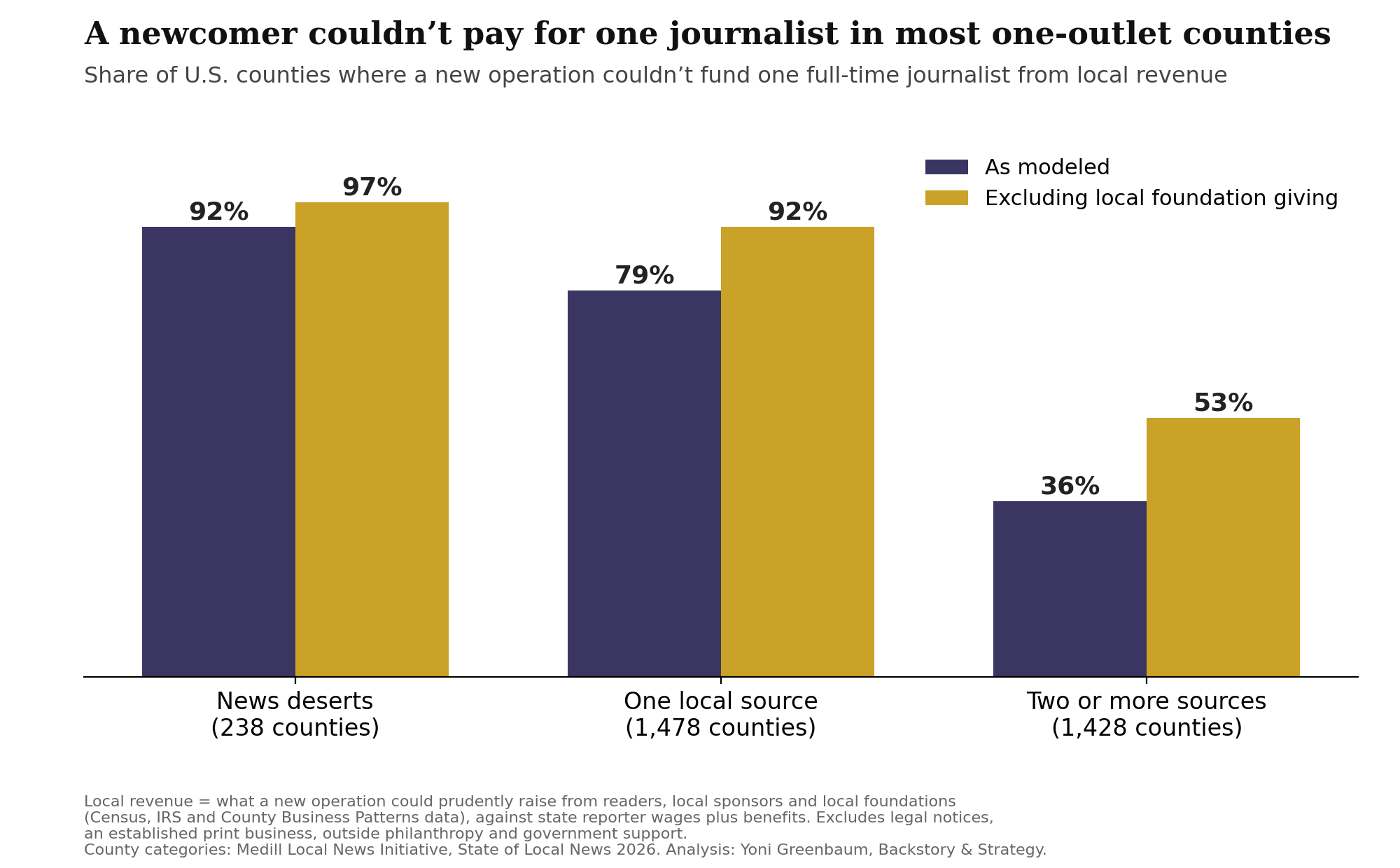
The middle column is the one that matters. Somewhere between 1,166 and 1,362 of the 1,478 counties with one local news source, nearly always a newspaper, couldn’t pay for a single full-time journalist out of local revenue if they were starting from scratch. I give a range rather than one number because of a quirk in the foundation data, which I explain below.
The pattern across the columns matters too. The more outlets a county has, the bigger its local market tends to be. And when I checked the model against the Local Journalist Index, an independent count of working local journalists, it held up. Even after accounting for population, places the model rates as more able to support journalism tend to have more journalists. The relationship is moderate, not perfect, but it’s there. (Source: The Local Journalist Index, a collaboration between Muck Rack and Rebuild Local News (2026).)
Mostly, this is a story about scale. Setting foundations aside, the counties where a newcomer could fund at least one reporter have a median of about 69,000 households. The typical one-source county has about 6,800. Nine in ten of the counties that can’t fund a reporter have fewer than about 19,000 households.
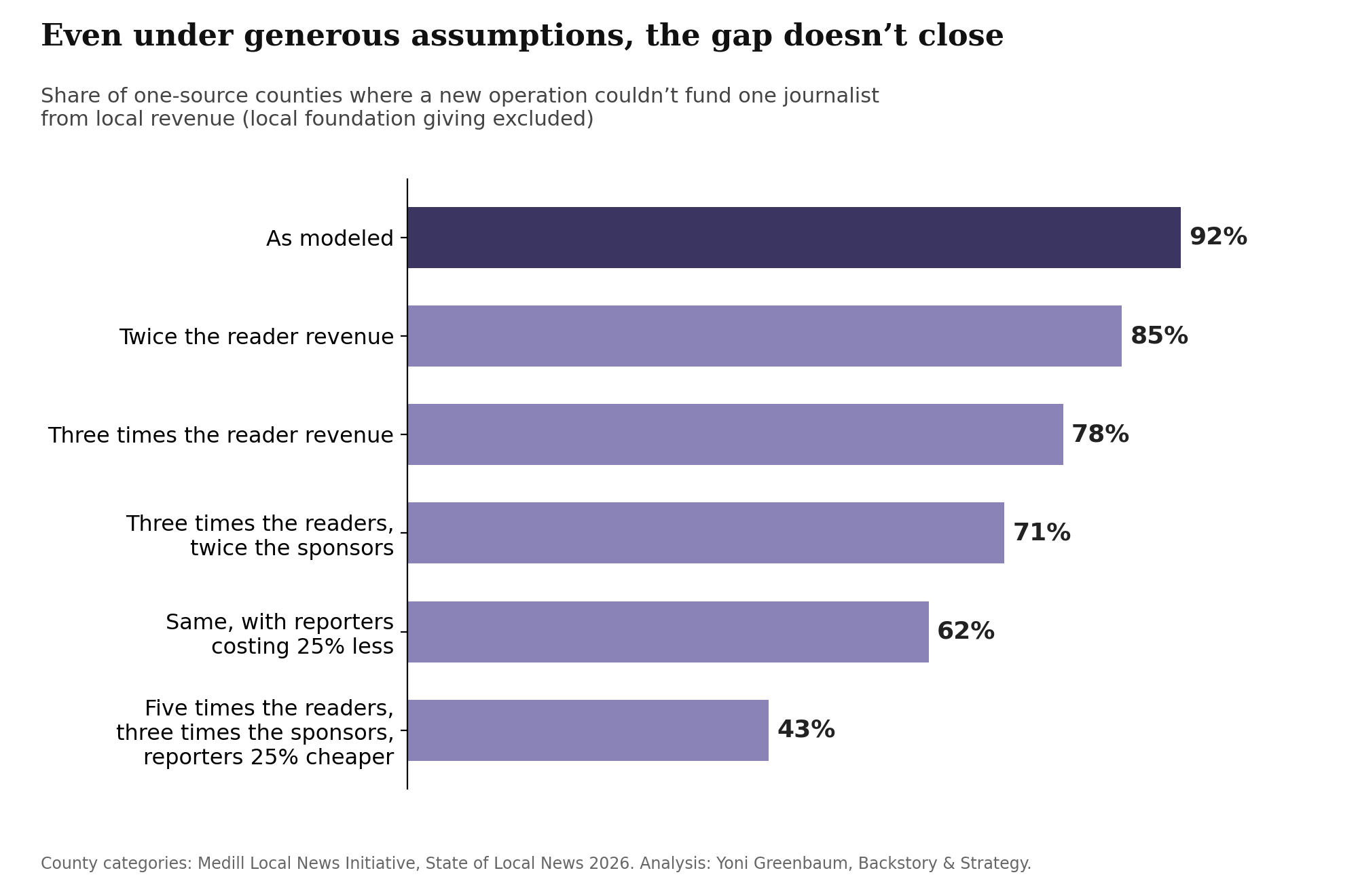
I also tested whether the answer is just a product of my assumptions. Even with five times the reader revenue, three times the sponsorship, and reporters costing a quarter less, more than four in ten one-source counties still can’t pay for one journalist from local revenue. The full set of tests is in the note at the end.
Two caveats are worth knowing. IRS data assigns a foundation’s grants to the county where it’s registered, not where the money goes. That’s how Lake of the Woods County, Minnesota, with about 1,800 households, looks on paper like it could support a 50-person newsroom, and it’s why I report everything with and without local foundation giving. And Medill, by design, counts where an outlet is based, not who covers a place, so a few suburban counties, like Fort Bend outside Houston and Boone outside Cincinnati, show up as deserts or one-source counties while probably getting some coverage from newsrooms next door. Neither changes the shape of the finding. They change the edges.
The anchors
Which raises the obvious question. If most of these counties can’t pay for one journalist, how does the outlet already there survive?
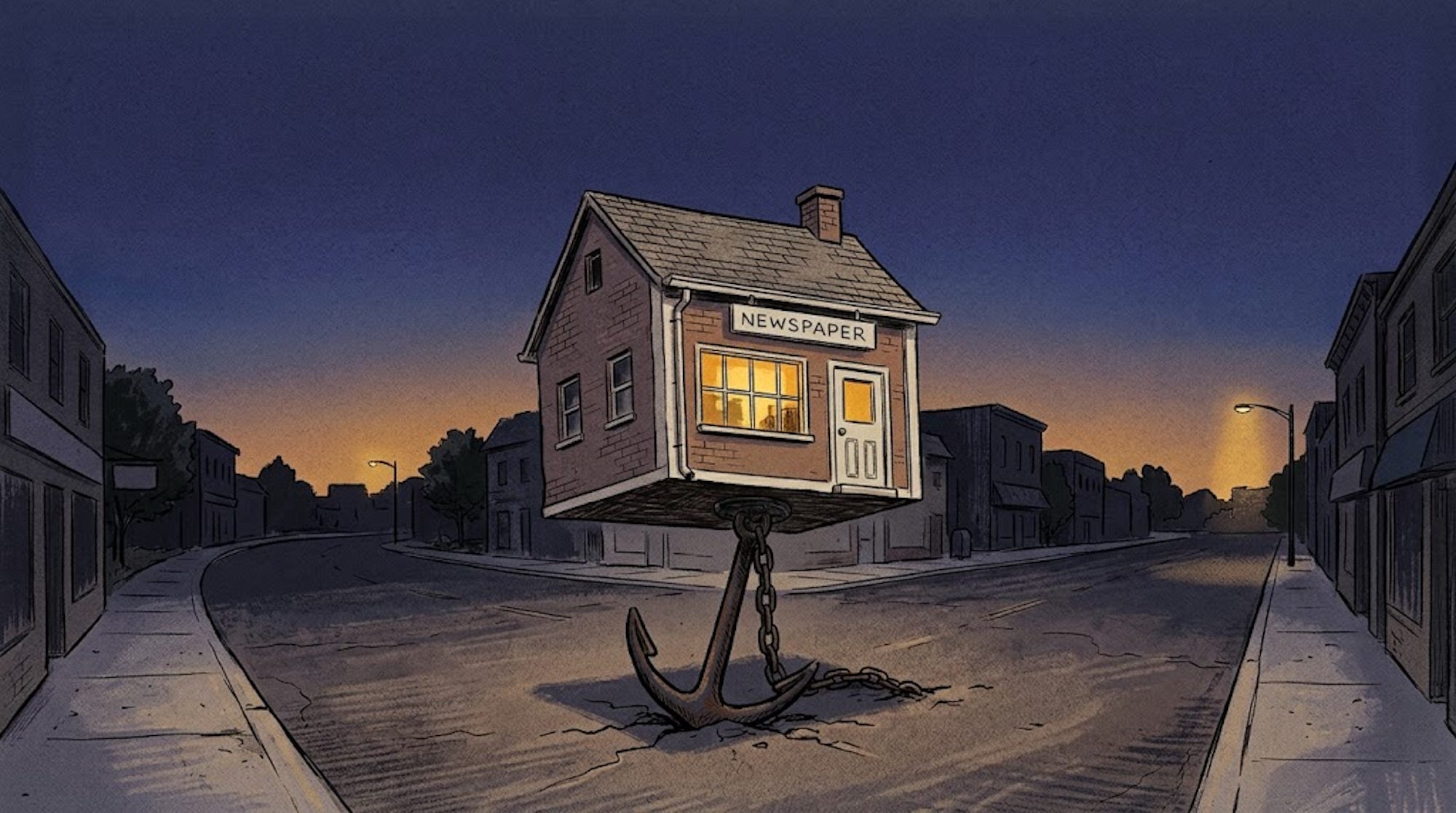
Mostly by doing less journalism than the masthead suggests, and by standing on what I’ve come to think of as anchors: support that holds a paper in place when the market alone won’t. In most of these counties, there are three of them: a print business built long ago, a statute, and a person.
Start with the journalism. The 2026 Local Journalist Index, from Muck Rack and Rebuild Local News, puts the national average at 7.8 local journalists per 100,000 residents, down 81 percent since 2002, and finds 70 percent of counties below even that. When I matched the index against Medill’s map, three in four one-source counties had the equivalent of less than one full-time local journalist based there. The index counts work that shows up online, so it may undercount print-only weeklies. (Source: The Local Journalist Index, a collaboration between Muck Rack and Rebuild Local News (2026).) What that looks like county by county is the next piece.
Sometimes the masthead outlasts the journalism entirely. Medill’s reporting from southern Illinois this year found a weekly still publishing with zero bylined stories on its front page.
The first two anchors usually come together. A paper that’s been around for decades has revenue a newcomer can’t replicate: advertisers who have bought space for thirty years, subscribers who renew out of habit, commercial printing jobs. That’s still local money, just money a startup can’t get. And it has legal notices, the ads state law requires local governments to buy. The National Newspaper Association once estimated that notices made up 5 to 10 percent of community newspaper revenue, and more recent estimates put the figure as high as 20 to 25 percent for small papers.
Some of the fight over notices is about a revenue line that matters more than it used to, not because notices grew but because everything around them shrank. That’s a dependence problem. But in a county of 3,000 households, “diversify” isn’t much of a plan. There isn’t much to diversify into.
I’ve seen the economics of a one-person paper up close. In March, I wrote about Paul Kosel, known in Groton, South Dakota, as “Paper Paul.” He bought the Groton Independent in 1986, fresh out of South Dakota State, and nearly forty years later, he’s still the whole operation. He covers the city council, compiles the legal notices, livestreams the football games, and prints the weekly in-house. He also works for the city as its technology specialist and runs the town’s mosquito control program.
This past winter, Paul and his wife launched a GoFundMe. The goal started at $900. The appeal said it plainly: “We are not asking for help to pay ourselves. We both work full-time jobs outside the newspaper.”
Groton isn’t a town that stopped caring. Between the email edition and the print weekly, the paper reaches about 400 readers in a town of 1,355, a share of its market most metro papers can only dream about. It’s a town that can’t carry the cost of print, postage, and technology on its own, no matter how loyal its readers are.
Groton, by the way, doesn’t even count as a one-source place. Brown County also has Aberdeen’s papers, so Medill’s map shows two or more sources there. The pressure I’m describing doesn’t stop at the 1,478.
The third anchor is the one nobody puts on a balance sheet: the owner. Paper Paul’s appeal said it in one sentence. The newspaper doesn’t pay the people who run it; their outside jobs do. A lot of small papers rest on someone like that, and what they pay themselves is rarely what it would cost to hire a replacement.
So the funder was right about the conclusion and wrong about the reason. A struggling metro daily told you very little about whether a community weekly could work. But most local markets won’t hand anyone starting out enough to pay for news. The papers that last are held in place by anchors, and none of them lasts forever.
The anchors are giving way
Two of them, the statute and the person, are already under pressure.
The statute first. In 2022, Florida became the first state to let local governments move public notices off newspaper pages and onto county websites. Researchers at Yale, Texas A&M, and INSEAD studied what happened next. In counties that had the website option, newspaper notices fell 37 percent relative to counties without one, and the county notice sites showed no discernible increase in traffic. Fewer notices ran where people actually look for them, and the declines were steepest for the hearing and zoning notices that draw the most public participation.
Across the river, New Jersey went further. Under a law Gov. Phil Murphy signed in June 2025, public entities have had to publish their legal notices on their own websites since March 1 of this year, rather than buying space in newspapers. The law does keep a role for news outlets: governments must point readers to their notices through ads in eligible online news publications, and private parties must publish their notices there. That shifts part of the business to digital outlets that meet the law’s criteria, but it’s a long way from what newspapers used to count on.
Here in Pennsylvania, lawmakers are debating whether to let notices move from newspapers to government-run websites.
I’ve spent enough time around Harrisburg budget fights to know how these debates get sold: as modernization and transparency. What rarely gets said out loud is that for the state’s smallest community weeklies, the same bill can pull the financial floor out from under them.
Every one of those debates gets framed as efficiency or transparency. Almost none of them gets framed as what it also is: a decision about whether the last paper in a county keeps its most reliable source of revenue.
Then the person. Medill’s closure examples this year keep coming back to one person. Four California papers owned by Highway 29 shut down after their CEO left. The Onawa Sentinel in western Iowa merged into its competitor after its owner died. The Grant County News in Nebraska survived its owner’s death only because a new buyer stepped in. When the person who was quietly subsidizing the paper stops, the paper usually stops too.
There’s a twist I didn’t appreciate in 2006. Under New Jersey law at the time, a new paper had to publish continuously for as long as two years before it could qualify to carry legal notices. My weekly would have spent its first year or two without the one revenue stream that keeps small papers alive today. The statute that protects the last paper is the same one that keeps a new paper from getting started. And now, in New Jersey, it no longer guarantees much to the last paper either.
Build anchors on purpose
If anchors are what hold the last paper in place in most of these counties, then the job is to see them clearly and to build new ones before the old ones give way. Three things would help.
Count the anchors. Every state press association and funder should map, county by county, which papers depend on legal notices and which depend on a single owner, before the next law or the next retirement does the mapping for them. Press associations are best placed to know which papers carry notices and which owners are nearing retirement. Funders can pay for the work and pool the results nationally. When the anchor is a person, the handoff is the most dangerous moment in a small paper’s life, and the field has very little built for it. Iowa’s press association showed this year what a bridge can look like. When Mid-America Publishing announced it would close roughly 20 papers within a week, a new program kept the papers’ legal notice status alive so buyers had time to show up. One paper stayed on life support for more than six months until it found a new owner. A county with one paper and less than one journalist isn’t covered. It’s barely held. As I argued in Fund Depth, Not Gaps, the depth worth funding in most of rural America is the last paper itself.
Pay for the gap on purpose. Start with public notice law, which is local news policy whether legislators call it that or not. Notices belong online too, and modernizing them doesn’t have to pull the money out of local journalism. Louisiana is moving local notices to newspaper websites starting in 2027, and New Jersey now routes part of that business through eligible online news publications. The better version of either would open eligibility to any qualified local news outlet, print or digital, new or old, instead of rewarding whoever has published longest. My own paper would have waited up to two years for that.
Beyond notices, some states have started paying for the gap directly. Illinois and New York offer tax credits tied to local journalism jobs, New Mexico passed one this year that also supports printing, and Vermont’s governor ordered state advertising steered to local outlets. Report for America does the same thing one reporter at a time, splitting the cost of each placement with the newsroom and local donors.
The gap is smaller than it sounds. Putting one reporter in each of the 1,362 one-source counties that can’t fund one locally would cost about $87 million a year in salary and benefits. Adding the news deserts brings it to roughly $100 million. That’s before any revenue those reporters’ outlets could raise, and before operating costs. Using a broader definition of news deserts than Medill’s, Rebuild Local News estimates that they already cost local governments about $1.1 billion a year in higher borrowing costs, roughly ten times that bill, though the two figures don’t cover the same counties. The public pays for the gap either way. The only choice is whether it pays for the journalism or for the consequences of not having it.
Size for the market, not the stomach. Too many launches start from the size of the dream, or the size of the bank account someone hopes to raise. Start from what the market can actually carry. In most of the counties in this piece, that’s one person, a shared regional desk or an extension of the paper next door, not a newsroom. Build that, prove it, and let the ambition grow from there.
The answer, twenty years late
Not long after I walked away from my own paper, I went to work across the river. From 2008 to 2012, I worked at what was then Philly.com, the Inquirer, and the Daily News.
It was a surreal full-circle moment: the same turmoil that had made my community paper so hard to fund in 2006 was now the daily reality I was navigating from the inside.
Today, the Inquirer is doing better than anyone in 2006 would have guessed. Medill named it one of this year’s Bright Spots after it recorded its first year-over-year revenue growth and, in Medill’s words, essentially turned profitable for the first time in more than two decades. It’s also been owned since 2016 by the nonprofit Lenfest Institute for Journalism. Even the region’s turnaround story has an anchor the market didn’t provide.
So was the funder right about my paper? I’d like to believe that, at least in the short run, it would have worked. But if I’m being honest, I don’t think it would still be around today. Jewish publications across the country have had a hard time surviving. The Jewish paper that has lasted in my corner of South Jersey, the Jewish Community Voice, has been around since 1941 and today is published by the Jewish Federation. Even there, the paper that survived is the one with an institution behind it.
I still don’t think that funder’s reasoning was right. But I’ve stopped thinking the question was unfair. If they can’t make money, how will you? For most of the counties on Medill’s map, the honest answer is: not from the market alone. Neither will anyone else. The real answer to “how will you?” is an anchor. Sometimes it’s an institution or a backer who isn’t the market. At the scale this problem demands, it has to be public policy. Every surviving paper has one, whether it’s a print business built long ago, a statute or a person. The work in front of us is to notice those anchors before they give way, and to build new ones on purpose.
I’m still a data person. But I’ve learned what that funder seemed to understand in 2006: numbers alone don’t open wallets. This time I’m not using them to ask anyone for a check. I’m using them to show why, in most of the country, that check was never going to come from the market.
If you run a weekly in a one-paper county and you think my model is wrong about you, tell me. Next time: the counties where journalism is still hanging on beyond what the market would pay for, which is to say, where the next deserts are most likely to come from. In the meantime, the county-level results from this piece are available as a free download. Get the data on GitHub.
How this was calculated
County categories come from the Medill Local News Initiative’s State of Local News 2026, rebuilt from the county data behind its interactive map. The rebuild reproduces Medill’s published counts of 238 news deserts and 1,478 single-source counties.
For each of the 3,144 counties, a modeling tool of my own estimates three local revenue ceilings: reader revenue, based on household data from the Census American Community Survey; local business sponsorship, based on qualifying small businesses (Census County Business Patterns); and local foundation giving (IRS 990-PF data). It compares those ceilings with the cost of a reporter at the state median wage plus benefits (Bureau of Labor Statistics).
The model estimates what a lean, digital-only new operation could prudently raise locally. On the cost side, it counts a reporter’s salary, benefits and payroll taxes, not software, insurance or other operating costs. It deliberately leaves out legal notices, revenue from an established print business, outside philanthropy and government support. Because IRS data assigns foundation grants to the county where a foundation is based rather than where its money goes, results are reported with and without local foundation giving. I also reran the analysis with much more generous assumptions for reader revenue, sponsorship and reporter cost; those results appear in the chart below. Treat all of it as an estimate of local self-sufficiency, not a verdict on any individual newspaper.
The model has other known limits. It probably underrates tiny, tight-knit towns: in Hooker County, Nebraska, the Hooker County Tribune has 726 paying subscribers in a county of 679 people. It prices reporters at the state median, though rural reporters often earn less; the tests below account for that. And it uses counties because that’s how Medill counts, even though a weekly’s market rarely follows a county line.
Do you know a paper standing on one of these anchors? A publisher who hasn’t taken a real paycheck in years, a weekly living on legal notices, a town where everything rests on one person? Tell me in the comments or hit reply. And if you run a weekly in a one-paper county and think my model is wrong about you, I want to hear that too.
Sources
Rebuild Local News, New Local Journalist Index Reveals 2026 Data. Source: The Local Journalist Index, a collaboration between Muck Rack and Rebuild Local News (2026).
Rebuild Local News, Local News Shortage Leads to $1.1 Billion in Extra Borrowing Costs
Munevar, Nakhmurina and Samuels, Newspaper Notice as a Government Transparency Mechanism: Evidence From Florida (SSRN, 2026) and Yale Insights summary
Public Notice Resource Center and Models for the future of public notice?
Muck Rack, Local Journalist Index 2025 (Hooker County example)