

A Quick Disclaimer: Backstory & Strategy is a personal, independent publication. The views, analysis, and commentary expressed here are strictly my own and do not represent the official position, strategy, or endorsement of the American Press Institute, its leadership, or its board. This is my personal space for analyzing the media landscape, testing new frameworks, and thinking out loud.
Journalism has a just-because-we-can, should-we problem.
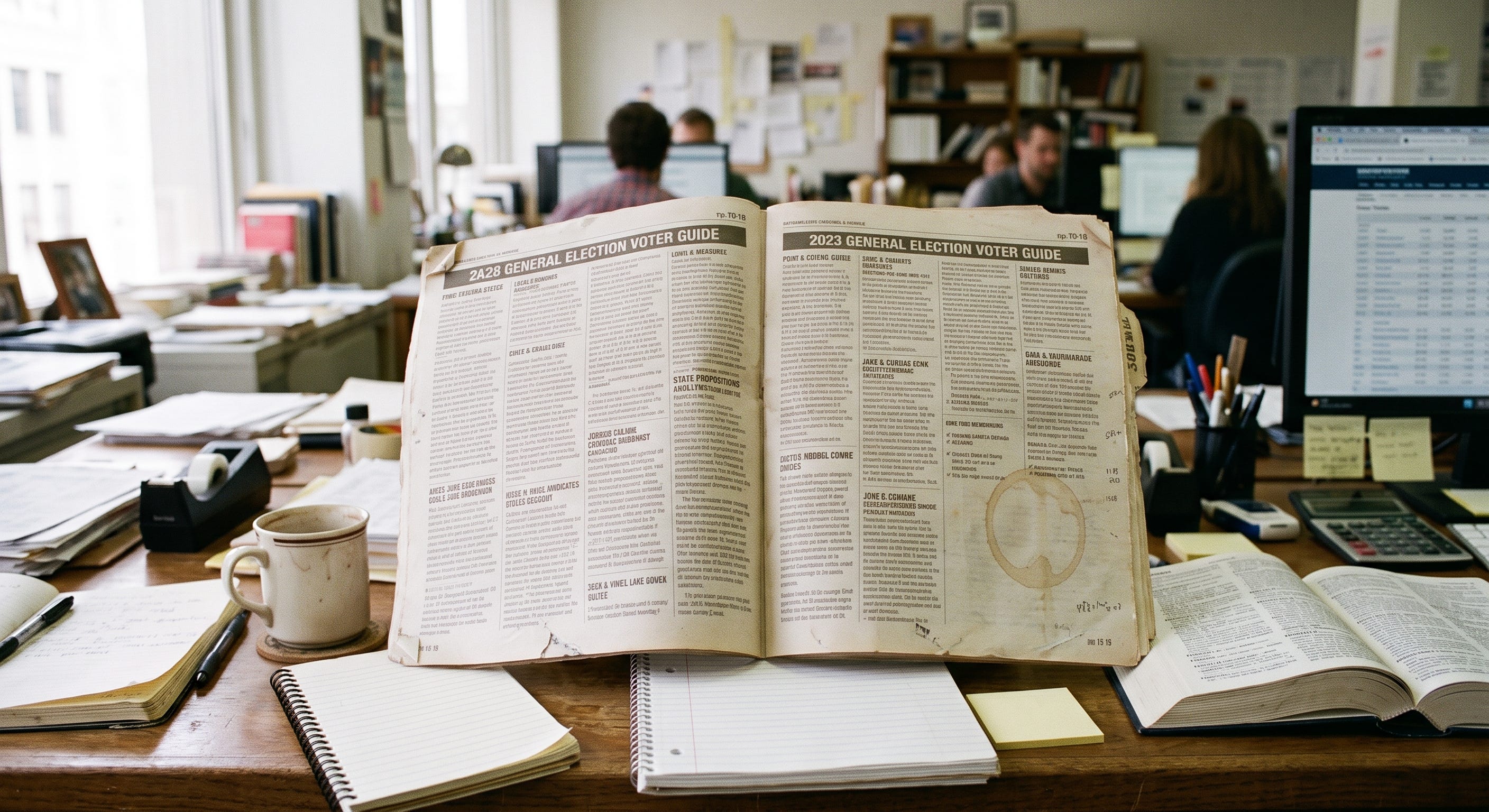
As we approach election season, the conversation in many newsrooms inevitably turns to voters guides. For some, it’s tradition — “we’ve been doing it for decades, our readers love it.” For others, it’s obligation — “our readers need one, and no one else does it.” To both, I say: really?
Tradition isn’t evidence. It’s inertia wearing a nicer outfit. And “our readers need it” is a claim, not a finding — one that almost never survives contact with an actual reader, because almost nobody asks them. Not with a survey. Not with usage data on the last cycle’s guide. Not even with the low-effort version: a few phone calls to find out if anyone used the thing, or would have missed it if it never existed.
I know this instinct from the inside, because I’ve said the version of it out loud myself, just about a different calendar date. Every August, in newsrooms across the country, an editor stands up in the morning meeting and asks some version of “anyone got anything new for back-to-school?” Nine times out of ten, somebody pulls up last year’s list, swaps the dates, and calls it done. I wrote a whole piece about that pattern a few weeks back — not because back-to-school coverage is uniquely broken, but because it’s the easiest place to catch the industry reasoning from habit instead of evidence, since you get twelve months of lead time and no excuse. Voters’ guides run on the same fuel. Different date on the calendar, same “we’ve always done it this way” hiding where “what does the reader actually need” should be.
If pieces like this are useful to you, subscribe. Backstory & Strategy covers journalism economics and media strategy — no fluff, no filler, just the stuff I’d want someone to tell me if I were still running a newsroom.
Is anyone actually checking?
I went looking for something sturdier than institutional memory — real research on whether voter guides move anything that matters, turnout or vote choice. What I found instead was a lot of adjacent evidence that doesn’t quite answer the question.
The League of Women Voters’ own numbers show that voters who received an LWV Voters’ Guide were more confident they had sufficient information and were more likely to vote in more of the contests on the ballot, compared to voters generally — a real effect, but a self-reported one, from the organization with the most reason to report it favorably.
Academic research on ballot measures tells you that wording and placement move votes more reliably than content does — lengthy ballots or measures buried near the bottom simply don’t get voted on. And one study of what voters actually know and act on found that knowing who endorses a measure has a measurable, decision-improving impact on voters’ choices for every measure studied, while simply knowing a policy fact only had a discernible impact on two of the measures examined. The endorsement cue does more work than the explainer — uncomfortable, for a format built almost entirely on the explainer.
Usability researchers have studied whether voters even click through a guide, and which links they follow. Nobody, as far as I could find, has isolated a newsroom-produced voter guide specifically and asked, cleanly, whether it changed anything downstream — a vote, a turnout number, anything measurable.
So: absence of evidence, not evidence of absence. Fair. But that cuts the other way too. If the best-resourced civic-information organizations in the country can’t produce a clean answer, the odds that your newsroom stumbled into one by accident are not good — and “we’ve never checked” is not the same claim as “we know it works.”
It was never about the guide
Here’s the thing, though. This isn’t really a piece about voters guides. They’re just the most sympathetic example — the one built on a genuinely admirable instinct, which is exactly what makes it a useful specimen. Pull on it long enough, and it unravels into a bigger and more uncomfortable pattern: how often our editorial and product decisions run on capacity, best-practice mimicry, or plain intuition, dressed up after the fact as reader service.
Once you’re looking for it, the pattern sorts into three flavors, and they’re not the same failure.
Capacity is the “we have the people, so we do the thing” logic. It feels efficient because it’s using resources that would otherwise sit idle — but it inverts the actual question. The question was never “what can this team produce,” it was “what does the audience need,” and capacity answers a different one entirely. A newsroom with a strong data desk doesn’t need voter guides any more than a newsroom with a strong photo desk needs a print magazine. Having the ability is not the same as having the mandate.
Best-practice mimicry is the “everyone does this” logic — copying the shape of what other, sometimes larger or better-resourced, newsrooms do, on the assumption that if it’s common, it must be validated. It rarely is. Common just means common. A tactic can spread through an industry via conference talks and awards entries rather than through evidence, and journalism, with its small, tightly networked professional culture, is especially prone to this kind of contagion.
Take the listicle. Popular memory credits BuzzFeed with the format — the article structured as a numbered list, each item fleshed out with a paragraph or two — and BuzzFeed certainly turned it into a defining feature of the social web and a business model built on shares. But writing for The Independent, Alex Johnson traced something recognizably the same format back to 1886: a speech by Sir John Lubbock offering a list of roughly 100 books “which on the whole are perhaps best worth reading.” Johnson’s case for Lubbock as the format’s actual godfather is a reminder that what feels like an industry’s clever new innovation is often just an old instinct in new packaging, copied forward by people who never asked why it worked the first time, let alone whether it still does.
Intuition is the hardest of the three to argue with, because it’s usually right often enough to have earned trust — an experienced editor’s gut is not nothing. But intuition curdles into a decision-making shortcut when it stops being tested against anything. The senior person’s hunch becomes the plan not because it’s been checked, but because no one in the room has the standing, or the appetite, to ask for the check.
All three modes share the same tell: they let an organization feel like it made a reader-centered decision without ever doing the one thing that would prove it — asking, measuring, or testing against actual reader behavior. Capacity, tradition, and intuition are all internally generated. They describe the newsroom. They don’t describe the audience.
Which brings the voter guide example back around, now doing double duty. It’s not just a case where nobody checked — it’s a case study in what “checking” would even look like, and how thin the available answers are even from the best-resourced players in exactly this space. The League of Women Voters, an organization built for a century around exactly this task, can point to more confident, more complete ballots — not to changed votes, not to new turnout. If that’s the ceiling for the institution most singularly focused on voter information, the odds that a mid-size newsroom’s guide is clearing a bar nobody defined are not good.
What checking actually looks like
The good news is that this is fixable, and I’ve seen it done. When we were building a new TV news program at Lehigh Valley Public Media, the best decision we made wasn’t a story choice or a hire — it was to skip the gut check entirely and go do real research first. We hired a firm and talked to nearly 3,000 potential viewers and users. They told us what they wanted from a news show, which beats would actually resonate, and which topics would address their real concerns. Not everyone can afford that price tag — we could, and that mattered — but the point isn’t the budget line. It’s that by launch, the program reflected what an audience had actually told us it wanted, instead of reflecting our capacity or our collective hunch about what “good local news” should look like.
So what does checking actually look like, in practice, for something as low-stakes-feeling as a voters guide or as high-stakes as a strategic pivot? Not a full research department. Just a habit of asking, before committing the FTE-weeks: What’s the evidence this serves a need, beyond that we’ve always done it, or everyone does it, or it feels right? If the honest answer is “we don’t have any,” that’s not a reason to panic and cancel the project — it’s a reason to say so plainly, and to treat the next cycle as a chance to actually find out.
Speaking of checking instead of assuming: I built NewsGrade to do exactly that for your own site — a real, specific readout on how AI crawlers, licensing signals, and content structure treat your work, instead of a guess about how AI systems see you. It’s pay-what-you-wish, including $0, so there’s no reason not to see where you stand.
Call it a gut check for any recurring project, guide or otherwise: capacity, consensus, or cause — which one is actually driving this? If you can’t point to the third, at least stop dressing up the first two as if they were.
If your newsroom has actually checked — surveyed readers, tested a project against real usage data, killed something because the evidence wasn’t there — I want to hear about it. That’s the harder story to find, and the one I’d rather write next.
Leave a comment and tell me what you found.