
Let Our People Be Heard
The chant I learned as a boy echoes in my work today: using every platform to shine light on wrongs and ensure the right voices are heard.

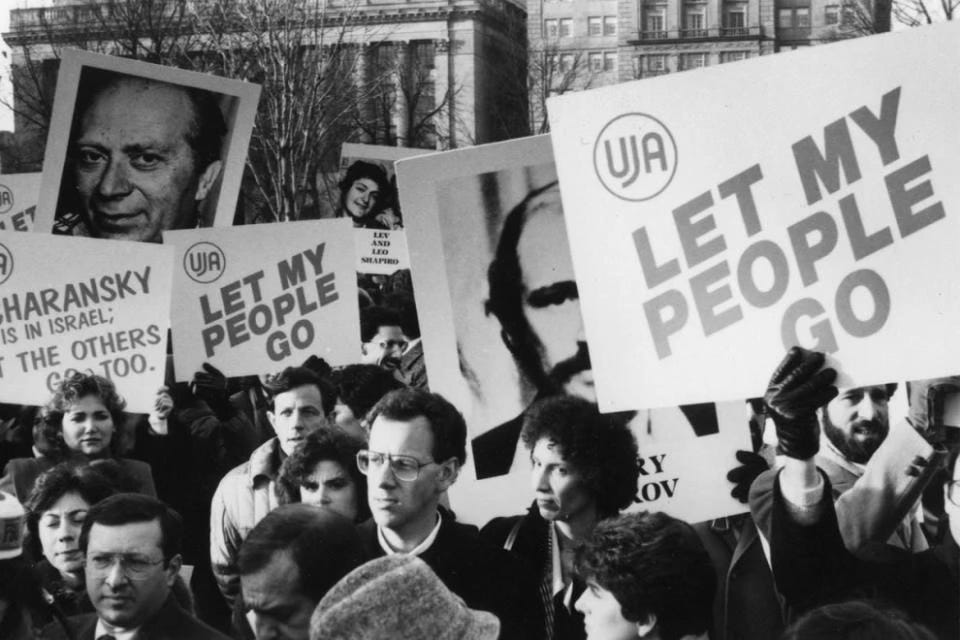
Editor’s note: Sometimes the biggest lessons come before we even know we’re learning them. For me, it started on a Bronx sidewalk in the 1980s, chanting for freedom—and realizing what can happen when people raise their voices together.
I was a kid on a street corner in the Bronx, chanting at a high security fence. On one side, the Soviet Union Diplomatic Compound. On the other, a gaggle of schoolchildren, parents, neighbors. We sang in rhyme, demanding freedom for people we had never met but loved fiercely anyway.
Those early protests taught me the power of raising one’s voice. The impact of people standing together—not as politicians or policy experts or activists, but as everyday people, willing to chant and sing and risk looking foolish to demand change. It was a lesson that stayed with me long after the picket signs were packed away.
I grew up in the 1970s and 80s in Riverdale, a Bronx neighborhood with a large Jewish population. My sister and I went to Jewish Day School. My father was a rabbi. The plight of Soviet Jews—Refuseniks—wasn’t an abstract news story. It was a cause that lived on our block.

The 20-story Russian Mission, where Soviet diplomats and their families lived, stood right in the middle of our neighborhood, surrounded by fencing and guards. For Jews in the USSR, even lighting a menorah could be an act of defiance. And leaving? Nearly impossible. Many were persecuted just for trying. International Jewish activism made their struggle a global fight. But for us kids in Riverdale, it was literally there for the taking—visible from the playground.
Our school organized regular protests at the Mission. We carried posters with the names of Natan and Avital Sharansky. We chanted: “1,2,3,4 open up the outer door, 5,6,7,8 let our people emigrate.” We prayed. We sang.
Sometimes it felt safe, almost like a field trip. Other times, as guards glowered at us from behind the fence, it felt scary. Always, it was formative.

And then one day, the lesson came full circle. When Natan Sharansky was finally free and visited a local synagogue that had been vocal in its support for him, I found myself singing and dancing again—but this time in celebration. I still remember holding his hand as hundreds of us danced in a circle of joy and relief.
For a kid who had once stood at that fence, it was a powerful crash course in cause and effect: the chants, the signs, the solidarity had mattered.
By the late 1980s, under Gorbachev, Soviet exit policies eased and the gates slowly opened. A mass exodus followed. The USSR fell apart in 1991. But for me, the lesson was indelible: when people raise their voices together, things shift.
That instinct didn’t stay on that Bronx street corner. It followed me into journalism. I saw that a newsroom could be more than a business, more than a profit center. It could be a megaphone for those who couldn’t be heard. A newspaper, a TV station, a website—each one a soapbox to shine a light on wrongs and to rally support for what was right.
Early in my career, at the Herald News in Passaic, New Jersey, I worked with reporters and photographers to document dangerous conditions in public housing. Later, at NBC10 and Telemundo62, my team homed in on the stories of young people living on the streets of Philadelphia—work that helped unlock millions of federal dollars for homeless youth. We covered addiction, recovery, and the families caught in the middle.

Each time, the mission was the same: give people a platform they didn’t otherwise have.
That chant I learned as a boy—“let our people emigrate”—still plays in my mind. The words shift depending on the moment. Today it sounds more like: let our people be heard.
That has always been the backstory that defines the strategy: using every platform I have to amplify voices, to champion those who need allies, to push for a world a little more just.
The chants of one generation can become the strategies of the next. What moments first taught you the power of raising your voice?
P.S. - If you found this post helpful, would you please consider restacking it and sharing it with your audience?
This spreads the word and keeps me writing the types of content that you have enjoyed.