
Before You Merge: A Blueprint for Public Media Consolidation
The field is making irreversible decisions with no framework to guide them. Here is one.

A Quick Disclaimer: Backstory & Strategy is a personal, independent publication. The views, analysis, and commentary expressed here are strictly my own and do not represent the official position, strategy, or endorsement of the American Press Institute, its leadership, or its board. This is my personal space for analyzing the media landscape, testing new frameworks, and thinking out loud.
The Corporation for Public Broadcasting is gone. The $535 million it distributed annually to more than 1,500 local stations is not coming back in any timeframe that helps a station facing a budget shortfall next quarter. The Public Media Bridge Fund — an initiative of Public Media Company led by Executive Director Erik Langner and backed by an advisory board that includes the CEOs of INN and the Democracy Fund’s equitable journalism program — has distributed $26 million to 74 organizations operating 186 stations, serving 30 million people across 29 states. It is a serious operation doing serious work. PMC CEO Tim Isgitt has been named to the TIME100 Philanthropy list for it.
It is also, by design and by honest description, a bridge. When asked what comes next, Isgitt said plainly that the fund is trying to “help everybody buy some time.”
Time for what, exactly, is the question the bridge was not built to answer.
Public Media Company projects that 115 stations — concentrated in rural and underserved communities, most of them relying on CPB for 25 percent or more of their operating revenue — will likely close by mid-2026 without sustained intervention. The Bridge Fund’s three-phase model — Stabilization, Sustainability, Transformation — is designed to move stations through crisis toward a more resilient future. The Sustainability phase explicitly funds mergers, regional networks, hub-and-spoke arrangements, and shared services. The Transformation phase is about system-level evolution. The intent is right. The architecture is sound. What the field does not yet have is a principled framework for answering the questions that precede every merger decision: Who should merge with whom? What gets preserved and what gets rationalized? How do you govern a merged institution serving genuinely different communities? And — the question receiving almost no attention — when is a merger the wrong answer entirely?
There is a Harvard Shorenstein playbook on public media mergers, published in 2021 by Elizabeth Hansen and Emily Roseman. It is a careful piece of research. It is also designed for a different problem — the merger of a public media station with a digital news startup — and it predates the CPB defunding by four years. The Bridge Fund’s Emergency Restructuring Program offers advisory support for structuring mergers and shared services agreements, and requires that applicants be open to restructuring as a condition of support. That is the right posture. What it does not yet provide is tier-differentiated guidance for which kind of merger to pursue, and what governance protections to build in before the papers are signed.
What the field has is money, urgency, institutional seriousness, and good intentions. What it does not yet have is the framework. This is an attempt to provide one.
The healthcare system dealt with a version of this problem thirty years ago. The lessons it produced are directly applicable to what public media is facing now. One of them is uncomfortable: consolidation designed around efficiency produces different outcomes than consolidation designed around function. The field is currently equipped for the former. It needs a framework for the latter.
What Emergency Medicine Figured Out
If you read my piece on the “160x problem” last year, you know I’ve been obsessed with how systems collapse when we manage them by headcount rather than by geography. In that essay, I looked at how the closure of a single rural trauma unit ripples outward, overloading regional hubs and creating vast medical deserts. The core tension there is identical to the one we are facing in public media today: if you look at a map through a spreadsheet, an isolated, low-volume node looks like an inefficiency to be eliminated. If you look at it through human anatomy, it is the only thing keeping a patient alive during the “golden hour” after a crash.
The trauma center model works because it starts with a different question than the one most consolidation processes ask. Not “which institutions are inefficient?” but “what function does each institution perform, and what happens to the community it serves if that function disappears?”
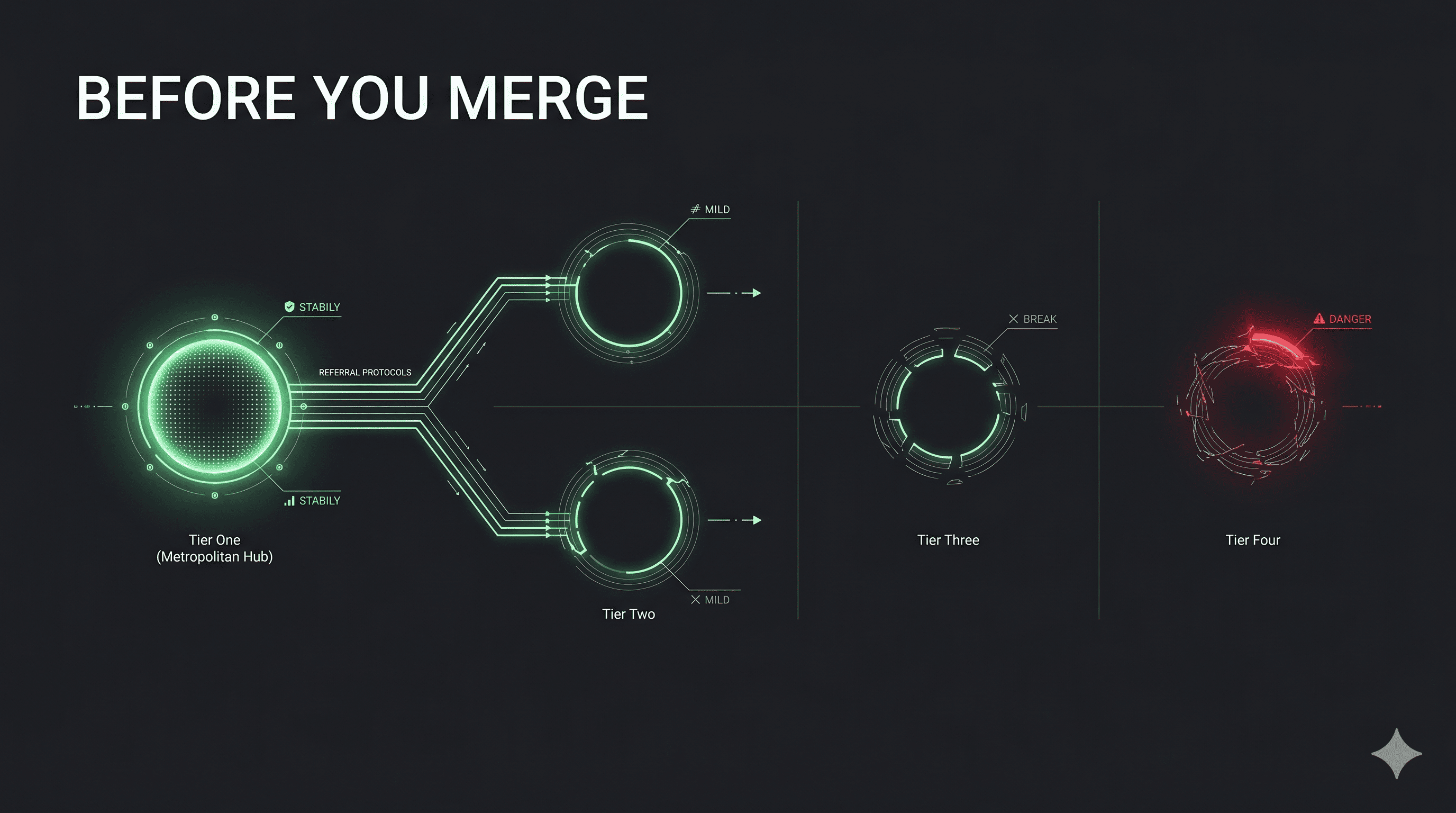
The answer to that question produced a tiered system. Level I trauma centers — the academic medical centers, the Johns Hopkins and Massachusetts Generals — handle the most complex cases, train practitioners, and maintain research capability. Level IV centers — the small rural hospitals — stabilize patients, manage what they can, and refer what exceeds their capability to the appropriate tier. Neither is a diminished version of the other. They are doing different, equally necessary work at different scales.
The critical design feature is not the tier itself. It is the referral protocol — the formal relationship between tiers that makes the system function as a system rather than as a collection of disconnected institutions. The small hospital knows what it can do and what it cannot. It knows where to send the patient when the case exceeds its capability. The large center knows it cannot serve rural Montana from Boston.
Healthcare’s consolidation wave in the 1990s and early 2000s applied a different logic. The pressures were familiar — declining reimbursements, rising costs, fragmented infrastructure that looked inefficient by the metrics being applied to it. The consolidation that followed optimized for institutional sustainability. The communities that lost local hospitals in the name of efficiency did not redirect their care to regional centers. Research documents what followed: reduced care-seeking, delayed treatment, and worse health outcomes — particularly for emergency and maternal care — in communities that lost local institutions. The research documenting what those communities lost came twenty years later. The hospitals were already closed.
Public media is not at the beginning of a stable period where a twenty-year correction cycle is merely inefficient. It is at the beginning of a consolidation moment, driven by financial emergency, that will produce decisions difficult to reverse. The trauma center model does not counsel against consolidation. It counsels for consolidation designed around function preservation rather than cost reduction. Those are related goals. They are not identical. And right now, the field has the tools for one and not the other.
What the Data Actually Shows
Semipublic, a public media financial transparency project run by former NPR product manager Alex Curley, has compiled every publicly available CPB financial filing from public media stations across fiscal years 2019 through 2024. That dataset — Annual Financial Reports, Financial Summary Reports, and Audited Financial Statements covering the vast majority of CPB grantees — reveals something the aggregate numbers obscure.
The average federal funding reliance across 467 surveyed stations was 16 percent of total revenue in FY23. Public television stations averaged 18 percent. Public radio stations averaged 14 percent. Those numbers have anchored most of the public conversation about how stations will absorb the CPB loss.
The distribution is the story. Not the average.
Among NPR member stations, the median reliance was just 8 percent — meaning more than half relied on federal funding for less than a tenth of their revenue. The average was 13 percent. That gap between median and mean is the tell: a large cohort of NPR stations has meaningfully reduced its federal dependence, while a smaller cohort has become significantly more reliant. The stations at the high end of that distribution are not randomly distributed across the country. They are concentrated in rural markets, in states with limited philanthropic infrastructure, and in communities that lack the donor base large-market stations draw on.
Two populations are particularly exposed. African-American Public Radio Consortium stations relied on federal funding for an average of 26 percent of revenue — twice the overall average. Native Public Media stations averaged 53 percent. These are not outliers in the statistical sense. They are a specific, identifiable population of stations serving communities for whom public media is not a civic amenity. It is infrastructure.
That distribution maps onto four merger tiers. Each tier has a different financial profile, a different community function, and a different set of merger options. Treating them as variations of the same problem produces the wrong answers for most of them.
Subscribe to Backstory & Strategy to get every operational breakdown delivered directly to your inbox.
The Four Tiers
Tier One: Low Federal Reliance (0–10% of revenue)
These are the large-market stations — GBH in Boston, WNYC in New York, KQED in San Francisco. They have diversified revenue, substantial membership bases, and enough institutional scale to absorb the CPB loss, however painfully. GBH lost 8 percent of its annual budget when federal funding was rescinded. It launched a $225 million fundraising campaign in response. That option is not available to a station running on $2 million a year in a rural market.
Tier One stations are the Level I trauma centers of this system. Their merger role is not to be absorbed — it is to absorb, selectively and with intention. The GBH and New England Public Media merger, announced in May 2026, is a Tier One institution taking on a smaller regional partner while explicitly committing to preserve NEPM’s brand, programming, and Springfield studios. That commitment is not incidental. It is the entire point. A merger that doesn’t make that commitment in writing, with structural enforcement, is not the GBH/NEPM model. It is a different transaction with different risks.
Tier One stations considering acquisitions should be required — by their boards, by their funders, and by the framework — to answer one question before any other: what community function does this institution perform that our merged organization must continue to perform, and how will the merged governance structure ensure it?
Tier Two: Moderate Federal Reliance (10–20% of revenue)
Mid-size stations with meaningful federal funding gaps but enough membership infrastructure to have options. Arizona Public Media lost roughly 15 percent of its revenue when CPB funding was rescinded and responded by eliminating positions and leaving others unfilled. That is a painful adjustment. It is not an existential one.
Tier Two stations have two viable merger paths. Horizontal mergers — combining with another Tier Two station in an adjacent market — can produce real administrative efficiencies without the governance complexity of a vertical merger. Shared HR, shared legal, shared engineering, consolidated membership appeals. The Vermont Public and Ocean State Media models both emerged from this horizontal logic. Two stations of comparable size and mission, finding efficiency through combination while preserving distinct community service.
The second path is upward affiliation — a formal operating relationship with a Tier One station that provides back-office services and coordination infrastructure without a full merger. This is the referral protocol made concrete. The Tier Two station retains its editorial independence and community governance. It gains access to legal, financial, and technical resources it could not afford independently. The Tier One station gains distribution reach and community presence in a market it could not serve cost-effectively on its own.
It is worth noting that even well-structured horizontal mergers are not insulated from the revenue loss. Ocean State Media— the merger of Rhode Island PBS and The Public’s Radio, completed in May 2024 — is a model of thoughtful integration. It still faced a $1.1 million budget hole and nineteen employee buyouts after federal defunding. Sound merger structure reduces the damage of the revenue loss. It does not eliminate it. The goal of the framework is to ensure that when the damage comes, the community function is the last thing cut rather than the first.
What Tier Two stations should resist is downward pressure — the instinct, under financial stress, to absorb a Tier Three or Tier Four station before solving their own sustainability problem. A Tier Two station that cannot yet sustain itself is not positioned to preserve the community function of an institution it takes on.
Tier Three: High Federal Reliance (20–40% of revenue)
This is where the merger conversation gets hard and where the existing frameworks offer the least guidance. West Tennessee PBS. Basin PBS in Texas. WQPT in Illinois. Stations that relied on federal funding for 40 percent or more of their total revenue, in markets where membership culture is limited and philanthropic infrastructure is thin.
These stations need mergers. The question is what kind.
A Tier Three station absorbed by a Tier One institution is not the GBH/NEPM model. GBH had the scale and the organizational intentionality to make explicit community function commitments and enforce them. Most Tier One stations absorbing a Tier Three partner will not have that combination. The absorbed institution’s community function will not be destroyed on purpose. It will be attenuated slowly, through governance decisions made by people who are not wrong to make them — decisions about resource allocation, coverage priorities, and organizational investment that will, over time, reflect the priorities of the institution doing the absorbing rather than the community being served.
The right merger for a Tier Three station is a horizontal one — with another Tier Three station in an adjacent or complementary market — combined with an explicit regional network arrangement that connects both to a Tier One or Tier Two coordination layer. The merged institution serves its combined geographic footprint. The coordination layer provides the back-office, legal, technical, and professional development infrastructure neither station could afford independently. Neither the merger nor the coordination arrangement requires giving up local editorial governance.
In markets where no compatible horizontal partner exists — particularly in states where a single station may be the only public media licensee across a vast geography — the Tier Three station faces the same structural challenge as Tier Four, and should be treated accordingly rather than forced into an unsuitable vertical merger with a large institution that lacks the intentionality to preserve its community function.
The governance document for any Tier Three merger must include — at minimum — the four structural protections detailed in the governance section below: a defined community coverage commitment, a protected budget line, a sunset review with teeth, and an explicit restriction on the disposition of broadcast infrastructure. None of these are optional for a cross-tier merger. They are the difference between a merger and an acquisition dressed in the language of preservation.
Tier Four: Critical Federal Reliance (40%+)
Stop. Before you merge, ask the question.
The five most CPB-dependent stations in the Semipublic dataset — KCUW in Oregon, KSHI in New Mexico, KUHB, KDSP, and KNSA in Alaska — all had reliance above 80 percent. The Native Public Media network averaged 53 percent. The African-American Public Radio Consortium averaged 26 percent. These stations exist in communities where commercial media has no presence, where the donor base is thin by design, and where the institution performs a function — emergency alerts, local language broadcasting, community-specific journalism, the civic connective tissue of isolated populations — that no merged institution will replicate.
For Tier Four stations, merger is often the wrong answer. It is not wrong because mergers are bad. It is wrong because the community function these stations perform is inseparable from their community embeddedness, and that embeddedness does not transfer. A Native-language public radio station absorbed into a regional network does not become a Native-language public radio station with better back-office support. It becomes a line item in a budget managed by people making decisions for a much larger institution. When that line item gets cut — and under financial pressure it will — the community loses the emergency alert that interrupts regular programming in the specific county where the listener lives. It loses the election coverage nobody else will do. It loses the school board meeting at 7 p.m. on a Tuesday that no commercial outlet attends. The station closing is a media story. What follows is a governance story.
The right answer for Tier Four stations is not merger. It is a dedicated coalition funding mechanism — a sustained, structured commitment from Tier One institutions, major foundations, and the philanthropic networks that have benefited from the public media ecosystem — to fund the specific community functions these stations perform that the market will not replace.
The Adopt a Station project, built by Semipublic’s Alex Curley from the CPB financial data, demonstrated that individual donors will direct money to specific at-risk stations when given the mechanism to do so. That model needs to be scaled institutionally. A formal commitment from the ten largest public media stations — GBH, WNYC, KQED, WETA, and their peers — to fund a dedicated Tier Four support pool would be more honest about what the ecosystem needs than a merger framework that doesn’t apply to the stations most at risk of disappearing.
The Bridge Fund is currently buying time for Tier Four stations. What happens when the Bridge Fund runs out matters more than any merger framework. The field should be designing the permanent mechanism now, while the temporary one is still functioning.
The Governance Problem Nobody Is Solving
The Harvard Shorenstein playbook on public media mergers — designed for mergers between public broadcasters and digital newsrooms, not station-to-station mergers — nonetheless produced a finding that applies here with equal force: public media mergers founder on governance more often than they founder on finances. The cultures, the editorial policies, the board compositions, the accountability relationships — these are harder to merge than the balance sheets.
That finding applies with additional force to the tier-spanning mergers the current crisis is producing. A Tier One station absorbing a Tier Three partner is not combining two similar institutions. It is creating a two-tier system within a single organization. The small station’s community will be numerically underrepresented in any governance structure built around audience size, donor base, or organizational headcount. Goodwill is not a governance mechanism. It is a starting condition that erodes under budget pressure.
Four structural protections every cross-tier merger document should include:
First, a dedicated community advisory board for the absorbed institution’s market — not advisory in the sense of being consulted, but advisory in the sense of having a defined role in coverage decisions, with a reporting relationship to the full board and a mechanism for escalating concerns about service reduction.
Second, a protected revenue allocation — a defined percentage of combined revenue, or a minimum dollar commitment, dedicated to the absorbed institution’s market. Not subject to reallocation in a budget crunch without full board approval and public disclosure.
Third, a sunset review — a formal assessment at three and five years of whether the merged institution is actually serving the absorbed community at the level the merger documents committed to. With teeth. Which means a defined consequence if it is not.
Fourth, an explicit restriction on the disposition of broadcast infrastructure. A station’s license, towers, and spectrum are public resources, not institutional assets to be repurposed or monetized when the financial pressure intensifies. The Bridge Fund has explicitly identified protecting spectrum and towers as a core mission priority. The merger document is where that protection gets legally enforced. Any merger in which the absorbed institution’s broadcast infrastructure can be sold or repurposed without community board approval and public process is not a merger. It is an acquisition dressed in the language of preservation.
None of these provisions are impossible to draft. The spectrum restriction in particular requires careful FCC-compliant language and cannot be boilerplate — it needs to specify what triggers community board review, what constitutes a qualifying public process, and what happens in the event of a subsequent acquisition of the merged institution. All of them require a board willing to enforce them against the institution’s own financial interest under pressure. That is the governance problem. The framework can require the documents. It cannot require the will.
From what I am observing in boardrooms right now, most station trustees are approaching these decisions with a corporate M&A mindset rather than a public trustee mindset. They look at a balance sheet with three months of runway left, panic, and look for an exit strategy that protects the legal entity. The underlying instinct is to treat the station like a distressed commercial asset — assuming that any entity that survives, under any corporate banner, is a win. What is entirely missing from these initial executive sessions is a rigorous assessment of community impact. Boards are voting to merge before they have even defined what local editorial output they are legally bound to protect. The framework can require the paperwork. The field has to supply the rest.
What the Field Should Do Right Now
The Bridge Fund is doing what it said it would do. The Sustainability Program’s requirement that merger proposals demonstrate efficiency gains without sacrificing local programming is the right standard. The Emergency Restructuring Program’s advisory support for stations facing sudden financial shocks is filling a gap that would otherwise go unfilled. The three-phase model from Stabilization through Transformation reflects a genuine theory of change, not just emergency triage.
What the framework below adds is specificity the Bridge Fund’s current programs do not yet provide: a tier-differentiated approach that tells stations which kind of merger to pursue, what governance protections to build before signing, and when to pursue something other than a merger entirely.
Six practical steps the field can take before the next round of merger decisions:
One: Adopt the tier classification as a shared language. The Semipublic data makes it possible to classify every at-risk station by federal reliance ratio in a single afternoon. That classification should be the starting point for every merger conversation, not an afterthought. Funders reviewing merger proposals should require it. Stations considering a partner should know their own tier and their prospective partner’s tier before any conversation goes further. The Bridge Fund is already receiving merger proposals. A tier-classification requirement in the application process would cost nothing and produce significantly better decisions.
Two: Build a proactive matching function, not just an application process. The Bridge Fund currently operates reactively — stations in crisis apply for support, and the Fund helps them identify options. Nobody is sitting with the Semipublic tier data, mapping the ecosystem, and initiating conversations between compatible stations before the financial emergency forces incompatible ones together. Public Media Company’s twenty-five years of transaction experience — more than $250 million in facilitated deals — almost certainly includes informal versions of this matching work. The crisis requires making it systematic, funded, and proactive at a scale informal relationships cannot reach. A Tier Three station in rural Montana should not have to find its own Tier Two affiliation partner under a 90-day runway. Someone with the full map should be making that introduction months earlier. The Bridge Fund’s Sustainability Program should publish tier-differentiated guidance — explicitly different frameworks for horizontal Tier Two mergers, Tier Two upward affiliations, Tier Three horizontal combinations, and Tier Four alternatives to merger — and pair that guidance with active outreach to at-risk stations that have not yet applied. Waiting for distressed institutions to self-identify their own solutions is how you get mergers built on proximity and existing relationships rather than functional compatibility. The Emergency Restructuring Program is already doing case-by-case advisory work on merger structures. That expertise should be codified, published, and deployed proactively.
Three: Protect the infrastructure, not just the license. The Bridge Fund explicitly lists safeguarding “towers, spectrum, and other critical assets to ensure they remain aligned with public media’s service mission” as a core priority. This deserves a louder voice in the merger conversation. A station that merges and transfers its broadcast license to a larger institution retains nothing — no governance protection, no community advisory board, no protected budget line — if the merged institution later decides to sell or repurpose the spectrum. Every merger document should include explicit, enforceable restrictions on the disposition of broadcast infrastructure. A license and its associated spectrum are public resources. The merger framework should treat them that way.
Four: Tier One stations should formalize their coordination role. The WNYC Station-to-Station Programming Project — which makes WNYC’s programming catalog freely available to qualifying at-risk stations, with automatic eligibility for any station that received 10 percent or more of its budget from CPB — is a quiet example of what this can look like. A large Tier One station extending its institutional capacity to smaller stations without requiring a merger. Public Media Infrastructure, the coalition formed by APMG, NFCB, NYPR, PRX, and the Station Resource Group with CPB backing before its dissolution, is already building part of this coordination layer at the distribution and technology level. The content, legal, technical, and membership coordination layer remains largely unbuilt. Every Tier One station should be asking what Tier Two and Tier Three stations in its region need from that layer — shared legal, technical, engineering, membership, and fundraising infrastructure — and committing to provide it as a defined service relationship rather than waiting for a financial crisis to force a merger.
Five: The field needs a permanent funding mechanism for Tier Four stations now. The Bridge Fund is temporary by design. A permanent coalition commitment — from Tier One stations, from major foundations, from the philanthropic networks that have been the beneficiaries of public media’s reach — is not charity. It is infrastructure maintenance. The Tier Four stations are the distribution layer that extends public media’s reach into the communities it exists to serve. Letting them close to fund mergers among stations that could survive independently is not rationalization. It is the healthcare consolidation mistake, made deliberately.
Six: Attach the open infrastructure string to every major merger grant. This is the step that separates a stabilization program from a genuine ecosystem intervention.
The journalism philanthropy field has been debating whether someone should play a directive role in forcing consolidation — a Special Master, in the language Elizabeth Hansen Shapiro used when she called for funders to “thin the herd.” Richard Tofel’s March 2026 interview with Hansen Shapiro at Nieman Lab was the match that lit this particular debate in journalism philanthropy circles. The argument that followed was largely about whether foundations have the legal and cultural authority to demand that kind of forced restart. Public media does not have time for that debate. The Bridge Fund exists. The authority is there, in the grant conditions, if the field chooses to use it.
The string should be this: any station that receives Bridge Fund sustainability funding for a merger or regional network arrangement must open its successful operational infrastructure to other stations in the tier system. If a Tier One station receives funds to absorb a Tier Three partner, the membership model, the legal templates, the engineering documentation, the content workflows — the institutional knowledge that makes the Tier One station a Tier One station — become available to other stations in the regional tier system. Not proprietary assets to be licensed. Open infrastructure to be shared.
The WNYC Station-to-Station Programming Project is the prototype. It makes WNYC’s programming catalog freely available to qualifying stations without licensing fees. That is what open infrastructure looks like at the content layer. The same logic applies to membership infrastructure, engineering documentation, and legal templates. The winner gets the resources. The ecosystem gets the ladder.
The Chrysler restructuring worked because the strings were painful. The trade-off for survival was an operational overhaul and a transfer of value back to the system. That is the model. Without this string, stabilization grants are airline bailouts — they keep institutions flying without changing the cost structure of the system that produced the crisis.
The Question Before Every Board
Every public media station board considering a merger in the next eighteen months will face a version of the same question. It will usually be framed as: does this merger make us financially sustainable?
That is the wrong question. Or rather, it is the second question. The first question is: does this merger preserve the community function our institution was built to perform? And if not, what would need to be different for it to do so?
A station that survives a merger but no longer performs its essential community function has not been saved. It has been laundered — the license persists, the brand persists, the FCC filing persists, while the reason the institution existed quietly disappears.
New Jersey PBS found no viable merger structure before its funding collapsed — both federal and state support evaporated simultaneously, and its management partner declined to renew. That outcome is worse than a well-structured merger. It is also what happens when the field has no framework in place before the crisis forces the decision.
If public media embraces this tier-based model, we stop treating consolidation as a slow, defensive retreat and start treating it as a conscious redesign. We stop asking how to make a dying funding model stretch further and start building a distributed, resilient infrastructure that outlives the current political emergency. We unlock a system where Tier One scale actively shields Tier Four independence, and where a local station’s survival isn’t dictated by the wealth of its immediate ZIP code. It gives us a blueprint to build an ecosystem that is structurally incapable of abandoning the communities it was built to serve.
The trauma center system works because it was built around an explicit acknowledgment that different institutions serve different functions at different scales, and that the small institution doing the essential local work is not a lesser version of the large one. It is doing a different, equally necessary job.
Public media was built on the same logic. Universal access. Every community. Not just the ones where the math works.
The math has stopped working for 115 stations. The Bridge Fund is serious, its leadership is credible, and its three-phase architecture is the right structure for the moment. What it needs now is the framework this piece attempts to provide — tier-differentiated guidance for which mergers to pursue, proactive matchmaking so the right stations find each other before the crisis forces the wrong ones together, governance protections with teeth, and the open infrastructure string that turns a stabilization program into an ecosystem intervention.
Without that string, the merger grants reproduce the pattern journalism philanthropy has always produced — choosing who stays on the lifeboats without requiring the survivors to build the ladder everyone else can climb. The Bridge Fund was built to be something different from that pattern. The open infrastructure string is how it proves it.
Public media serves 43 million Americans in communities commercial media will not reach — PMC’s own figure for the population served by at-risk stations. The Bridge Fund’s distributed grants account for 30 million of them already. The decisions being made in the next eighteen months will determine whether those communities still have a station in ten years. Not because the money ran out. Because nobody asked the right questions before the papers were signed.
That is what the framework is for.
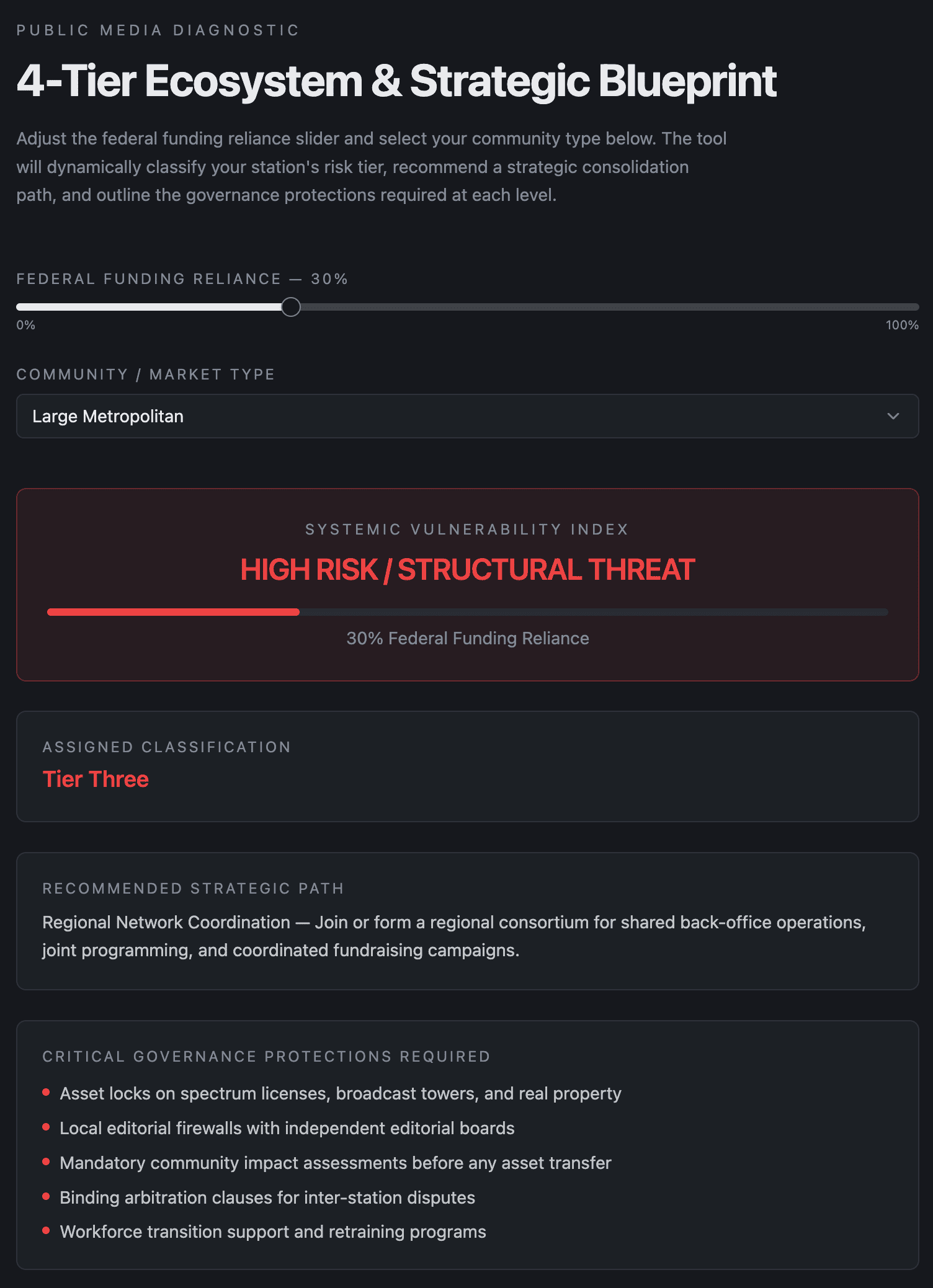
How to Read This Matrix
This blueprint converts raw data into an operational diagnostic tool for public media boards, station managers, and philanthropic funders. By inputting two critical variables—a station’s historic reliance on federal funding and its specific market profile—you can instantly determine its baseline risk and strategic constraints.
Federal Funding Reliance: This is the percentage of your station’s total annual operating budget that vanished when federal funding was rescinded. For a large metropolitan station, this may be less than 5%. For rural, tribal, or historically underserved stations, it frequently exceeds 40%.
The Systemic Vulnerability Index: This acts as a triage gauge. As reliance increases and philanthropic infrastructure thins, the index moves from stable/absorptive capacity (green) to existential threat/merger failure zone (deep red).
The Outcome: The matrix dynamically generates your prescriptive tier, your viable strategic path, and the mandatory governance shields required to protect your local community footprint before any papers are signed.
4-Tier Ecosystem & Strategic Blueprint
This interactive visual model maps how your proposed 4-tier system evaluates risk under pressure. You can simulate varying levels of federal reliance and market characteristics to test the blueprint against actual station conditions
By the Numbers
115 — Stations projected by Public Media Company to close by mid-2026 without sustained intervention, most in rural and underserved communities
43M — Americans served by the 115 at-risk stations, per PMC’s own calculations — in communities commercial media will not fill
$26M / $73M — Distributed to 74 organizations by the Public Media Bridge Fund from $73 million raised — across 186 stations in 29 states serving 30 million people
16% — Average federal funding reliance across 467 surveyed stations in FY23 (Semipublic / CPB financial data)
53% — Average federal funding reliance among Native Public Media stations — more than three times the overall average
26% — Average federal funding reliance among African-American Public Radio Consortium stations — twice the overall average
8% — Median federal funding reliance among NPR member stations, versus a 13% average — the gap that reveals the distribution story the averages obscure
705 vs. 44 — Staff count at GBH versus New England Public Media at the time of their May 2026 merger — the scale differential every cross-tier merger must account for
$225M — GBH’s fundraising campaign goal following federal defunding — a Tier One option unavailable to the stations most at risk
3 — Phases of the Bridge Fund’s model: Stabilization, Sustainability, Transformation — the architecture is right; the tier-differentiated framework is what comes next
If this piece made you think — or if you think I got something wrong — I’d genuinely like to hear it. The comment section is open.
Backstory & Strategy is supported by Editorial Style — premium apparel built by journalists for journalists. Explore the Stylebook →