
Stop Calling It “Legacy Media”
One term is doing five different jobs at our meetings, and none of them are helping.

The journalism industry has a language problem. Not the kind your copy desk catches, either. It’s the kind that hides inside words everyone uses, and nobody bothered to define.
Sustainability. Local. Democracy.
We toss them around at conferences and in grant applications like everyone in the room is in on the same secret. We aren’t. But the word doing the most unexamined work right now, the one we reach for almost reflexively, is legacy media.
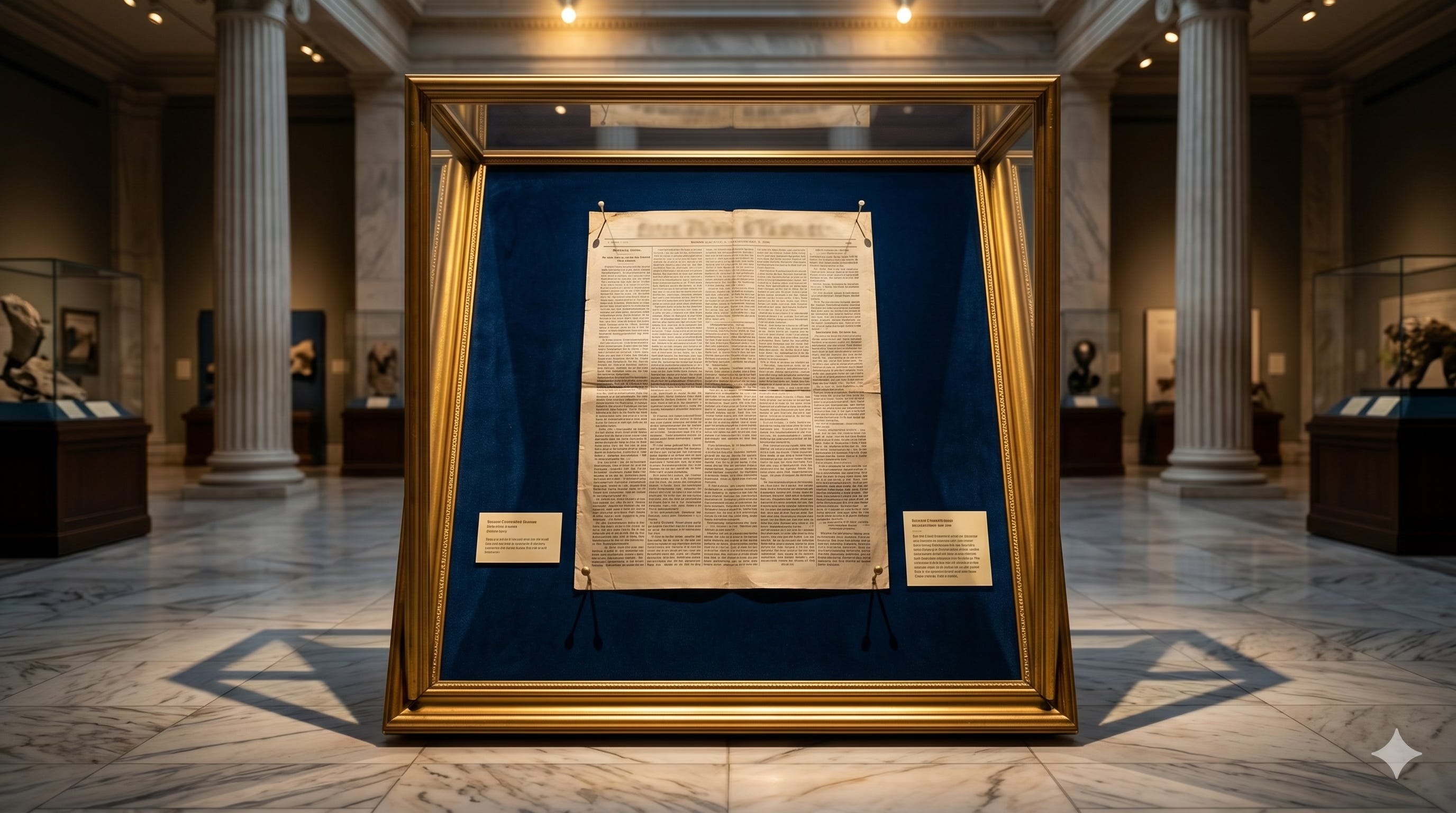
I’ll be honest about what got me started on this. Someone referred to a U2 song as a classic the other day, and it made me flinch. Not because they were wrong. Where The Streets Have No Name came out in 1987. By any normal math, it’s a classic. But I was there. I didn’t live through that song as history. I experienced it as a Tuesday. Hearing someone file it away felt less like a compliment and more like a bureaucratic decision. The thing I lived inside of was suddenly being placed behind glass.
That’s exactly what the journalism industry keeps doing to itself.
This is the same trap we fall into when we talk about metrics or funding targets. We rely on the illusion of a shared definition while the entire machine runs on guesswork. I dug into why we keep doing this—and how the industry is optimizing for a baseline it hasn't actually defined—in Why the Journalism Ecosystem is Flying Blind.
Pull up a stool. Backstory & Strategy is a completely independent look at media economics, leadership, and the connective tissue between them. If you value clear-eyed analysis that cuts through the industry jargon, subscribe to get every post directly in your inbox.
“Legacy media” used to be a pretty specific tool. It pointed at print newspapers and broadcast networks—the places built before the internet. The underlying point was simple: these organizations were designed for a world that doesn’t exist anymore. Fine. That was at least useful to talk about, even if it was a little lazy.
But the word didn’t stay put.
Look at where we are now. Digital-native outlets that launched between 2005 and 2015 are either completely dead or totally unrecognizable. BuzzFeed News, Mic, Mashable—at least the way we used to know them—are just gone. Meanwhile, some of those original “legacy” players adapted and survived. The New York Times has more digital subscribers today than most digital-first startups ever had total readers.
Somewhere along the way, the word quietly shifted. It stopped describing a business model vintage and started functioning as a status marker. It stopped meaning “built before the internet” and started meaning “the ones with the buildings and the mastheads.” It became less about when you were born and more about whether you belong to the old power structure.
That’s rhetoric, not description. And sloppy language leads to sloppy strategy.
Think about the conversations you hear every week. A local newspaper publisher in central Pennsylvania hears “legacy media” and pictures the New York Times and CNN. A tech investor means anything that isn’t algorithmically distributed. A journalism professor uses it to describe advertising-dependent business models, no matter when they launched. A politician uses it to mean “media I want to discredit without naming specific names.” And a 25-year-old podcaster just means everything that existed before they started paying attention.
One term, five completely different jobs. And none of them think they’re using it loosely.
If this breakdown hits close to home, or if you’re currently sitting in a meeting where these words are being thrown around, pass this piece along to a colleague.
It’s the same disease that infects so much of our internal vocabulary. We use terms that create the illusion of shared understanding while everyone stays safely inside their own silo. When a funder says “we don’t fund legacy media,” what are they actually cutting off? When a platform says “we’re partnering with legacy publishers,” who is actually sitting in the room? The word does real gatekeeping work while pretending to be neutral taxonomy.
It gets even weirder when you look at how journalists themselves handle it.
There is a version of “legacy” that people wear like a badge. The lineage version. You work at an institution that broke Watergate, or published the Pentagon Papers, or has a century of Pulitzers on the wall. In that register, legacy means pedigree. It’s the journalistic equivalent of old money. You don’t have to explain yourself because the masthead does it for you. A Washington Post or BBC credential still opens doors that a perfectly good digital outlet’s credential doesn’t. Everyone knows it, even if we don’t say it out loud.
But there is another version that journalists internalize like a quiet shame. We’re slow. We didn’t adapt fast enough. We lost the audience. The building is half empty. We used to have 400 people in this newsroom, and now we have 90.
In that register, legacy doesn’t mean pedigree. It means decline. And the people who feel that most acutely aren’t the ones who left for digital startups. It’s the ones who stayed. They chose loyalty to the institution and watched the place shrink around them.
A journalist can hold both of those feelings at the exact same time. Pride in the heritage, grief about the trajectory. The word legacy touches both nerves at once, which is why it’s so hard to talk about cleanly.
The pride version works fine when you’re talking to sources or the public. The institutional brand still carries weight out there. But inside the bubble—at conferences, on panels, in Slack channels—the vibe changes. You get this defensive crouch. You can feel it when someone from a major metro daily shares a stage with someone from a scrappy nonprofit newsroom. The nonprofit person has all the moral energy in the room. They’re “the future.” The daily person is quietly calculating whether acknowledging their institution’s resources will read as tone-deaf.
Meanwhile, younger reporters at these same outlets are a different species entirely. They wanted the credential and the training, but they aren’t sentimental about the model. They’ll leave for a better opportunity without a shred of the guilt their predecessors would have carried. Legacy to them is a stepping stone, not an identity.
Here is the deepest irony of the whole thing. The journalists who probably should claim the label most confidently are the ones at regional papers and local television stations who have been doing essential accountability work for decades on shrinking budgets. But they don’t think of themselves as legacy. They just think of themselves as still here. The term feels like it belongs to the big nationals, not to them. The word manages to completely miss the people it most accurately describes while sticking to institutions that have largely moved past the limitations it implies.
We keep trying to paste national frameworks onto regional problems, assuming that what works for a massive brand vintage works for a local operation. It doesn't. If we want to look at how local infrastructure actually survives without the safety net of old money, we have to talk about proximity, not centralized franchises. I mapped out that exact structural math in Scaling Up vs. Scaling Across: The $20 Million Mirage.
So what do we do with it? We should probably stop using “legacy” as an analytical category and just start saying what we actually mean.
Is the organization print-dependent? Advertising-reliant? Institutionally governed? Pre-digital in its cost structure? Nationally scaled? Every single one of those is a real descriptor with real strategic implications. Every one of them points toward specific challenges and specific fixes.
“Legacy” points toward nothing. It’s just a vibe with a footnote.
The journalism industry needs sharper language because it needs sharper thinking. Right now, one of our most frequently used terms is doing little more than letting people sort the world into “us” and “them” without ever having to explain the difference. That isn’t analysis. That’s just positioning.
And if anyone needs me, I’ll be over here not calling The Joshua Tree classic rock.
What does “legacy” mean in your corner of the sandbox? How does your newsroom or organization navigate the gap between pedigree and reality? Drop your thoughts, examples, or pushback in the comments below.
Backstory & Strategy values precision. If you spot a factual error, a broken link, or a typo, please let me know directly so I can get it sorted.