

A Quick Disclaimer: Backstory & Strategy is a personal, independent publication. The views, analysis, and commentary expressed here are strictly my own and do not represent the official position, strategy, or endorsement of the American Press Institute, its leadership, or its board. This is my personal space for analyzing the media landscape, testing new frameworks, and thinking out loud.
In my seven years at Lehigh Valley Public Media, first as Chief Content Officer and then as Chief Operating Officer, I was in the room for some of the conversations about getting the Commonwealth’s seven public television stations to share their back offices. None of them got very far.
Those conversations focused on purchasing, HR, and finance, the usual suspects whenever anyone says “shared services.” The savings were real but modest, and they never moved the needle enough to justify the work of untangling seven organizations, so nobody followed through.
If you sit on a board, fund public media, or run a station, this is the math I’ll keep doing in public, using public filings and no spin. Backstory & Strategy is free. Subscribe so the next one lands in your inbox instead of your colleague’s forward.
Looking back, I think we were aiming at the wrong layer. The real money sits deeper in the building, in the machinery: master control rooms, traffic systems, donor databases, and transmission costs that every station carries on its own.
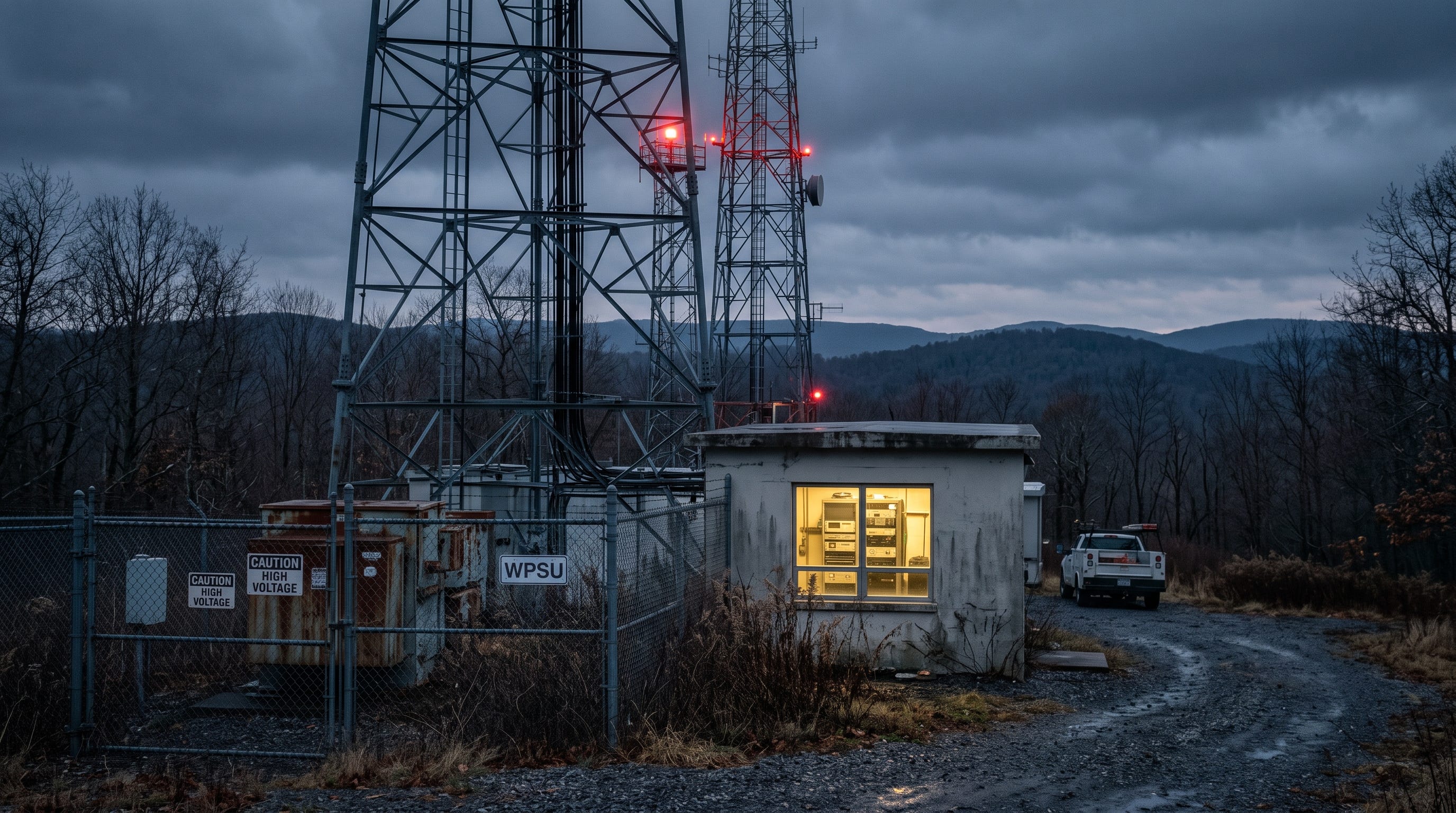
That history is why I read the news of WHYY taking on WPSU a little differently than most of the industry did. It was called a rescue, and for viewers and listeners across central and northern Pennsylvania, it was one. WHYY took over WPSU for a dollar and set out to raise roughly $17 million over five years to keep its television and radio signals on the air. But I couldn’t stop thinking about the simpler math underneath it: neither WHYY nor its donors can do that three more times.
If Pennsylvania’s remaining independent stations wait for an emergency bailout every time the next liquidity wall hits, the map falls apart. So the strategic question for Pennsylvania has less to do with who WHYY takes on next and more to do with why independent stations in one state are still paying for duplicate master control rooms, separate donor databases, redundant audits, and parallel administrative staffs while the reporters underneath them are asking for resources.
Why this matters outside Pennsylvania
If you’re reading this in Ohio, Texas, North Carolina, or California, it would be easy to file all of this under Keystone State bookkeeping. I’d hold off.
Pennsylvania packs nearly the entire national public media taxonomy inside one border. There’s a dense metro anchor in Philadelphia, a legacy Rust Belt metro in Pittsburgh, a university-born station now run by that metro anchor, an eight-figure spectrum-auction endowment in the Lehigh Valley, a Harrisburg licensee that spent the last few years owning a daily newspaper, and smaller dual licensees running television and radio on thin margins. Whatever financial, governance, or transmission headache you’re dealing with between Seattle and Miami, some version of it is concentrated here.
That makes the next two years in Pennsylvania a proving ground. States can drift into chaotic consolidations that leave rural news deserts and hollowed-out local brands behind them, or they can build a repeatable blueprint that protects local journalism while rationalizing the expensive technical machinery underneath it.
If your state has more than two sets of public broadcasting call letters, Pennsylvania is just having its crisis first.
If your state has more than two sets of public broadcasting call letters, send this to someone who’d recognize their station in it.
The myth of belt-tightening
Whenever someone raises a structural overhaul at this scale, veteran trustees and station leaders push back, and it’s an understandable instinct. We’ve weathered federal funding fights and recessions for forty years. Why not freeze hiring, defer maintenance, and ride it out?
Because this downturn doesn’t cycle back. On one side, the revenue engine is wearing out. Cord-cutting has permanently eroded linear PBS viewing, digital audiences convert at a fraction of legacy pledge rates, and corporate underwriting has splintered into programmatic digital ads. On the other side, costs keep climbing. Tower leases carry built-in escalators, enterprise software compounds every year, and the cost of staying legal with the FCC doesn’t drop because your audience moved to YouTube.
Against a gap like that, belt-tightening turns into a slow, quiet rot. First the local public affairs show goes, then the education outreach position. Then the statehouse or environmental reporter job sits vacant while syndicated national feeds fill the airtime. By the time the balance sheet stabilizes, the station has preserved its overhead and its executive titles and given up the civic mission that justified both.
And here’s the part boards guarding their independence should sit with: waiting is the surest way to lose it. A station that runs its reserves to zero doesn’t get to negotiate a partnership of equals. It gets absorbed on the buyer’s terms, or it turns off the transmitter. Building an operating compact now is how a board protects local journalism before the balance sheet makes the decision for it.
What the balance sheets actually say
A quick note on sources. Everything here comes from public documents: IRS Form 990 filings, audited financial statements, and regulatory filings. I don’t have access to any station’s internal dashboards or monthly cash-flow reports. If the fault lines are this visible in historical filings, I’d expect the pressure inside the boardroom to be sharper.
Take WQLN in Erie. On paper, it looks like a steady legacy operation, with no bank debt, nothing drawn on its $500,000 credit line at the close of FY25, and about $3.3 million in a board-designated endowment. Look a little closer, and you can see the whole system’s problem inside one station.
In FY25, WQLN booked about $1.26 million in Corporation for Public Broadcasting grants, roughly 37 percent of its operating support. It also posted a GAAP operating deficit of about $920,000, and that was with the federal money still coming in.
Raising money is expensive, too. WQLN brought in about $1.56 million from members and events like its Great TV Auction and Brewfest, and spent about $1.06 million on fundraising and support to do it. That works out to roughly 68 cents for every dollar raised, which says less about the team than about what it costs to run a bespoke development shop in a mid-sized market. For comparison, WHYY spent about $10 million on fundraising in FY25 against roughly $40 million in contributions, about 25 cents on the dollar, and still paid more than $2 million of that to three outside direct-response firms. Scale brings the cost down. Nobody in Erie can buy scale alone.
Much of the rest of the budget is locked in. A 2011 tower sale-leaseback carries inflation escalators through 2031, and program rights run past $800,000 a year. Cutting either one means shrinking the signal or gutting the programming that drives memberships. And like most Pennsylvania stations, WQLN also runs an NPR-member radio service, WQLN-FM, which is leaner and deeply loved by its listeners but still tied to television’s heavy capital and transmission costs.
To bridge the gap, the board has started taking quarterly draws from the endowment. Take CPB away and add it to the existing deficit, and the annual hole approaches $2.2 million. Even allowing for non-cash items like depreciation in that GAAP figure, the runway is measured in a couple of years rather than decades.
To be fair to WQLN, its board isn’t sitting still. Since the rescission, the station has landed a $751,647 stabilization grant from the Public Media Bridge Fund. It has voted to sell a building it says is too big for its staff of about 20 and put the proceeds back into the endowment, and it has seen its Erie Gives support triple. Those moves buy real time, and they deserve credit. They don’t change the structure underneath. The fixed costs that made the station fragile are still there. The fuse is just longer.
Two kinds of leverage
The usual assumption in public media consolidation is that WHYY holds all the cards, thanks to its population reach and its metro donor base. The balance sheets tell a more complicated story.
Lehigh Valley Public Media in Bethlehem likely holds the largest endowment in Pennsylvania, built on the roughly $82 million it received from the 2017 FCC spectrum incentive auction. WHYY has the biggest audience and footprint, and WLVT has the deepest financial cushion. (A quick reminder: I don’t speak for LVPM and have no inside view of its current finances.)
WHYY’s own FY25 audit makes the point for me. At year's end, it had about $2.3 million in financial assets available for general expenditure within twelve months, against $48 million in annual expenses. Expenses rose 11.5 percent while revenue grew about 6 percent. In September, it upsized its line of credit from $3 million to $5 million. The station carries a $65 million board-designated endowment, and the audit says those funds could be made available if necessary, which is not the same thing as liquid. Philadelphia has the reach. The cushion is thinner than the footprint suggests.
That split rules out a simple Philadelphia takeover. WHYY won’t accept being outvoted by smaller stations, and WLVT has no reason to subordinate its balance sheet to Philadelphia.
It also exposes the sector’s most dangerous habit, which is treating endowments as operating funds. Whether a board oversees $3.3 million in Erie or an eight-figure portfolio in Bethlehem, spending principal to keep duplicate master controls, competing sales teams, and fragmented back offices running is burning the seed corn to heat the house. Endowments exist to produce steady yield for local reporting, and server racks are a poor use of that money.
The diagnostic blind spot
So why hasn’t anyone run the collective math before now?
Partly because of how our industry examines itself. For decades, public media leaders have leaned on two disconnected tools: the single-station audit and the broad industry whitepaper. The audit tells you what one organization did eighteen months ago, in isolation, with nothing about overlapping signals, regional philanthropic capacity, or shared infrastructure. The whitepaper floats at 30,000 feet, calling for collaboration and digital transformation without ever touching a tower lease escalator or a master control shift.
Pennsylvania actually had a down payment on that view once. The Pennsylvania Public Television Network tied the stations together for decades, and the state later kept a modest technology line for them. Harrisburg cut the network loose and eventually zeroed out the station grants. Since then, nobody has looked at the Commonwealth as one economic system, partly because connecting 990 line items, audited liquidity notes, county demographics, and broadcast operating costs in a single framework is hard to do.
Over the past year, I’ve been building and testing a modeling tool of my own, designed to close that gap. Feed it line-item expenses, capital structures, and market data, and you can stress-test an entire media ecosystem instead of guessing.
Point it at Pennsylvania, and one thing becomes obvious: a big share of the money needed to stabilize Pennsylvania’s struggling stations is already inside the system. It’s just tied up in duplicate technical machinery.
By my count from the licensees’ most recent public filings, Pennsylvania public broadcasting spends roughly $100 million a year on broadcast operations, and around $35 million of that goes to non-editorial overhead. Even with WPSU now absorbed into WHYY, six separate master control rooms across the remaining licensees, separate traffic systems, duplicate donor software, competing sales reps, and full administrative suites are still being maintained for every market. That’s the layer those earlier shared-services conversations never reached. Run separately, smaller stations will burn through their capital and face forced sales. Run as a shared network, the math starts to work.
The political impasse
Float an operating alliance like this in private, and the walls go up fast.
In Erie, Scranton, Harrisburg, and Pittsburgh, trustees suspect a trap. After watching WPSU get absorbed, it’s natural to wonder whether “shared services” is a polite waiting room for a WHYY takeover.
In Philadelphia, the skepticism runs the other way. Why would a metro station already carrying a big new central Pennsylvania footprint slow down to take on smaller markets’ legacy costs?
In Bethlehem, the wall may be highest of all. That spectrum money belongs to the Lehigh Valley and its digital future, and nobody is pooling it to balance someone else’s books.
Every one of those reactions makes sense, and together they explain why the system keeps drifting toward the edge. The metro anchor can’t bail out everyone else, the regional stations can’t escape their own audits, and the capital anchor can’t count on market returns to cover operating burn forever.
A workable path asks no one to give up their community identity. It asks them to separate their civic mission from their utility bills.
The blueprint: The Commonwealth Public Media Alliance
The alternative to emergency sales is a formal Joint Operating Agreement and a public-benefit Management Services Organization, or MSO. Call it the Commonwealth Public Media Alliance. I’ve covered the basic architecture of station partnerships in Before You Merge and the cloud infrastructure side in The Transmitter Is Still On, so I’ll focus here on the two pieces that would make this effort different from the ones I sat in on.
The first is a hard savings rule. Those earlier conversations died because the savings were too small and too optional. This time, the savings have to be big enough, and contractual enough, that nobody can shrug and walk away. For every dollar a station pays the MSO, it must retire at least $1.40 in duplicate local overhead. The MSO bills through service-level agreements based on actual use, per playout channel or per active donor record. That rule is what keeps the alliance from paying the consortium tax, where a joint venture hires a shared executive director and a few consultants while every member keeps its old payroll.
In WQLN’s case, the model has the station shedding about $1.9 million in local overhead. Roughly $1.25 million of that is master control and technical maintenance. The rest is back-office finance and donor processing that move into the MSO. In exchange, WQLN pays the MSO about $400,000 a year. Here’s how that plays out against the FY25 books, with and without the new revenue the alliance would have to generate:
WQLN PRO FORMA: YEAR 2 UNDER THE CPMA MODEL
───────────────────────────────────────────────────────────────────────────────
                                    FY25  FY25 budget        CPMA: CPMA: shared
                                  actual  without CPB  shared only + pooled rev
Operating Expenses            $4,299,669   $4,299,669   $2,850,000   $2,850,000
 Content & News                1,819,959    1,819,959    1,850,000    1,850,000
 MSO Shared Service Fee                —            —      400,000      400,000
 Local Tech/G&A/Dev            2,479,710    2,479,710      600,000      600,000

Operating Revenues            $3,380,063   $2,124,472   $1,928,043   $3,050,000
 Federal CPB                   1,255,591            0            0            0
 Membership & Events           1,363,118    1,363,118    1,350,000    1,350,000
 Underwriting                    353,043      353,043      353,043      750,000
 Regional News Fund              125,000      125,000      125,000      850,000
 Facility / Misc                 283,311      283,311      100,000      100,000

Net Operating Result          $(919,606) $(2,175,197)   $(921,957)    +$200,000
───────────────────────────────────────────────────────────────────────────────
Read it left to right. Losing CPB turns a $920,000 deficit into a $2.2 million hole. Shared services alone close more than half of that, putting WQLN roughly back where it stood when the federal money was still coming in. That’s the money already inside the system. The local overhead line covers fundraising and support of about $1.06 million, technical operations, and general administration; the tower lease stays on WQLN’s books in every column, because nothing about shared master control changes a lease signed through 2031.
The last stretch, from a $920,000 gap to a $200,000 surplus and an endowment that stops shrinking, takes new revenue, and I want to be honest that it’s an assumption, not a given. Yes, I said earlier that underwriting is splintering. That’s exactly why it has to be sold differently. A regional health system or utility that won’t buy Erie on its own might buy Erie, Scranton, and Harrisburg in one statewide package, and no single station can offer that today. The regional news fund, described below, does the rest.
The second is a two-chamber board. An Operating and Capital Chamber handles major technology decisions, with votes weighted by operating size and capital contribution, which gives WHYY and WLVT the voice they’ve earned. Alongside it sits a Licensee Senate, where every station gets one equal vote and an absolute veto over editorial charters, local beats, and station identity. Philadelphia can’t steamroll the smaller markets, and the smaller markets can’t deadlock every big investment.
The rest of the structure is guardrails:
No license transfers. Unlike the Penn State transaction, which required moving WPSU’s licenses to WHYY, the MSO model requires no license surrender. Under Section 310(d) of the Communications Act, a station can’t hand off control of its programming, personnel, and finances without triggering an unauthorized transfer of control. Every station keeps its 501(c)(3) status, its FCC license, its call letters, and full control of what airs. The MSO is simply a contractor for playout, IT hosting, and donor processing. It processes transactions; it doesn’t approve budgets. Each licensee’s board keeps spending authority and signs its own audit, which is the line the FCC has held for shared-services arrangements.
No cross-collateralization. No station’s endowment can back another member’s debts or leases, and donor-restricted money stays bound to its donors’ intent. WQLN’s endowment stays with WQLN’s board in Erie, and WLVT’s spectrum reserves stay in Bethlehem. If shared services help bring WQLN’s budget back into balance, the board can stop spending principal, and a standard 4 percent draw would produce about $132,000 a year for reporting in Northwest Pennsylvania.
People first. Local engineers keep jurisdiction over local transmitters and field gear, existing collective bargaining agreements stay intact, and each station’s donor file is walled off from every other station’s fundraisers. Through attrition and retraining, the model moves roughly $4 million a year statewide out of back-office overhead and into beat reporting and digital newsrooms.
Milestone-based transition money. Moving master controls to a shared cloud facility and standardizing donor systems would take an estimated $6 million to $8 million over two years, and none of it should come out of small stations’ operating cash. A public-philanthropic match could cover it. That means about $3 million from Pennsylvania foundations, about $2.5 million from the state, and the remaining $500,000 to $2.5 million from the better-capitalized stations, released in tranches tied to verified milestones like signing a shared playout agreement or shutting down redundant vendor contracts. Two of those asks deserve plain language. The state money would mean Harrisburg putting back a version of the station technology funding it eliminated. And the station share is a real ask of WHYY and LVPM: a one-time, capped investment in infrastructure they would use too, not an open-ended draw on anyone’s reserves. The regional news fund modeled for WQLN isn’t imaginary money either. It pools existing community foundation journalism grants into a predictable formula, and it pays for local beat reporting the station already does under a maintenance-of-effort rule: cut reporters, lose your share.
Who moves first?
Which brings me back to those meetings I sat in, and to the hardest question in this piece: who actually takes the first step?
I’ve seen what happens when nobody does. A mid-market general manager who proposes this looks like they’re admitting defeat. If WHYY proposes it, it looks like a takeover. If Lehigh Valley proposes it, it sounds like an invitation to tap the spectrum endowment. Station staff can’t be expected to convene a process that rewrites their own org charts, so the first move has to come from outside the building, from three directions at once:
The funders. Stations don’t sit down to cut overhead until their major benefactors tell them to. That means a coalition of Pennsylvania’s anchor foundations, including The Heinz Endowments in the west, the William Penn Foundation in the east, and regional partners like the Erie Community Foundation, drawing a clear line. No more emergency checks to subsidize duplicate transmission and accounting software, but real money for the bridge to sustainability. A $500,000 planning grant would give station leaders both the mandate and the cover to come to the table.
A neutral quarterback. No single station can run this, and neither can a general management consultancy that doesn’t know Section 310, CPB grant compliance, or how pledge audiences behave. Funders should hire an experienced independent intermediary like Public Media Company to sign NDAs with every station, open the confidential ledgers, model the true cost of service, and build the governance charter without favoring any market.
A board-to-board alliance. Inside the boardroom, the spark has to come from trustees rather than staff. Picture the board chair of a capital anchor like WHYY or WLVT teaming up with the chair of a regional independent like WQED, WITF, WVIA, or WQLN to send a joint letter to their peers. When board chairs talk to board chairs, the conversation moves from protecting titles to fiduciary duty, and the message gets simple. A trustee’s job is to make sure the community still has a local newsroom twenty years from now, and duplicate transmitters have nothing to do with that.
Two questions for the next board meeting
WHYY’s move to take on WPSU settled one thing: the era of standalone public broadcasting in Pennsylvania is ending.
The next phase can unfold through exhaustion, with another mid-market station getting a going-concern note, draining its reserves, and surrendering at an emergency weekend board meeting. Or station leaders, trustees, and funders can look honestly at the numbers, treat technical distribution as the shared utility it already is, and build a compact on purpose.
If you sit on a Pennsylvania public media board, you don’t need a consultant’s report to start. At your next executive session, ask your leadership two questions:
What is our exact cash runway if federal funding is gone for good, and how many months of deficits will our reserves actually cover?
What share of every dollar we raise from our community goes to administrative, engineering, and transmission overhead we could share with neighboring stations?
The tools to see the math clearly already exist. What we need now is the institutional courage to build something that fits reality.
Station leaders and trustees: which part of this model breaks first in your market? The governance, the savings rule, or the new revenue? Push back below. The best objections will shape a follow-up piece. If you’d rather tell me privately, just reply to this email.
Good analysis. I would encourage you to think more broadly. This is not a WHYY discussion. It's a public television discussion. It's almost strange to write those words -- public television -- because it's no longer the way most people think and it is disconnected from the way most people behave when they choose to watch video on a linear television channel. In theory, local public TV stations exist to provide a local public service, but nearly all of their airtime is devoted to non-local programs because interest in and funding for local programs has become so modest.
So why are we struggling with a local-based system with more than 200 local affiliates? If the answer is to provide substantial public service, then let's focus on building a strategy to support that idea for the next 20 years (or whatever long period). If the answer is to play national shows (or APT, etc.) in each local market, we certainly don't need 200+ transmitters to feed local cable head-ends to do that.
Sure, bring public radio and some form of local streaming and events and school interaction back into the mix. Public radio does make economic sense because its expense structure -- from production to transmission -- is so much less than television's structure. The other stuff is useful, but not the basis for a successful ongoing business. I don't really care whether WHYY and the other major market stations take over the smaller ones because the value proposition can now easily be covered through other forms of media and distribution. And I don't really care that GBH or WNET someday eats a big fish like WHYY. What I care about is a model that is reasonable and defensible for the mid-21st century. If that's a national public television network that provides services that cable networks and streaming services do not -- arts, public affairs, documentaries, etc. -- that's fine. If there's a better way to support local programming and (we agree) local news and public affairs, probably taking a few pages out of NPR's playbook (if not handing the whole thing over to the radio people), that's fine, too.
Any discussion about future strategies for local public television stations in Pennsylvania or anywhere else seems to be a waste of good resources and the energy of people who know a lot and can do a lot about it (like you). Please, please focus on a meaningful future for public media in the U.S. (and hopefully connect us to people outside the U.S., too), and get out of Pennsylvania's weeds.
Thanks for allowing me to be candid. I see great value in public media, and public television, but I no longer see the value in the current model.