
The Best Editorial Decision I Ever Made Started With a Lie
How betting on trust and talent led to front-page gold during the Iraq War

What's the best editorial decision you've ever made? Or worst?
It was 2003. I was City Editor at The Herald News in Passaic, NJ. The U.S. had just launched its invasion of Iraq, and I knew our coverage needed to reflect that moment, especially for Paterson, a city with a large Arab population and a personal stake in the headlines.
I had an idea. I was certain we could find a local Iraqi American returning home to check on family after years of exile. I figured that if we could find the right person, we could report on the journey. And while most media were telling the military angle or not covering at all, we could tell the human story behind the war.
Not sure where exactly to start, I pitched the concept to Jonathan Maslow, one of our editors and a seasoned international reporter and book author. It didn't take much convincing—I think he heard "Baghdad" and was all in. He started making phone calls and reaching out to people in the community, looking for our exiled subject.
While we still hadn't identified anyone to travel with, we knew we had to get started on logistics and pitched the idea to our Executive Editor. My strategy then (and now) was to go into these meetings with a story budget and proposal that reflected what we believed the story would be as opposed to what we had at the moment. Thinking back, I'm not sure we told him that we hadn't identified anyone yet, but I have no doubt that deep down inside, he knew.
He gave us the green light. Why? Because he trusted me and I trusted Jonathan. He knew that working together we would pull off what we planned.
Were we concerned about Jonathan's safety? Sure. Did we consider forgoing this approach and applying to embed with a military unit? No. Why not? Because that type of reporting we could get from the Associated Press or readers would get from other newspapers. If we were going to make the effort and spend the money, it would need to be coverage that differentiated us.
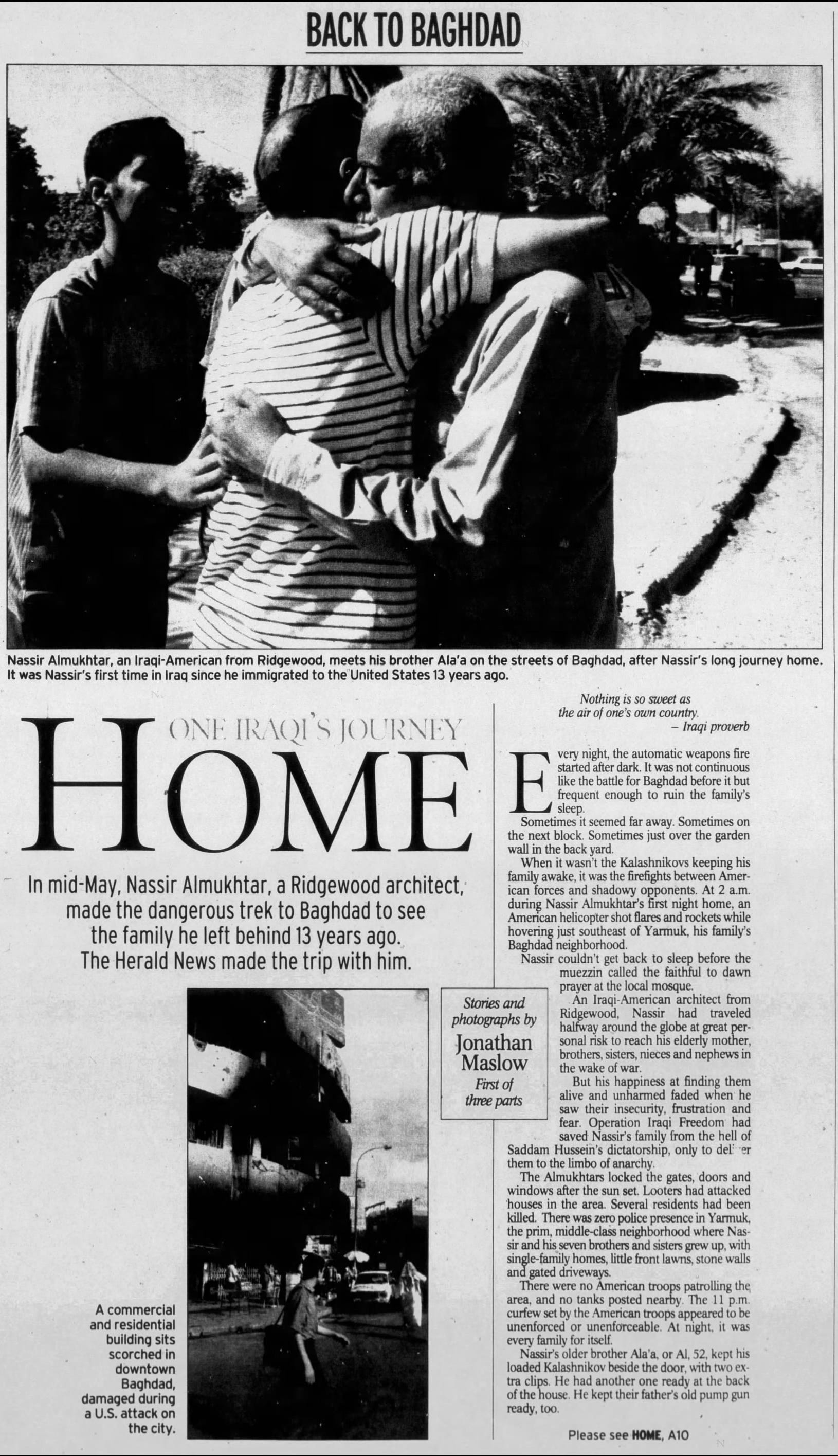
Jonathan came through, as I thought and as our executive editor believed he would. He found Nassir Almukhtar, an architect from Ridgewood, NJ, preparing to return to Baghdad after 13 years of living in the United States—flying to Jordan, then hiring a driver to take him across the desert. Jonathan joined him for the adventure, carrying a satellite phone, a money belt full of cash, an old 35mm camera, and a whole lot of courage.
The reporting was riveting—human, raw, and unmatched by any other paper in the Commonwealth at the time. Our daily phone check-ins were often interrupted by gunfire, a detail he captured in his articles.
His stories, using his words and photos, ran on the front page over four days. For those days, the newspaper was sold out in Paterson. More than just circulation gains, we gained loyal readers and subscribers as the Arab community in Paterson appreciated our efforts to tell their story.
I learned several things from this project that I've applied throughout the rest of my career:
Great journalism often requires making bets on people before you can prove the story exists. Sometimes a story starts with a hunch and takes time to get to the facts. If you discard the hunch, you'll never discover the story.
If you show your team that you trust them, they will trust you. Jonathan trusted my initial thesis. I trusted that he would be able to not just find our subject but pull this all together. Other reporters took notice—our reputation for backing ambitious journalism grew.
And finally, go to the story. Sure we could have done the story by interviewing Nassir before he left and then after he returned. We could have used the photos he took. It would have been an okay story for maybe a day, but it wouldn't have been what Jonathan delivered.
Yes, this project was built on trust. My editor trusted my judgment. I trusted Jonathan's skill. And Jonathan trusted Nassir with the most important thing of all: his life.
What's the biggest editorial risk you've ever taken? I'd love to hear about the decisions that kept you up at night—the ones that either paid off spectacularly or taught you never to try that again. Share your story in the comments below.
And if this resonated with you, consider subscribing for more insights on journalism, leadership, and the calculated risks that define our careers. Hit that heart button if you've ever had to pitch a story you didn't quite have yet.