
The First AI Election and the Infrastructure Nobody Built
Local newsrooms aren't ready. And the clock is running.

Recently, Palantir’s CTO told Bloomberg that the war in Iran will likely be remembered as the first large-scale military conflict driven, enhanced, and made substantially more productive by artificial intelligence. He meant it as a compliment to the technology. But if you cover news for a living, it should land differently.
Because if Iran was the first AI war, then November is the first AI election.
Not metaphorically. Operationally. The same dynamics that defined the Iran information environment — AI-generated content produced at scale, the speed of synthetic media outrunning the speed of verification, and something researchers are calling the “liar’s dividend,” where real footage gets dismissed as fake because the fakes are so convincing — are now pointing directly at a midterm election cycle that is already, today, seeing AI-cloned candidate voices and synthetic campaign ads running without meaningful disclosure.
We have roughly eight months. The infrastructure doesn’t exist. And two of the most instinctive responses to that problem would make things worse.

The first instinct is abstention. If newsrooms can’t reliably verify what they’re seeing, maybe they should pull back from the most contested territory. Cover the races they can handle. Avoid amplifying content they can’t authenticate.
It’s an understandable impulse. It’s also a gift to exactly the forces that benefit from an information vacuum.
Disengagement doesn’t protect communities from disinformation. It accelerates their exposure to it. If credible local newsrooms step back from competitive House races, school board fights, and statehouse campaigns, someone else fills that space. And whoever fills it won’t be operating with journalism values. The abstention instinct, taken seriously, hands bad actors a very cheap and very effective weapon: generate enough noise and confusion, and your adversaries retreat. This is not a precedent the industry can afford to set.
The second instinct is centralization. Let an organization like the Associated Press handle it. Let a designated, trusted, national institution serve as the verification layer for election-related content — a single authoritative voice that local newsrooms can cite and readers can trust.
For those outside the industry, the Associated Press is a nonprofit news cooperative that has served as American journalism’s shared backbone for more than 180 years — the organization that calls elections, sets wire standards, and whose reports appear in thousands of outlets that couldn’t otherwise afford national and international coverage. If anyone has the credibility and reach to serve as a national arbiter of election truth, the thinking goes, it’s them.
This one is more seductive, and it falls apart in more ways.
Capacity, first. The Associated Press is already stretched covering elections across 50 states. Adding real-time AI verification for every local race, every deepfake targeting a state legislative district, every synthetic robocall in a competitive primary is not a bigger version of the same job. It’s a categorically different one. This isn’t one high-profile race for the White House. It’s 435 separate House battlefronts, 35 Senate seats, and 39 gubernatorial races. The threat surface is massive, and it’s composed entirely of local skirmishes that national newsrooms simply aren’t staffed to monitor.
More importantly, centralized truth infrastructure is a single point of failure. If AP becomes the designated arbiter of election reality, you’ve created something adversaries will specifically target — not with better fakes necessarily, but with sustained attacks on AP’s credibility itself. The goal doesn’t have to be winning the argument. It just has to be muddying it enough that the designation stops meaning anything.
And there’s a legitimacy problem that’s distinct from accuracy. AP can tell you a video is fake. It cannot restore the trust of a voter in a community that already doesn’t believe institutional media. For verification to work, it has to be legible and credible to the people being targeted. That almost always requires a local voice. Not a wire service dateline from a national bureau.
The problem, in other words, isn’t a shortage of truth-tellers. It’s a shortage of trusted, proximate, well-resourced ones.
Here’s the structural reality the industry needs to sit with. Consolidation and the growth of small nonprofit newsrooms are pointing in opposite directions at exactly the wrong moment.
Consolidated legacy outlets have the verification infrastructure — the forensic tools, the legal backstops, the experienced political editors who’ve seen this before. But they’re covering fewer communities and doing it increasingly from a distance. Small nonprofit newsrooms are actually in the communities that matter most for midterm coverage. They have the relationships. They have the local credibility. They’re the ones whose voices can actually cut through.
But they’re running lean. A two-person statehouse bureau isn’t equipped to navigate real-time AI disinformation when a deepfake drops at six in the evening before Election Day. They don’t have a forensic video analyst on call. They probably don’t have a lawyer either.
So the coverage gap and the credibility gap land in the same place simultaneously. This is not a technology problem that will be solved by better detection tools, though better tools would help. It’s an infrastructure problem. And infrastructure problems require infrastructure investments.
This is the moment when someone will point out that the verification tools exist. And they’re right. There is a legitimate and growing ecosystem of startups building content authentication technology — synthetic media detectors, provenance tracking, forensic video analysis — much of it genuinely impressive. Some of it is even affordable. The argument from that corner of the industry is that newsrooms just need to open their checkbooks, or funders need to open theirs.
But that framing has the constraint wrong. Small nonprofit newsrooms aren’t declining verification tools out of indifference. They’re making payroll decisions every quarter. Telling a two-person statehouse bureau to evaluate, procure, and integrate authentication software is like telling a corner store to hire a cybersecurity firm. Technically sound advice. Completely disconnected from operational reality.
There’s also a fragmentation problem. Dozens of companies are each solving a slice of the verification challenge, each with their own interface, pricing model, and integration requirements. For a national outlet with a dedicated technology team, that’s navigable. For a small newsroom, evaluating that landscape is itself a significant labor cost — before a single fake has been flagged.
And even when the tool works perfectly, the trust layer doesn’t transfer automatically. “Our AI verification software flagged this as synthetic” is not a sentence most local audiences will find reassuring — particularly in communities where trust in institutions, including technology companies, is already thin. The verification has to be explainable in human terms by a source the community already trusts. No startup can sell you that.
The tools aren’t the problem. Accessibility and operational capacity are. The right infrastructure doesn’t compete with the verification ecosystem — it makes those tools actually usable by the newsrooms that need them most.

Here’s the harder truth. The current architecture of journalism support was built for a slower world. Grant cycles, program development, pilot projects, cohort training — all of it assumes a threat landscape that holds still long enough to respond to. AI disinformation doesn’t hold still. It mutates between the time a funder approves a grant and the time a newsroom completes the training. Teaching newsrooms to identify today’s deepfakes is useful. It is not sufficient. The lake moves. The fish change. The fishing lessons are always a cycle behind.
This isn’t an indictment of the people running journalism support organizations. Most of them understand the problem clearly. It’s a systems observation: the infrastructure we built to support local journalism was not designed for adversarial conditions at election speed. And November doesn’t care.
So what actually needs to happen — right now, not in the next planning cycle?
Newsrooms need to make explicit editorial decisions today about how they will handle unverified AI-generated content during the election cycle. Not a policy document for the website. An operational protocol that every person touching election coverage understands before the first incident, not after. That’s an internal leadership responsibility that no JSO can outsource.

Funders need to make emergency investments in shared infrastructure — not programs, not curricula, not convenings. Actual operational capacity. A verification cooperative that small newsrooms can call at ten at night when something breaks. Legal backup for outlets that get targeted for calling a fake a fake. Rapid-response communication support when a local newsroom becomes the story. These are fundable things that could exist before November if someone decided they were a priority this week.
Journalism support organizations need to stop asking what programs they can build and start asking what newsrooms need to survive the next eight months. Those are different questions and they lead to different answers.
And platforms — which have largely escaped accountability in this conversation — need to be pushed publicly and specifically on what they are doing to protect local election information environments, not just national ones. Meta’s election security apparatus is built for scale and built for English. A deepfake targeting a state house race in a competitive Pennsylvania district is below its detection threshold by design. A piece of AI-generated disinformation targeting Vietnamese-American voters in a Houston suburb, or Spanish-speaking voters in a competitive Arizona legislative district, may not register at all. The most dangerous AI election experiments in November won’t happen in the races that national platforms are watching. They’ll happen in the races nobody is watching. That gap is not acceptable and someone needs to say so loudly.
The information vacuum is not neutral. It has a direction. It flows toward whoever is most willing to fill it without worrying too much about accuracy. Local newsrooms with strong community relationships and thin operational capacity are not just at risk of getting things wrong this cycle. They’re at risk of getting things wrong in ways that damage their credibility permanently — at exactly the moment when local news credibility is the most valuable and most fragile thing the industry has.
The first AI election is not coming. It’s here. And when it’s over, someone will do the accounting — which newsrooms were ready, which weren’t, who helped, and who was still drafting the program proposal.
Nobody gets to watch from the sideline and call it someone else’s failure in November.
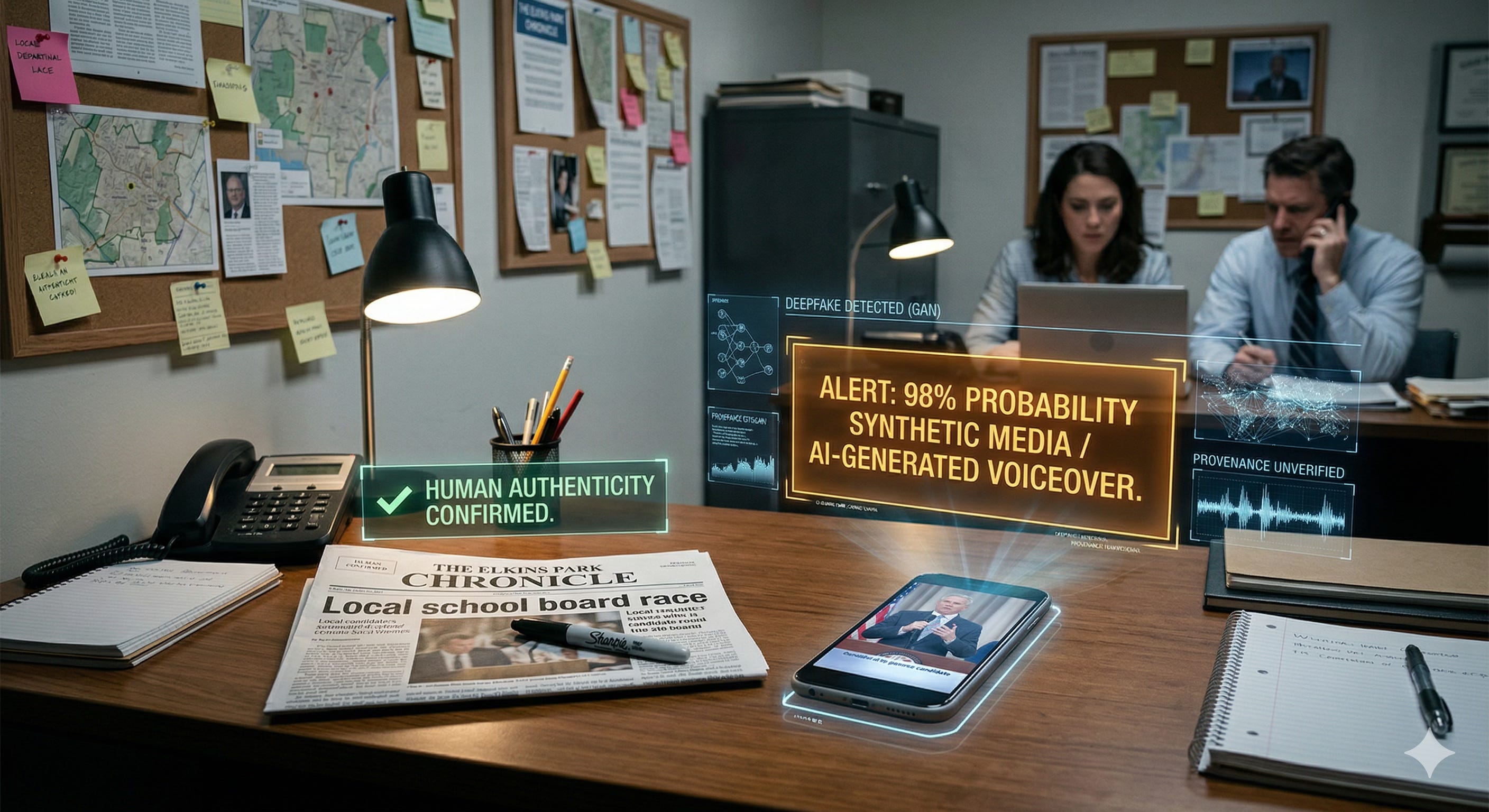
Does your local newsroom have a “red phone” for AI? If a high-fidelity deepfake of a school board candidate dropped in your community at 6:00 PM on a Monday, who would you call to verify it? I want to hear from the reporters and editors on the ground—hit reply and tell me what your “operational protocol” looks like right now (or if it’s currently just a prayer).
Infrastructure is only as strong as its weakest link. If you found this analysis of the “first AI election” useful, please share it with a colleague in a different newsroom or a funder who needs to see the “corner store vs. cybersecurity firm” reality of local journalism.