
The Growth Trap: When Mission Outruns the Money
Success built on exceptional gifts is not success. It is a pause between realities.

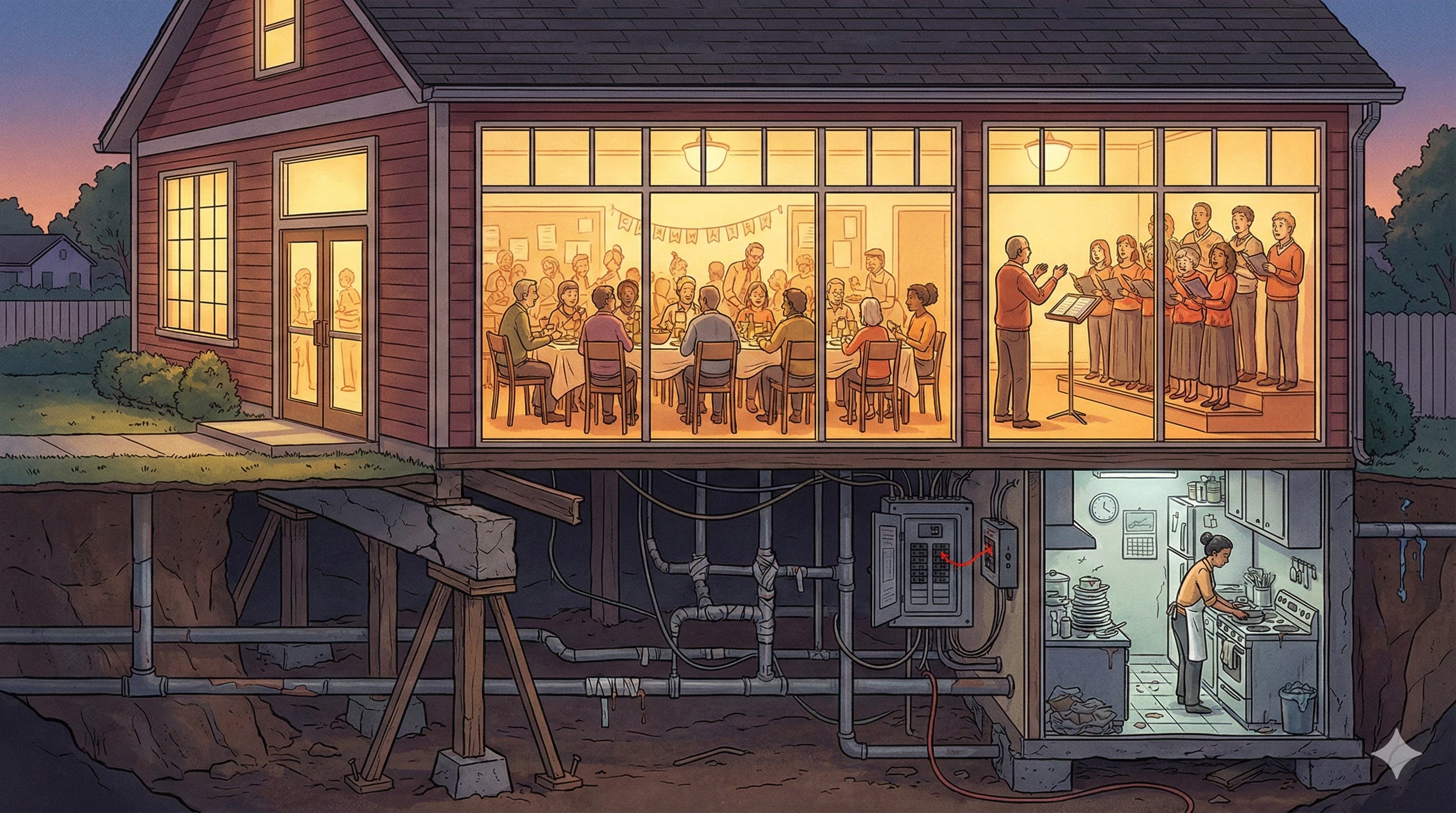
I was reviewing the board package for a local community organization recently, and I noticed a pattern I’ve seen in every newsroom and nonprofit I’ve worked with.
It’s the moment where the future feels unstoppable.
The programs are full. The volunteer lists are growing because the work matters. The community events are drawing crowds. A new youth program launches, and suddenly, there are teenagers choosing to spend their free time there instead of disappearing behind a screen.
People are finding purpose. And they are finding each other.
On the financial side, the balance sheet finally looks friendly. Enrollment is ahead of budget. A couple of big gifts — and one very well-timed estate — rocket fundraising into the stratosphere. The board smiles. The staff breathes. You might even get a nice note about “momentum.”
It’s all true. And it’s all worth celebrating.
But beneath that win is a quieter, more dangerous story.
Admin costs drift higher because the real world does not bill itself in neat monthly installments. Maintenance costs spike because buildings age in seasons, not spreadsheets.
And then there is the kitchen.
It was designed for simple hospitality—coffee, light snacks. But because the mission is strong, it has become the beating heart of the community: cooking for the food-insecure, hosting large dinners, feeding the soul of the place.
In product terms, we would call this Product-Market Fit. The users love it. Demand is through the roof.
But in operational terms, it is a prototype that never got its upgrade. It is running on residential equipment and volunteer goodwill. It is a product that is failing to live up to its potential not because the vision is wrong, but because the infrastructure is invisible.
The “customer” sees the beautiful meal. The “staff” sees the breaker that trips if you run the microwave and the coffee maker at the same time.
And this is where the trap snaps shut.
Someone looks at that success and says: “We should do more. Let’s start a café. Let’s do nutrition classes.”
They want to scale the output (the meals) without upgrading the operating system (the room, the staff, the budget).
Program growth creates optimism. Optimism creates commitments. Commitments create cost.
The Windfall Illusion
Every organization has a year where the universe just smiles. A longtime supporter leaves a legacy gift. Another family steps up with surprising generosity. Fundraising numbers leap off the page.
Someone says: “We’re finally turning the corner.”
This is the most dangerous moment in nonprofit finance.
Because a one-time gift looks exactly like recurring revenue… until the next year, when it isn’t there.
Temporarily, it erases the deficit. Quietly, it hides the true cost of the work. Accidentally, it encourages growth the baseline can’t support.
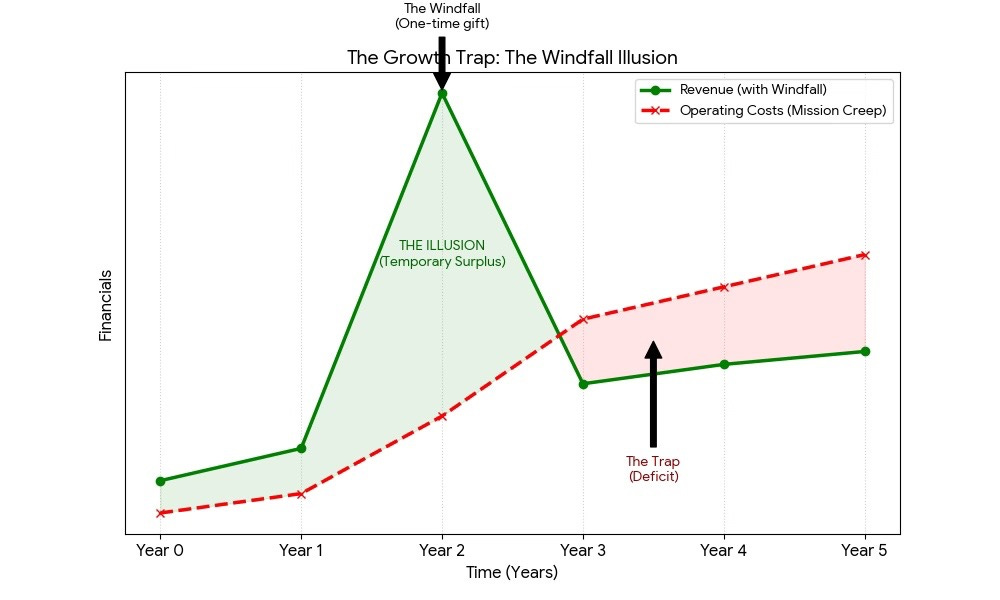
A windfall does not fix the system. It simply lets you see what the system could be.
The responsible question is not: How do we spend this good fortune?
It’s: How do we ensure we don’t need this again?
Windfalls should buy options. They should buy time. They should buy a path to recurring revenue. What they should never buy is amnesia.
This is how growth happens. And this is how financial drift happens: When the mission expands faster than the infrastructure that must support it.
It becomes easy to believe that windfalls will continue. That staff capacity is infinite. That volunteers are a renewable resource with zero cost. That a good year means a good system.
One board makes a smart move: they approve a dedicated fee to protect their safety cushion instead of draining the operating budget later. That’s sustainability thinking.
But here is the question for you: What other parts of your organization deserve that same seriousness?
Here’s the uncomfortable truth. Success built on exceptional gifts is not success. It is a pause between realities.
The organizations that last — the ones that survive the leadership transitions and the difficult years and the economic mood swings — share a mindset. They invest in the boring parts while the exciting parts are thriving.
They:
Match every new program with a real revenue plan.
Allocate true costs to space, staff, and equipment.
Treat staff time as a limited resource.
Build systems before the cracks show.
Act like funding won’t fall from the sky again.
They understand the generosity curve. They know that this year, two donors changed the story. Next year, they may not.
So look at your own roadmap. Are you writing a business plan or a thank-you note?
None of this takes away from the joy of what is being built. In fact, sustainability is love in its most practical form. It is what ensures the meals keep coming. The lights stay on. The community stays connected.
Growth is a gift. It is also a responsibility because nothing collapses faster than success that wasn’t designed to last.
This is the time of year for big resolutions. But maybe the best resolution is to stabilize what we already have. What is one “invisible” part of your work that you are committing to strengthening in 2026?
P.S. — Did this analysis provide you with a breakthrough strategy?
If so, please consider making a one-time tip to support the deep research and analysis that goes into every Backstory & Strategy post.
Additionally, if you found this post helpful, please restack it and share it with your audience. This spreads the word and keeps me writing the types of content you enjoy.