
The Haggadah of the Newsroom: Strategic Lessons from the Four Children
What the ancient ritual of the Seder teaches us about audience segmentation and the future of journalism.

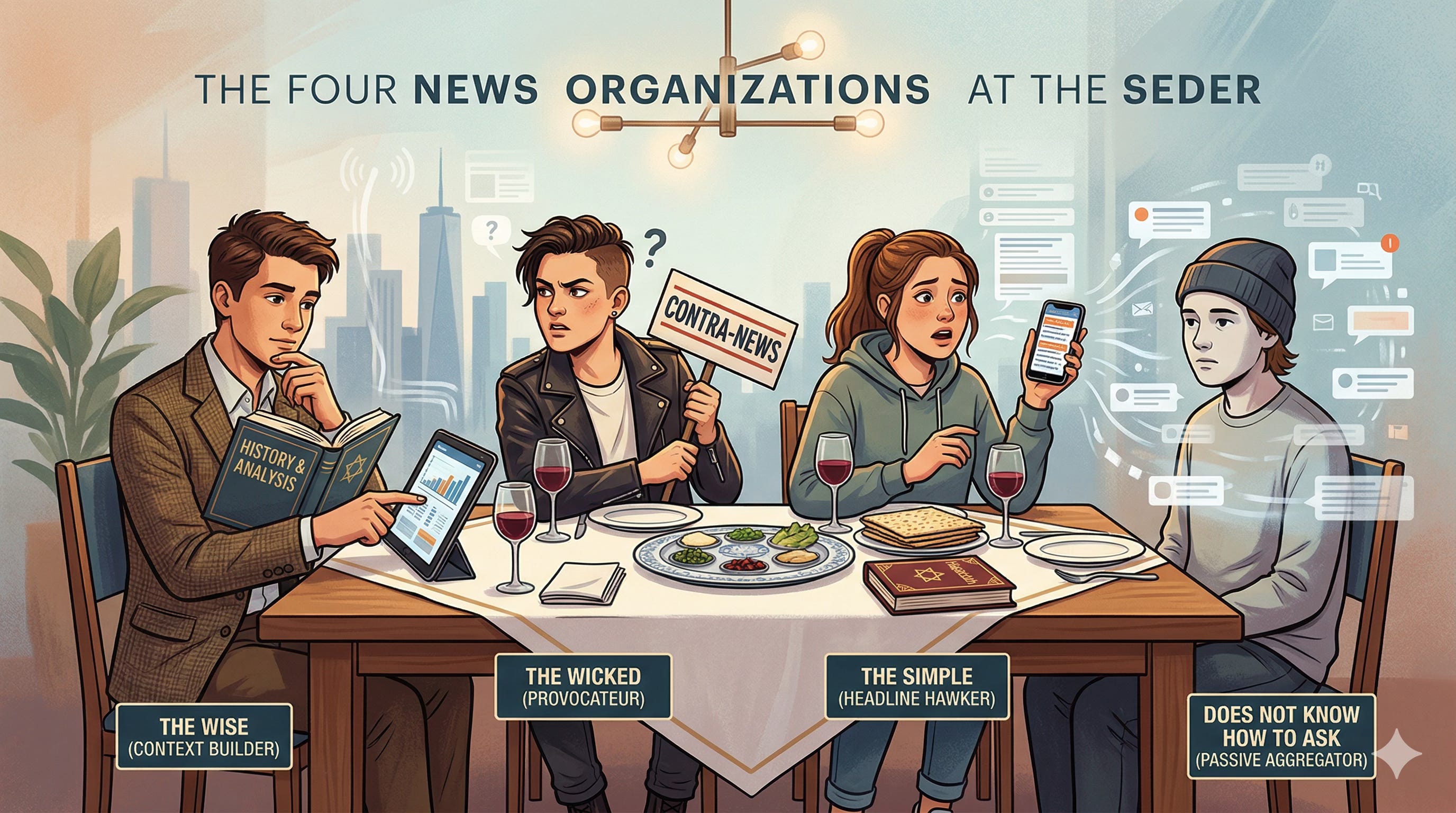
Last night, my family, along with Jews around the globe, gathered to celebrate the Passover Seder. We swallowed our fair share of bitter herbs. We sipped our wine. We retold the story of Exodus, working our way through the ancient Hebrew textbook known as the Haggadah.
When we got to the Four Children, I started pondering the state of journalism today.
Here’s how that works. During the Seder, four children ask four questions about what’s going on. Each child represents a different personality type: The Wise. The Wicked. The Simple. And the Child Who Does Not Know How To Ask. Rather than simply describing these children, the Haggadah actually provides guidance on how to directly address each child based on their individual perspectives and motivations. It is an audience segmentation and reader engagement strategy wrapped up in one ancient scroll. It knows that the story will only resonate if you tell it in a way that they can understand and appreciate.
What would happen if we substituted those children for the Four News Organizations eating at our media ecosystem dinner table? How should we “answer” them today?
1. The Wise Organization (The Context Builder)
Question: “What are the testimonies, the statutes, and the laws?”
Profile: This organization wants the “big picture.” If a bridge collapses, they’ll explain the engineering blueprints as well as give you a history of infrastructure spending.
Engagement Strategy: The Hagaddah instructs the reader to “teach him in detail, including all the symbols.” In other words, leave no breadcrumb unturned.
Lesson: Don’t skip on context for this audience. Feed their craving. Give them the backstory, the dataset, the primary sources, and the “why.” This is your brand’s loyal base.
2. The Wicked Organization (The Provocateur)
Question: “What does this service mean to you?”
Profile: Notice how they say “you” instead of “us.” The wicked child separates themselves from the group. They are likely hyper-partisan, but they could also be the “anti-establishment” brand. They aren’t here to learn the story. They’re here to question why the others are telling it.
Engagement Strategy: “Answer him with a set-the-teeth-on-edge bluntness.”
Lesson: Avoid the trap of arguing with someone who is not interested in finding common ground. Call out the skepticism with straight talk. Remind them that if we don’t have a commitment to a basic set of facts, then both the community and your business model suffer.
3. The Simple Organization (The Headline Hawker)
Question: “What is this?”
Profile: This organization thrives on news-you-can-understand. Sound-bite journalism. The Simple child only wants the “What.” The Who, What, Where, When… but none of the Why.
Engagement Strategy: Keep your explanation simple. “With a strong hand, we were brought out.”
Lesson: Be straightforward with these readers. Don’t ask them to do homework. Serve them truth, but make it easy to digest. You’re not trying to entertain them; you’re trying to move them to the “Wise” seat by gaining their trust.
4. The Organization That Does Not Know How to Ask (The Passive Aggregator)
Silence: This child utters not a word. They quietly listen to the story, waiting for the grown-ups to finish.
Profile: Such brands don’t ask questions because they have no editorial voice to do so. Think of the AI-driven news aggregators. Or your Facebook feed. There is no journalism taking place. Just a lazy regurgitation of whatever else is happening on the internet.
Engagement Strategy: The Haggadah is clear: “You must open the matter for them.”
Lesson: Unfortunately, that means it’s up to us. Media leaders can’t abdicate our responsibility to give these organizations a voice. We have to tell the story because they won’t.
The “Fifth” Child
My favorite part about the Four Children explanation? They all eat together.
A healthy media culture needs all four. In fact, we need all Jews to sit at that table together. The challenge today is that we stopped conversing with other Jews around the table. We’ve clustered together into our ideological tribes.
As we move through the rest of Passover, I hope we can work on leading the Simple child toward wisdom, bringing the Wicked child back into the “us” fold, and speaking louder so that those who don’t know how to ask can hear our voice.
Happy Passover to those observing.
Which of these “children” do you see dominating your social feed right now? Is there room for the “Wise Child” in a 280-character world? Let’s talk about it in the comments.
Backstory & Strategy is a labor of love. If you enjoyed this lens on media, I’d be honored if you subscribed or shared this post with someone who cares about the future of our industry.
A Note on Accuracy: I strive to get the backstory right every time. If you spotted a detail about the Seder or media strategy that feels off, please let me know here so I can set the record straight.