

A Quick Disclaimer: Backstory & Strategy is a personal, independent publication. The views, analysis, and commentary expressed here are strictly my own and do not represent the official position, strategy, or endorsement of the American Press Institute, its leadership, or its board. This is my personal space for analyzing the media landscape, testing new frameworks, and thinking out loud.
Every newsroom I’ve worked in has had some version of this. Someone brings up the mission, and you can watch a certain kind of colleague do the math in their head. Nice words. But how’s that going to pay the bills? Nobody says it out loud. It just hangs there until the conversation gets around to something with a number on it.
Here’s the version of that fight everyone’s already heard. A reporter I knew covered something, went back for a follow-up, then came back a third time with another angle. Her editor told her to move on. She pushed back, the way good reporters do. His answer wasn’t about budget or the news cycle. It was simpler than that.
“You just care too much.”
Nobody in that exchange was a villain. He had six other stories fighting for her time and a metric telling him this one had run its course. But listen to what the sentence actually says. Not “we’ve covered this enough.” Not “there’s no more news here.” You care too much. The caring was the problem. Not the story.
That fight didn’t stay in the newsroom. It just changed rooms.
New pieces on journalism economics and media strategy land here regularly. If you’d like the next one in your inbox:
I’ve sat across the table from the executive-suite version of it more times than I can count. A CFO leans back, no malice in it, and asks: What’s this actually going to do for us? Are we making money, or are we just spending it?
Nobody in the room thinks that’s an unreasonable question. Most of the time, it’s the right one. But notice what it assumes before anyone answers. Make money or spend money. Two boxes on a spreadsheet. There’s no third box for this is what keeps people trusting us long enough to have a next quarter at all. If it doesn’t land in one of those two boxes, it doesn’t exist on the page he’s looking at.
That’s the pattern. Not villainy. Legibility. The editor couldn’t measure what a third story might’ve meant to the people still living it. The CFO can’t measure what trust is buying the company three years out. And it isn’t confined to a newsroom or one CFO’s spreadsheet. It’s the same fight between a CFO and a CRO, margin discipline against growth at any cost. The same fight between a CMO and a CEO, brand and trust against this quarter’s number. The same fight an Executive Director has with a Board, or a Board has with itself, mission fidelity against a finance committee asking hard questions about runway. Different titles, different rooms, same mechanism every time: one side of the table is holding a number, the other side is holding something true that doesn’t fit on a slide, and the number wins by default, not because it’s right, but because it’s the only thing anyone in the room can point to.
The instinct to go the extra round, the extra follow-up, the extra year of patience, is expensive and hard to measure. The instinct to cut it is cheap and shows up on a spreadsheet immediately. Nobody votes against caring about people in a strategic planning session. They just can’t chart it. So it drifts to the bottom of the agenda. Then off it.
Doctors know this pressure, and they’ve even had to invent new vocabulary for it. In 2018, physicians Wendy Dean and Simon Talbot argued that what looks like burnout in medicine is often something more specific: moral injury, the wound that comes from knowing what a patient needs and being blocked from providing it by billing codes, productivity quotas, and insurer requirements standing between the doctor and the exam room. Teachers know a version of the same thing, standardized-test optimization slowly flattening what used to be judgment about a specific kid in a specific classroom. Journalism has its own version, and we’ve been living inside it for two decades: pageview chasing, SEO-optimized aggregation, the algorithm quietly becoming the audience we actually write for.
The numbers back up the feeling, and they’re worse than most people outside a newsroom realize. A 2024 Reynolds Journalism Institute study of more than a thousand journalists found that roughly eight in ten considered burnout a critical issue in their newsroom, and about one in five were actively planning to leave the field. A separate survey of local journalists by UNC’s Center for Innovation and Sustainability in Local Media found that seven in ten had experienced work-related burnout, a rate the researchers tied directly to more than a decade of layoffs, consolidation, and newsrooms leaning harder on fewer people to cover the same ground. This isn’t a mood. It’s a documented, industry-wide trend, and it’s what happens when the caring instinct keeps losing arguments to the spreadsheet often enough, for long enough.
So here’s the actual question, stated as plainly as I can put it: can journalism be a viable business and still genuinely care about the people it serves? Not care when resources allow it. Anyone can care when it’s free. Can it still care when caring costs something measurable? Can it survive that cost?
I don’t think the honest answer is yes or no. I think it depends on something more specific than “try to care more.” It depends on where, exactly, the metric sits relative to the mission.
Here’s the test. Look at any profession under efficiency pressure and ask: is the business model neglecting the human relationship, or extracting from it?
Neglect and extraction get lumped together under the same word, efficiency, but they’re not the same failure at all.
A newsroom chasing pageviews is neglecting its reader. The incentive points away from care, but nothing in the model requires actively working against the reader’s interest. A doctor drifting toward volume is optimizing for something adjacent to the core function of healing, not opposed to it. That’s bad. It’s also fixable, because nobody’s revenue depends on the neglect continuing. Leadership can, at any point, decide the boring 80% gets automated so the caring 20% gets protected, and the business survives the decision.
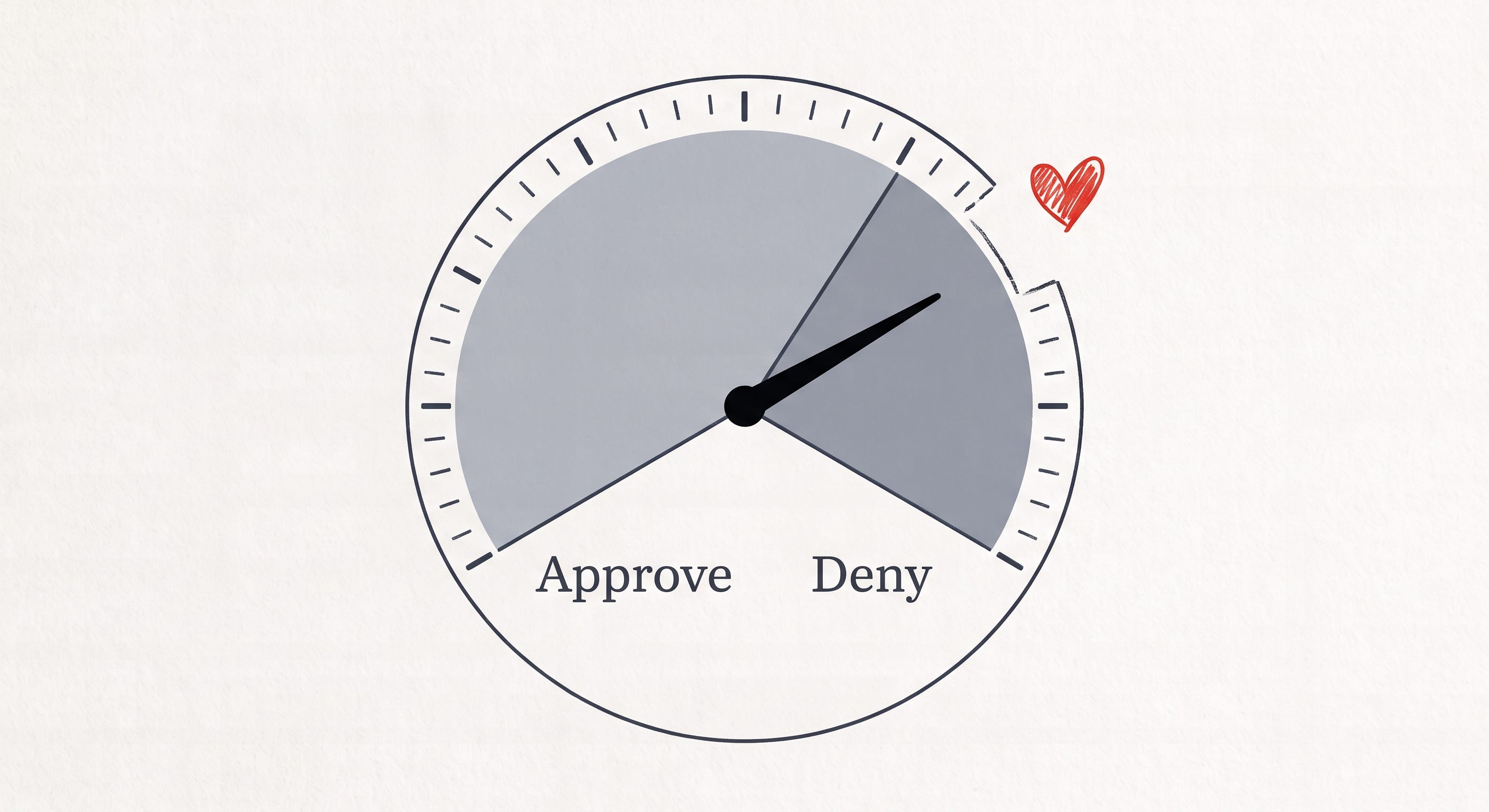
Then there’s insurance, and here the pattern stops being metaphorical. A 2025 ProPublica and Capitol Forum investigation found that EviCore, a company that reviews treatment requests on behalf of insurers covering roughly 100 million Americans, uses an algorithm that insiders reportedly call “the dial,” adjustable to raise or lower the odds a given request gets denied. Some of the company’s contracts are structured so it earns more the more it cuts medical spending. A separate ProPublica investigation found that Cigna’s internal review system let its doctors deny claims without opening the patient’s file at all, moving through roughly 300,000 denials in two months at a pace one former reviewer described as 1.2 seconds per claim. Federal data shows insurers denied more than 48 million claims in a single year, and patients appealed fewer than two in a thousand of them.
None of that is a rogue actor. It’s the system working exactly as designed, because approving the expensive claim, covering the borderline case, exactly the moments where a caring human would step in, is the thing that directly reduces the bottom line. The incentive isn’t misaligned with the heart. It’s structurally opposed to it, on purpose, by design. There is no version of “automate the paperwork so humans can focus on the caring part,” because for an insurer, the caring part is the cost center the entire model exists to minimize.
That’s the insurance test as an illustration. Here’s how to actually run it against your own organization, in a real budget meeting, the way “no money, no mission” became usable because it was a decision rule and not just a description.
Ask yourself four questions in this order.
The reversal question. If you started doing the caring thing tomorrow, does your business get worse, or does it break? A newsroom that runs more follow-ups sees revenue dip a little. An insurer that stops denying borderline claims doesn’t dip, it stops being the business it was built to be. If reversing course costs you margin, you’re looking at neglect. If reversing course collapses the model, you’re looking at extraction.
The direction question. Does your margin go up when you do more for the people you serve, or up when you do less? This is the sharpest one, because you can’t talk your way around it. A newsroom’s revenue doesn’t rise because it under-covers a community. It just fails to rise as much as it could. An insurer’s profit rises specifically when it denies more claims. If your honest answer to “does less care make us more money” is yes, you’re on the extraction side of the line, whatever your mission statement says.
The line-item question. Is the cost of care a rounding error you’ve never gotten around to prioritizing, or is it the specific thing your margin has been engineered to minimize? Neglect looks like an unstaffed beat, a follow-up nobody assigned, a training budget that got cut two years running and never came back. Extraction looks like a system, a dial, an algorithm, a contract structure, purpose-built to make the caring outcome the expensive one.
The distribution question. When you make this tradeoff, who actually absorbs the cost? Your bottom line, or a specific group of people quietly carrying it instead? Neglect tends to spread thin across an organization. Extraction tends to concentrate on whoever has the least power to push back: junior staff, the communities with the least institutional leverage, the patients least equipped to appeal a denial.
Ask yourself all four and the answer usually comes fast, because they tend to agree with each other. That’s the point. This isn’t supposed to be a gray area you argue about in the abstract. It’s a Tuesday-morning gut check: run the numbers you already have through these four questions, and you’ll know within about ten minutes which side of the line you’re actually on, whatever you’d have said if someone had just asked “are we the good guys.”
Where does journalism land?
Mostly on the fixable side, still. A newsroom that optimizes entirely for pageviews is failing its audience, but it isn’t required to fail them to survive. A subscription or membership model, done right, actually flips the whole equation: the outlets making it work (Texas Tribune, The 19th, most of the strong nonprofit local shops) didn’t get there by being more efficient at traffic. They got there because the relationship is the business model. The Texas Tribune’s own audience team has started calling this “belonging” rather than membership, the idea that readers need to feel heard and connected, not just billed, and that trust is the precondition for that belonging rather than a byproduct of it. Trust isn’t competing with revenue in that structure. It’s generating it.
Remember the 80/20 split from a few paragraphs back, the boring work that can be automated so the caring work gets protected. AI is the sharpest current test of whether a newsroom actually draws that line or just talks about it. Used to eliminate rote work, transcription, first-draft aggregation, the administrative sludge that eats a reporter’s day, it’s the 80% getting automated exactly as intended, freeing humans for the judgment and voice that made anyone subscribe in the first place. Used to replace the judgment itself, the tool that was supposed to protect the 20% quietly becomes the thing that erodes it. Same technology, same pressure, opposite outcome, entirely dependent on whether leadership decided in advance what was commodity and what wasn’t.
That’s the uncomfortable part for our field specifically. A bad medical outcome eventually shows up in mortality data. A bad insurance denial shows up in a headline. Bad journalism just shows up as a slow decline in trust scores that everyone spends a decade arguing about the meaning of. The ambiguity is exactly what makes it so easy for a newsroom to drift toward the insurance model without anyone ever deciding to. Nobody chooses to extract from the reader. They just fail to defend the line, one quarter at a time, until the line has moved without a vote.
None of this stays contained inside the newsroom, either, and it doesn’t land evenly when it doesn’t. A University of Washington study tracking Seattle-area journalists from 2015 to 2021 found that journalists of color left the field at disproportionately higher rates than white journalists over the same stretch. A 2025 survey of newsroom layoffs and buyouts since 2022 found that journalists of color made up 42% of those let go, more than double their roughly 17% share of the industry, and that most of them had been in their jobs three years or less.
Care, in other words, isn’t only whether a reporter gets to write the third follow-up. It’s who gets protected long enough to build a career and who gets depleted first when an organization starts treating people as the softest line item to cut. My colleague Samantha Ragland, who leads API’s work on newsroom sustainability, put it well to Nieman Lab a few years back: pushing back on a culture that runs on overwork means challenging what the industry has always told people makes them valuable in the first place. That’s a harder fight than a budget line, and it’s the one that quietly decides who’s still in the building five years from now.
I’ll always argue for a good business plan, and I’ve had to make that argument to people who didn’t want to hear it. At Lehigh Valley Public Media, I’d get pushback from the team almost every time margins or revenue came up. “We’re a nonprofit,” they’d say. “Why do we need to make money?” And the board would say the opposite, in four words that turned out to be the truest sentence in the building: no money, no mission.
Neither side was wrong, which is what made it hard. The staff’s instinct came from the right place. They’d watched revenue conversations, in other newsrooms and sometimes in their own, turn into an excuse to cut the very things that made the journalism matter. Caution around “make money” talk wasn’t naivete, it was scar tissue. But the board was right too, in a way that doesn’t feel true until you’ve actually run the budget: mission without a business plan isn’t purity, it’s a countdown clock. Nonprofit or for-profit, journalism doesn’t get to skip that homework, and plenty of well-meaning newsrooms have gone under holding the moral high ground and an empty bank account. The job of leadership in that room wasn’t to pick a side. It was to keep saying the thing both sides needed to hear: the money and the mission aren’t in competition, they’re each other’s precondition, and the moment either one gets treated as optional is the moment the organization starts failing at the other.
But there’s a line even inside that reconciliation, and it’s worth being precise about where it sits. A good business plan and the decision to extract from your own people, or from the communities you’re supposed to serve, are not the same discipline wearing different clothes. One is stewardship. The other is the insurance model with a masthead on it. The whole point of the test is that you don’t get to call the second one a business necessity just because it’s the more legible choice.
And it doesn’t stop at the boardroom door. This isn’t really a newsroom problem, it’s an organizational one, and for nonprofit newsrooms specifically, funders can make it sharper instead of easier, sometimes without meaning to. API’s own research on nonprofit journalism funding found something close to backwards: about two-thirds of nonprofit news outlets report web traffic or social media metrics to their funders, but only around four in ten funders actually ask for them. The newsrooms are volunteering the legible number before anyone requires it. That’s the whole pattern in this piece, playing out one level up, and it’s more honest than “funders forced our hand.” A traffic figure is easy to defend in a grant report. “We changed how a community understood an issue” is not, even when the second thing is closer to the actual mission.
And when a nonprofit depends on one or two institutional funders for most of its budget, which researchers who study mission drift note is common in the sector, those funders end up in a position to shape priorities whether they intend to or not. Nobody has to impose the dashboard from outside. An organization under enough financial pressure will build one for itself and hand it over voluntarily, because the metric is legible and the mission isn’t, and the metric wins the argument by default. Same pattern as the CFO’s two boxes. Just with a grant report standing in for the spreadsheet.
So: can journalism be successful and still have a heart? Only where leadership actually answers the question instead of letting the dashboard answer it by default, and only if that answer gets re-litigated at every layer where it comes up again, because it does come up again. The CFO and the CRO have this argument. So does the CMO and the CEO. So does the Board, with itself, every time the finance committee asks a harder question than the program committee does. The organizations that keep their heart aren’t the ones that settled the question once at the top. They’re the ones where every layer of the org chart has the language to name what’s commodity and what’s actual product, and the standing to defend the second category out loud when the spreadsheet argues against it. The ones that never build that language anywhere below the top drift, one quarter at a time, one desk at a time, toward the insurance model without anyone ever choosing to.
That language has to work in the room where it actually gets tested, though, and that room is usually smaller and less dramatic than a boardroom. It’s the room with the CFO in it. He didn’t ask a bad question at the start of this piece, and he doesn’t need a worse one to argue with. He needs a third box on the page he’s already looking at, one that isn’t revenue and isn’t cost, a place to write down what the trust or the relationship or the mission-critical work is actually buying the organization, in terms specific enough that he can hold leadership to it the same way he holds them to the other two boxes. That’s not asking him to stop asking his question. It’s giving him a real answer to it, instead of a mission statement he was never going to accept as one.
The heart was never the thing efficiency was trying to kill. It’s just the thing nobody put on the dashboard.
Related: The Teshuva Test
If this got you thinking, which of the four questions above would be hardest to answer honestly about your own organization? I’d genuinely like to know. Drop a comment, I read all of them.
One place this shows up in a very literal, measurable way: whether your organization’s own website is legible to the people and systems that decide whether to trust it. That’s the exact problem NewsGrade was built to catch. It won’t tell you if your organization has a heart; that’s not a spreadsheet question. But it will tell you, in a couple of minutes, how visible your site’s trust signals actually are to readers and AI systems alike, and where the gaps are costing you attention you didn’t know you were losing.
If this piece was useful, the best way to help it find the people who need it is to send it to them directly.