
The Job We Haven’t Been Doing
What I said at the University of Maryland’s Local News Network Summit — and why it applies everywhere.

On Friday, I spoke at the University of Maryland’s annual Local News Network Summit in College Park — a room of about 70 journalists from across Maryland, from legacy outlets and startups alike.
The morning began with the release of a significant new piece of research: The News That Audiences Need, a human-centered design study of the Maryland news ecosystem from the UMD Merrill College of Journalism, based on in-depth interviews with residents across the state. It’s worth reading in full.
The study’s opening line has been rattling around in my head since I read it the night before.
“One of the most pressing problems weakening the local news ecosystem has little to do with revenue or technology. The problem is the journalism itself.”
I’ve been writing a version of that argument for the past year here on Backstory & Strategy. And it’s what we work on every day at the American Press Institute.
It’s nice to finally have the data.
The study is rooted in Maryland — Maryland voices, Maryland communities, Maryland needs. That specificity is its strength. You can’t build something real without that kind of ground truth.
What I want to offer is the other direction.
Not what Maryland needs — but what the structural failure looks like everywhere. Why the same gap shows up in rural Missouri and suburban Philadelphia and College Park. And why the math only works one way regardless of the zip code.
Because here’s what I’ve found working with newsrooms nationally: knowing the job isn’t the same as completing it.
A plumber who knows your pipes are broken but doesn’t show up until three days after the flood hasn’t done the job.
The question I keep coming back to isn’t what to cover. It’s whether the journalism actually lands.
And that’s a different problem entirely.
A Quick Disclaimer: Backstory & Strategy is a personal, independent publication. The views, analysis, and commentary expressed here are strictly my own and do not represent the official position, strategy, or endorsement of the American Press Institute, its leadership, or its board. This is my personal space for analyzing the media landscape, testing new frameworks, and thinking out loud.
Just in Case. Just in Time.
Most journalism is built just in case.
Just in case you happen to be on the homepage. Just in case this story is the one you needed. Just in case the timing works out.
Utility journalism is built just in time. At the moment you’re standing in the grocery aisle. At the moment, the letter from the landlord arrives. At the moment, you need to decide whether to show up to that zoning meeting.
That gap — between just in case and just in time — is what I’ve been calling the Last Mile problem in journalism.
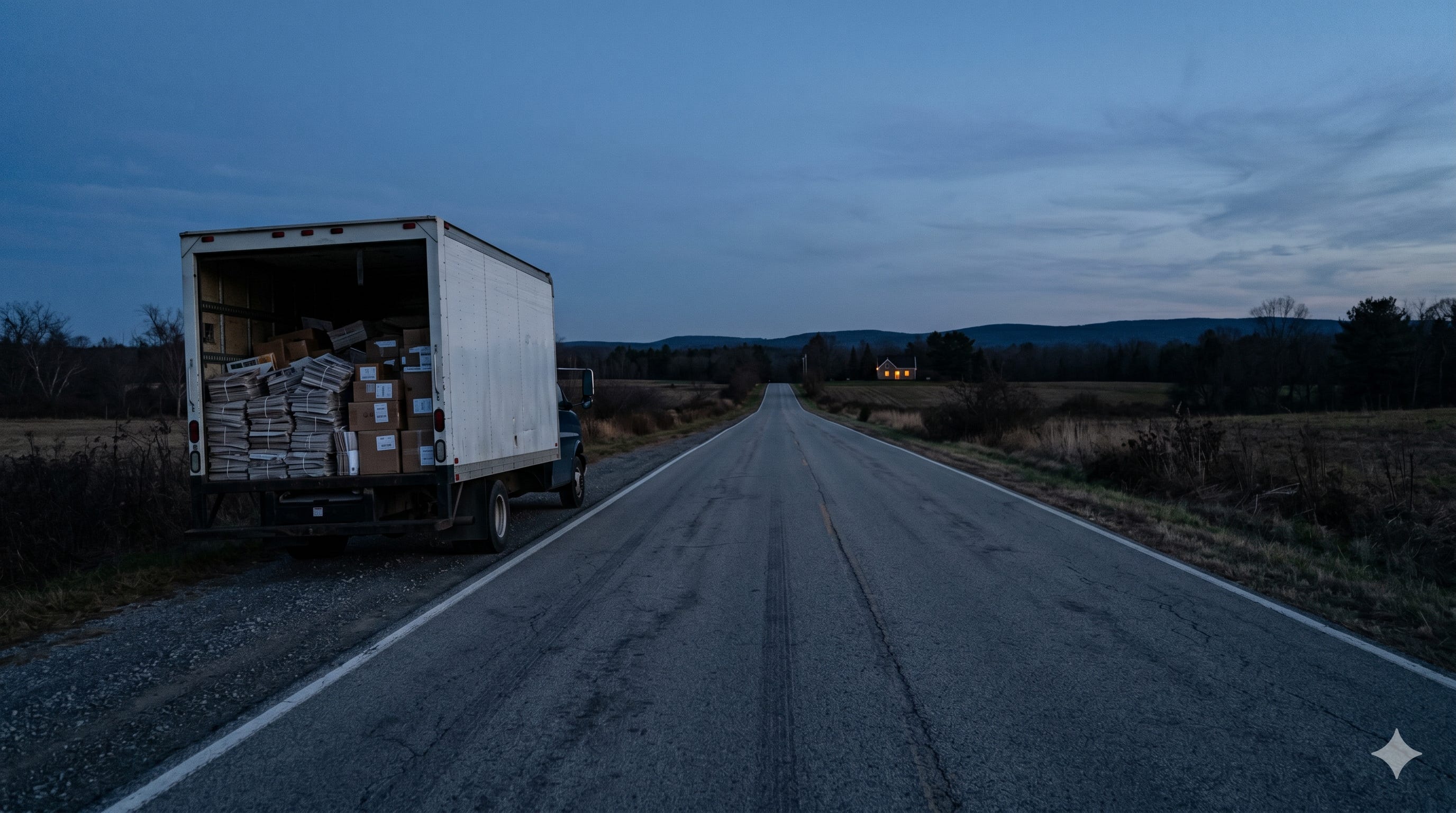
The term comes from logistics. In package delivery, the Last Mile is the final leg of the journey — from the distribution center to your front door. It sounds simple. It’s actually the most expensive, most failure-prone part of the entire operation.
The product exists. The warehouse is full. But getting it from the truck to the moment someone actually needs it — that’s where everything breaks down.
Journalism has the exact same problem.
The reporting exists. The story is published. But getting it from the homepage to the moment a person actually needs it — to the moment they’re standing in the grocery aisle, or opening a letter from their landlord, or trying to figure out what that zoning vote means for their street — that gap is costing us everything

I Learned This the Hard Way
I spent years running a nightly newscast covering ten counties across Northeastern Pennsylvania and New Jersey. 5,600 square miles.
I thought geographic scale was my greatest strength. More communities. More stories. More reach.
But when I went to talk to funders and donors, they didn’t see a region. They saw ten separate communities that had almost nothing to do with each other. The person in Scranton didn’t care about the zoning board in Belvidere.
My ambition was actually killing my ability to be essential to anyone.
I was covering everything. I was indispensable to no one.
That’s a relevance problem. Not a distribution problem. An indispensability problem.
Then the pandemic hit.
And for about fourteen months, our entire team at PBS39 in the Lehigh Valley accidentally became a utility.
We launched a daily program called Community Update on Coronavirus. Live on television every night. Rebroadcast on our NPR station. It wasn’t a newscast in the traditional sense. It was a tool.
Medical experts came on to answer real questions from real people. When vaccines became available, we walked viewers through eligibility. When unemployment claims jammed the state system, we brought on people who could troubleshoot the process in real time. When schools went remote, we helped parents navigate what that actually meant for their kids on Monday morning.
We weren’t just reporting on the pandemic. We were helping people get through it.
And the audience knew the difference.
According to TVB analysis of Nielsen data, local news viewership surged dramatically. Among 18-to-34-year-olds — the demographic the industry had largely written off — viewership increased 162 percent by the third week of March 2020.
They didn’t show up because they were bored. They showed up because local news was being useful to them in a way it hadn’t been before.
And then the pandemic receded. And we went right back to story mode.
The trackers came down. The eligibility tools expired. Nobody looked at what had just happened and said, “We just proved that utility journalism drives trust and revenue. Let’s build permanent beats around this model.”
We treated it as an emergency response. Not as a strategic revelation.
What the Gap Actually Looks Like
Here’s what that gap looks like in practice.
The Bureau of Labor Statistics releases a CPI report. Headline inflation hits 3.8 percent. Beef has surged 14.8 percent. Food at home jumped 0.7 percent in a single month.
CNBC runs a chart. The AP writes a story quoting an economist who says it could get worse.
All of it is accurate. Almost none of it is useful.
The gap between “beef is up 14.8 percent” and “here are three protein strategies to hold your weekly grocery budget steady” is enormous. That gap is where an entire beat should live. Almost nobody is filling it.
We have built economic journalism as a weather report. Here is today’s number. Here is what went up. Here is an expert saying the storm might continue.
It tells people what happened to them. It does not tell them what to do about it.
The first newsroom builds agency. The second builds anxiety. Both are accurate. Only one actually helps.
Where AI Fits — And Where It Doesn’t
I published a piece on this last week, so I’ll be concise here.
The fear in every newsroom right now has a specific shape. AI gets good enough at writing — really good, passably-indistinguishable-from-human good — and newsrooms discover they no longer need as many reporters. The content keeps coming. The lights stay on. But the journalists are gone.
It’s a coherent fear. And it’s wrong. But only conditionally.
AI is going to replace what too many newsrooms have been calling journalism. The commodity content. The wire rewrites. The SEO plays. The press release transforms. The weather report economy coverage.
The Reuters Institute put it plainly in their most recent research: “Publishers using AI to produce more efficiently may find themselves accelerating the very commoditisation that threatens them.”
If you are optimizing that operation, AI is your extinction event.
But here’s what AI cannot do. It cannot give someone a sense of belonging to their city. It cannot make a reader feel that this outlet gets us — the way a beat reporter who’s covered the school board for a decade gets us. It cannot be the reporter who stayed until the story was right. It cannot be the neighbor with a notebook. It cannot be the outlet that showed up when something went wrong and didn’t leave until something changed.
AI doesn’t create the Last Mile problem. It just makes ignoring it fatal.
The Framework: Moment, Action, Channel
A few weeks ago I was at Ohio University as faculty for the Kiplinger Fellowship — a program for working journalists and editors from across the country. I ran a workshop called The Last Mile. 31 journalists in the room. Publishers from rural Missouri. Investigative producers from network news. Solo founders building newsrooms from scratch.
I handed each table a real community crisis and gave them one rule: solve it without writing a story. Build a tool instead.
Every single table built a technology solution. Text alerts. Interactive maps. Push notifications. Not one table defaulted to a story.
Here’s what surprised me most: I didn’t have to convince anyone to think this way. The moment I gave them permission to build a tool instead of write a story, they moved immediately.
The instinct was already there. The framework was what was missing.
That framework has three parts. I call it Moment, Action, Channel.
The Moment is the specific point in someone’s life when they actually need the information. Not when it’s newsworthy. When it’s needed.
The Action is what you want them to be able to do with it. Not consume it. Do something.
The Channel is where they actually are when that moment arrives. Which is probably not your homepage.
Take the grocery price spike. The Moment is standing in the meat aisle. The Action is compare, substitute, recalculate. The Channel is a text alert that lands before the shopping trip starts. Not a story that published three days ago.
Every time a reader encounters coverage that describes their situation without helping them respond to it, the newsroom gets filed away in the same mental category as the problem itself

The Math Makes the Case
The UMD study found that when Maryland residents were asked what “local” means to them, not one of them defined it by administrative boundaries. One resident said: “Local means this is something I can affect. I can help make a difference here.”
That’s not a geographic definition. That’s a utility definition.
And this isn’t just anecdotal. A June 2025 Pew Research Center survey found that 83 percent of Americans have not paid for news in the past year. Of the 74 percent who regularly encounter paywalls, only 1 percent say their first instinct is to pay. The most common response — 53 percent — is to find it somewhere else for free.
The obvious read: people don’t value journalism.
But here’s the thing. A separate 2024 Pew study found that 74 percent of Americans said they had “a lot of” or “some” trust in their local news organizations, and 85 percent believed local news outlets are at least somewhat important to their community.
Trust. Perceived civic importance. But won’t pay.
That’s not apathy. That’s a product mismatch.
People aren’t refusing to pay for something they don’t care about. They’re refusing to pay for something they experience as a public good — the same way they experience the fire department or the public library. You don’t subscribe to the sidewalk.
That’s not an apathy problem. That’s a product mismatch.
And the revenue data makes it even clearer.
Look at the Sebastopol Times. Two-person newsroom. Town of 7,500 people. Conversion rate for paying supporters: 24.5 percent — compared to a typical metro daily’s 3 percent. That’s an 8-times difference in conversion.
Now look at the Charlotte Ledger. Incredible journalism. Metro area of 900,000 people. As of 2021, revenue of roughly $175,000 — and they’ve only grown since.
Sebastopol. Two staffers. 7,500 residents. Revenue: roughly $100,000.
Charlotte has 120 times the population. But less than 2 times the revenue.
The hyperlocal model is nearly 70 times more efficient at extracting value from its footprint.
Why? Because the readers in Sebastopol aren’t subscribing to content. They are paying the community’s salary so that the community continues to function. That’s not a transaction. That’s membership in something that matters.
That’s what AI can’t replicate. And that’s exactly what communities everywhere — not just in Maryland — are hungry for.
The Only Thing We Actually Control
The UMD study calls for a shift from a journalism of attention to a journalism of value.
I’d call it closing the Last Mile.
Same idea. Different metaphor. Same urgent problem.
And it starts — not with a new strategy, not with a new budget line, not with a consultant — it starts with one question about the next story you write.
What is the Moment when someone actually needs this? What is the Action I want them to be able to take? What is the Channel where they actually are when that moment arrives?
If you can answer all three, you’re building utility journalism.
If you can’t — you’re producing content.
The problem isn’t revenue. It isn’t technology.
It’s the journalism itself.
That’s the only thing any of us actually controls.
So let’s start there.
📬 If this resonated, share it.
The ideas in this piece only matter if they reach the people who can act on them — editors, publishers, funders, and journalists working on the ground. If you know someone who should read this, forward it or share the link.
💬 What’s your Last Mile?
Every newsroom has a version of this problem — stories that get published but never land. I’d love to hear yours.
Where does the journalism break down for your outlet? Drop it in the comments — or reply directly to this email.
The best responses may end up in a future piece.
📖 Not yet a subscriber?
If someone forwarded this to you, you can get Backstory & Strategy — analysis on journalism economics, infrastructure, and sustainability — delivered directly to your inbox.