
The Know-It-All vs. the Knows-Nothing: A Leadership Trap
Some bosses act like they know everything. Others clearly don’t know anything. Both can wreck momentum, morale, and teams — but for very different reasons.

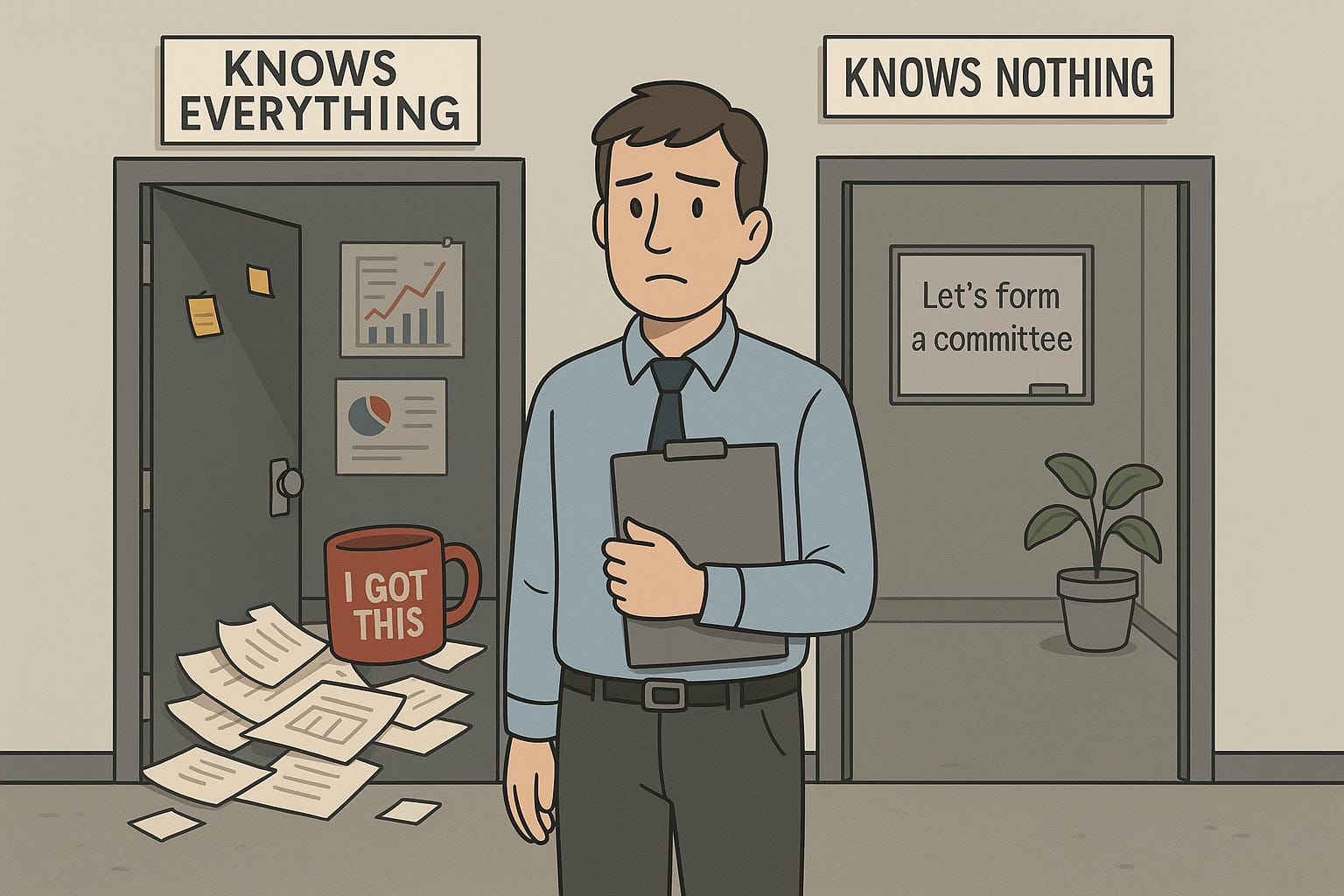
The worst boss I ever had thought she knew everything.
The second-worst boss knew absolutely nothing.
Guess which one did more damage?
I read this LinkedIn post the other day, and it stuck with me:
“You don’t have to know everything… I have to remind myself of this every time I start work on a new project. You are not expected to go in already knowing all of the answers.”
That’s sound advice—especially when you’ve seen it ignored as much as I have. Here’s why.
Let’s start with a story.
I spent one horrible job early in my career at a small weekly paper. The editor had been there a long time. And by long, I mean a long time. She knew a lot about the business… back when there was a lot to know. But her world had moved on without her. Her skills had atrophied and, without coaching or evaluation, she made up for it by shouting.
Okay—screaming.
But that’s a story for another day.
She was a toxic mix of both: a leader whose knowledge had expired (the knows-nothing) but who projected absolute certainty to hide it (the know-it-all). It made me realize that while both types are toxic, they come from very different places.
I’ve seen this story play out again and again:
Some bosses pretend to know everything.
Others are embarrassingly wrong about everything.
And both can be incredibly harmful.

Why Some Bosses Are Know-It-Alls
What’s Behind It? The Psychology Driving It
The Dunning-Kruger effect is a big part of it. When you have limited competence in an area, you overestimate how well you can perform that function because you don’t know enough to recognize your own incompetence.
This plays out in extreme form with people who’ve had a little success. That success blurs lines. Leaders who are good at one thing (say, closing a deal) start to believe they’re good at everything.
Power also rewires behavior. Even small doses of authority lower empathy and raise overconfidence. And if you have people constantly deferring to you? You have the best case of the Emperor’s New Clothes ever. People mistake deference for validation.
Organizational Factors
Workplaces also reward this behavior by accident. Know-it-alls look and sound like confident, decisive leaders—which is what most of us associate with good leadership. They get promoted for having "all the answers," even when those answers are totally wrong.
Once someone is in a leadership role, there’s the sunk-cost effect. How do you un-promote someone? It’s tough to even question it. Implicitly, you’re challenging the organization that put them there.
The Insecurity Trap
Okay—here’s the irony: many know-it-alls are absolutely riddled with insecurity. For them, admitting they don’t know something is tantamount to admitting they’re wrong. And to them, that’s unacceptable. So they double down. They are more confident, not less.
The Know-Nothings
This is the other side of the coin—and in some ways, even worse.
How They Got There
The Peter Principle is real: people rise to the level of their incompetence. Strong individual contributors become weak managers. Or someone is hired based on paper qualifications that sound great but don’t actually reflect current competence.
In media and nonprofit orgs, I see this a lot. Boards promote people based on their fundraising ability or public profile. Or bring in "industry veterans" who are really just dinosaurs in a fast-moving field. They’ve just never kept up with how digital or audience or strategy or content or analytics work now.
The Doing-Nothing Problem
Unlike the know-it-alls, these leaders don’t even make the wrong call. They make no call.
I worked with one director who responded to every strategic decision by forming a "task force."
Need to refresh our content calendar? Task force.
Should we invest in video? Different task force.
It took three months for us to end up with four committees meeting weekly, and zero actual decisions. Projects were paralyzed while he "gathered input" or waited for others to take the lead.
Why It’s Even Worse
The know-it-all at least has the juice to drive the car off a cliff in a single, swift, catastrophically wrong turn.
But the know-nothing boss just lets the car run out of gas in the desert.
One ends in a fiery explosion.
The other just stalls out—draining your momentum, morale, and eventually, your people.
Worse? Know-nothings often hire people less competent than they are, just so they don’t feel threatened. Sets up a vicious cycle that’s difficult to reverse.

So What Can You Do About It?
If You Work for a Know-It-All
Document, document, document. These folks will rewrite what you said or agreed to at will.
Ask questions, not challenges. "Just to clarify…" sounds better than "You're dead wrong."
Play to their ego. Frame your ideas as extensions of theirs: "Here's a way to build on what you suggested…"
Protect your energy. You won’t change them. Your best shot is to do good work and keep your sanity.
If You Work for a Know-Nothing
Manage up with structure. Come in with options and say, "I recommend B—does that align?"
Take initiative when they freeze. Just make sure you loop in the right people so you're not flying solo.
Build in alignment check-ins. If they won't steer, at least confirm destination: "Are we still prioritizing X?"
Find outside counsel. Get a trusted mentor or peer who reminds you what healthy leadership looks like.
And If You’re Seeing These Patterns in Yourself?
That’s actually a good sign. Self-awareness is the first (and hardest) step.
Ask yourself:
Am I listening as much as I'm talking?
When's the last time I said "I don't know" in front of my team?
Do I make space for feedback—or just say I do?
Am I promoting challengers—or just people who agree with me?
If anything here resonates, try this:
Build a feedback loop. Get someone you trust to poke holes in your thinking before you act.
Say "I don't know" out loud. It builds trust, not weakness.
Get a coach or peer sounding board. Someone who tells you the truth, not just what you want to hear.
Final Thought
You don't have to know everything. But you do have to know when to ask, when to listen, and when to lead.
That’s the difference between authority and true leadership—a difference your team feels every single day.
Ever worked for one of these bosses—or been one yourself? I'd love to hear how you handled it.
PS - If you found this post helpful, would you please consider restacking it and sharing it with your audience?
This spreads the word and keeps me writing the types of content that you have enjoyed.