
The Last Mile Goes to Athens
Why 31 of journalism’s leaders spent an afternoon building with LEGOs to solve the design failure at the heart of the industry."

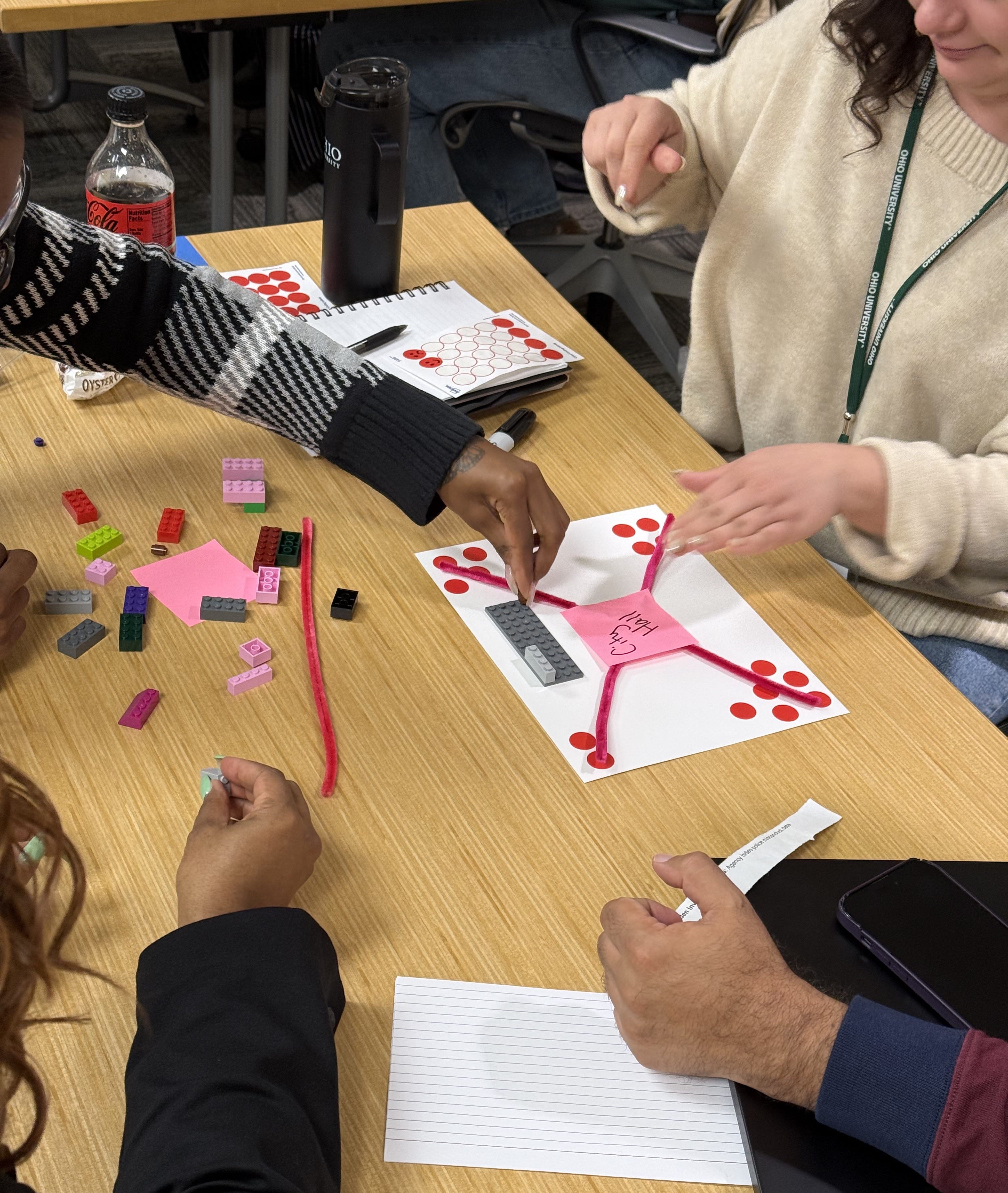
I spent this week at Ohio University as a faculty member for the Kiplinger Fellowship program at the E.W. Scripps School of Journalism. If you’re not familiar with it, the Kiplinger program is one of a handful of nationally prominent journalism fellowships. Since 1973, journalists have competed for slots in a program that brings working newsroom leaders to Athens, Ohio, for an intensive week of workshops, conversations, and the kind of sustained professional development that most of us stopped believing we had time for. Knight Kiplinger, whose family’s generosity makes the program possible, was there most of the week. He was gracious with both his time and his words, and I particularly enjoyed a conversation we had about our shared history at Ottaway Newspapers, even if our tenures there were separated by a few decades.
If you’re tired of journalism that stops at the headline, join us as we figure out how to close the last mile. Get every strategy delivered to your inbox.
I was there representing the American Press Institute. Teaching is core to what we do at API. It always has been. For eighty years, the organization has existed to help newsrooms get better at the work, and direct engagement with working journalists is one of the most important ways we do that. Programs like Kiplinger are exactly where API should be showing up.
This year’s cohort included 31 fellows. I want you to look at this list.
Audra Anderson, managing editor at Cascadia Daily News in Bellingham, Washington. Ann Augherton, managing editor at the Arlington Catholic Herald. Toria Barnhart, deputy editor at The Park Record in Park City. Natasha Barber, managing editor at Star Publications in Sauk Centre, Minnesota. Nicholas Bechtel, assistant news editor at NBC4 in Columbus. Katie Brandt, editor-in-chief of Chicago Health Magazine. Chris Coates, senior director of local news at Lee Enterprises. Meghann Garcia, managing editor of the Uvalde Leader-News. Kenneth Garner, publisher of Garner Media Holdings in Marysville, Missouri. Jeff Gaye, publisher of Respect in Cold Lake, Alberta. Dave Gould, president and CEO of Main Street Media of Tennessee. Christopher Gunty, associate publisher and editor at Catholic Review Media in Baltimore. Ashton Hagen, general manager of the Grant County Herald in Elbow Lake, Minnesota. Matthew T. Hall, deputy editor of investigations at inewsource in San Diego. Faisal Karimi, an exiled Afghan journalist and publisher of Nowruz Media in San Francisco. Tom Lappas, publisher of the Henrico Citizen. Hyuntaek Lee, an independent journalist from South Korea. Julie Makinen, co-founder and board member of the Coachella Valley Journalism Foundation. Jatara McGee, anchor and investigative reporter at WPXI in Pittsburgh. Victor Parkins, publisher of the Mirror-Exchange Media Group in Milan, Tennessee. Geoffrey Plant, editor of the Taos News. Walter Smith Randolph, executive producer of investigations at CBS News New York. Debbie Schimberg, founder and publisher of The Providence Eye. Andy Schotz, editor of The Frederick News-Post. Jen Sieve-Hicks, editor and owner of the Buffalo Bulletin in Buffalo, Wyoming. Elizabeth Stephens, executive editor of the Columbia Missourian and Boone County Journal. Matt Sullivan, chief operating officer of Spotlight Delaware. Becca Tucker, deputy publisher at Straus News. Travis Weik, group editor of the Southern Indiana News Group. Tyra Whitney, news producer at WLS-TV in Chicago. Abel Escudero Zadrayec, founder and director of 8000 in Bahia Blanca, Argentina.
Read it again if you went fast. That list is doing more work than it looks like.
You’ve got a managing editor in Uvalde, a publisher in rural Missouri, an investigative producer at CBS in New York, and a founder running an outlet out of Bahia Blanca. There’s a newspaper owner in Buffalo, Wyoming and an independent journalist from South Korea. Catholic press. Public media veterans. A Lee Enterprises director sitting in the same room as a solo founder in Providence who built her newsroom from scratch.
That range is the point. The problems facing journalism right now are not siloed by format, geography, or business model. And whatever we build next has to work across all of them.
The Workshop
My session was called “The Last Mile: Closing the Gap Between Journalism and Impact.” Regular readers will recognize the framework. The Last Mile is an argument I’ve been developing for months in this newsletter, rooted in a simple observation: journalism has never seriously reckoned with the distance between publication and impact. We publish and assume the work reaches people. It usually doesn’t. Not because the journalism is bad, but because we’ve never treated delivery as a design problem.
I opened with a story from my time at Philly.com. A Saturday when the Inquirer newsroom had an exclusive about a local hospital that had cured a form of blindness in children. Graphics, video, sidebars, the full package. We called in extra staff. We built out pages. And at noon we hit publish.
Nobody read it.
The Phillies, the Flyers, and the Sixers were all playing that afternoon. Our Saturday readers came for sports. A story about curing blindness, with close-up photos of eyes, was not what they were looking for at that moment on that platform. The journalism was excellent. It was also completely irrelevant to the audience we were actually serving that day. That’s not a quality failure. That’s a design failure. And design failures have design solutions.
From there, I introduced the three-part framework that structures the Last Mile argument: Moment, Action, and Channel. The Moment is when the problem hits. Not generally, not eventually. Specifically. The 7 AM headache when “Pete,” your neighbor, is standing in his kitchen trying to figure out why the school bus didn’t come. The Action is the verb. What does Pete need to do? Is he checking, comparing, navigating? If he’s just reading, you’re still in story mode. And the Channel is how the tool reaches him. Not your homepage. Not a story buried on page six. A text message that meets him in his kitchen at 6:45 in the morning.
If an idea doesn’t clear all three, it’s not a tool. It’s just more noise.

The Build
The fellows didn’t just hear the framework. They had to use it.
Each table drew a scenario from what I called the Bucket of Chaos: real community crises stripped down to their operational core. The School Bus Blackout, where routes changed 48 hours before school starts and the district portal is down. The Senior Food Desert, where the only grocery store within walking distance of the senior center just closed. The Water Boil Panic, where an alert went out but nobody knows which blocks are actually affected. The Secret Election, where a polling place is under renovation and no one knows where to vote.
The rules were simple. No articles allowed. You’re building a tool, not writing a story. Prototype the full framework so that Moment, Action, and Channel are all visible. And design for replication, meaning another newsroom in the room could template your solution for their own community.
They had 25 minutes and a resource table full of LEGOs, Post-its, markers, and pipe cleaners. I walked the room, listening for what I call Story Drift, the gravitational pull back toward writing an article instead of building something a person can use. When I heard it, I redirected. What’s the specific moment Pete uses this tool? What does he actually do? How does he get it?

What I Noticed
Here’s what struck me, and it wasn’t in the script.
Every single table built a technology solution. Text alert systems. App-based dashboards. Push notification workflows. Interactive maps with real-time data feeds. These weren’t Silicon Valley product managers. These were editors, publishers, and reporters from newsrooms of every size and description. And yet when asked to solve a community problem, every one of them reached for a phone screen.
An attendee pointed this out to the room and I thought it was an interesting observation. Thirty years ago, I said, if we’d run this same exercise with the same prompts, the solutions would have looked completely different. A phone tree. A flyer inserted into the newspaper. A bulletin board at the library. A partnership with the local radio station to run announcements. Those tools were analog, and they were also effective, because they met people where they actually were.
What changed isn’t just the available technology. What changed is how we think about the problem. Technology has become the default solution set, even for people who spend their careers working in communities where a significant percentage of readers still get their information from print, from church bulletins, from word of mouth at the diner.
That’s not a criticism of the fellows. Their instincts were sound and their builds were sharp. But it revealed something worth sitting with. The Channel in the Last Mile framework is not a platform. It’s not Facebook or an app or a notification system. It’s a conduit. The only question is whether it reaches Pete at the moment he needs it. And sometimes the conduit that closes the last mile is a volunteer with a clipboard knocking on doors at the senior center. Sometimes it’s a laminated card on the counter at the pharmacy. If the problem is that seniors at the community center don’t know where to get groceries, then the laminated card with three phone numbers and a van schedule is the most sophisticated utility tool you can build. It’s not low-tech. It’s the right tech.
The technology default is a form of Story Drift too. Instead of drifting back toward the article, you drift toward the app. Both moves share the same underlying error: designing for the solution you’re comfortable building rather than the problem Pete actually has.
Do you know a newsroom leader who needs to hear the 'laminated card' argument? Forward this to them.
The Accountability Card
The session ended with what I think matters most. Each fellow wrote down a story their newsroom is currently chasing that gets clicks but leaves Pete exactly where he started. A clicky story. Then they wrote down the utility tool they could build instead, using Moment, Action, and Channel.
They wrote it on two cards. Kept one. Handed the other to the person sitting next to them. That person is their accountability partner. The instruction was simple: call them out next week if they didn’t build it.
I don’t know how many of those cards will turn into real tools. Some will. Some won’t. But something happened in that room that I think matters more than any individual prototype.
Whether these fellows worked in television or newspapers, dailies or weeklies, whether they were exiled from Afghanistan or editing a weekly in Buffalo, Wyoming, they all arrived at the same place. The format differences that usually dominate industry conversations fell away. What replaced them was a shared recognition that relevancy isn’t about how good your journalism is. It’s about whether your journalism is useful. And that the distance between content delivery and genuine utility is the gap most newsrooms haven’t yet learned to close.
Thirty-one journalists walked into a room in Athens, Ohio, thinking about their newsrooms. They walked out thinking about Pete.
What’s the 'laminated card' or 'phone tree' equivalent in your community? I’d love to hear how you’re closing the last mile in the comments.
Even strategy practitioners get the details wrong sometimes. Notice an error? Report it here so I can fix it.