

A Quick Disclaimer: Backstory & Strategy is a personal, independent publication. The views, analysis, and commentary expressed here are strictly my own and do not represent the official position, strategy, or endorsement of the American Press Institute, its leadership, or its board. This is my personal space for analyzing the media landscape, testing new frameworks, and thinking out loud.
March, right? You remember when everyone was losing their minds over the Hollywood deepfake? The nightmare scenario everyone kept talking about was some slick, cinematic video so convincing that dropping it at midnight flips a Senate race.
Well, no.
What showed up instead was way cheaper and quicker. Also, a hell of a lot dirtier.
Academia and the think tanks finally realized what campaign operatives knew a long time ago. Research across the last few cycles keeps landing on the exact same reality: synthetic media is a distribution problem, not a generation problem. Making a convincing fake costs pocket change today. Getting it in front of the right voters is where the effort goes.
The Shift Lead: An Election Night WFH Playlist for the Back-Bench

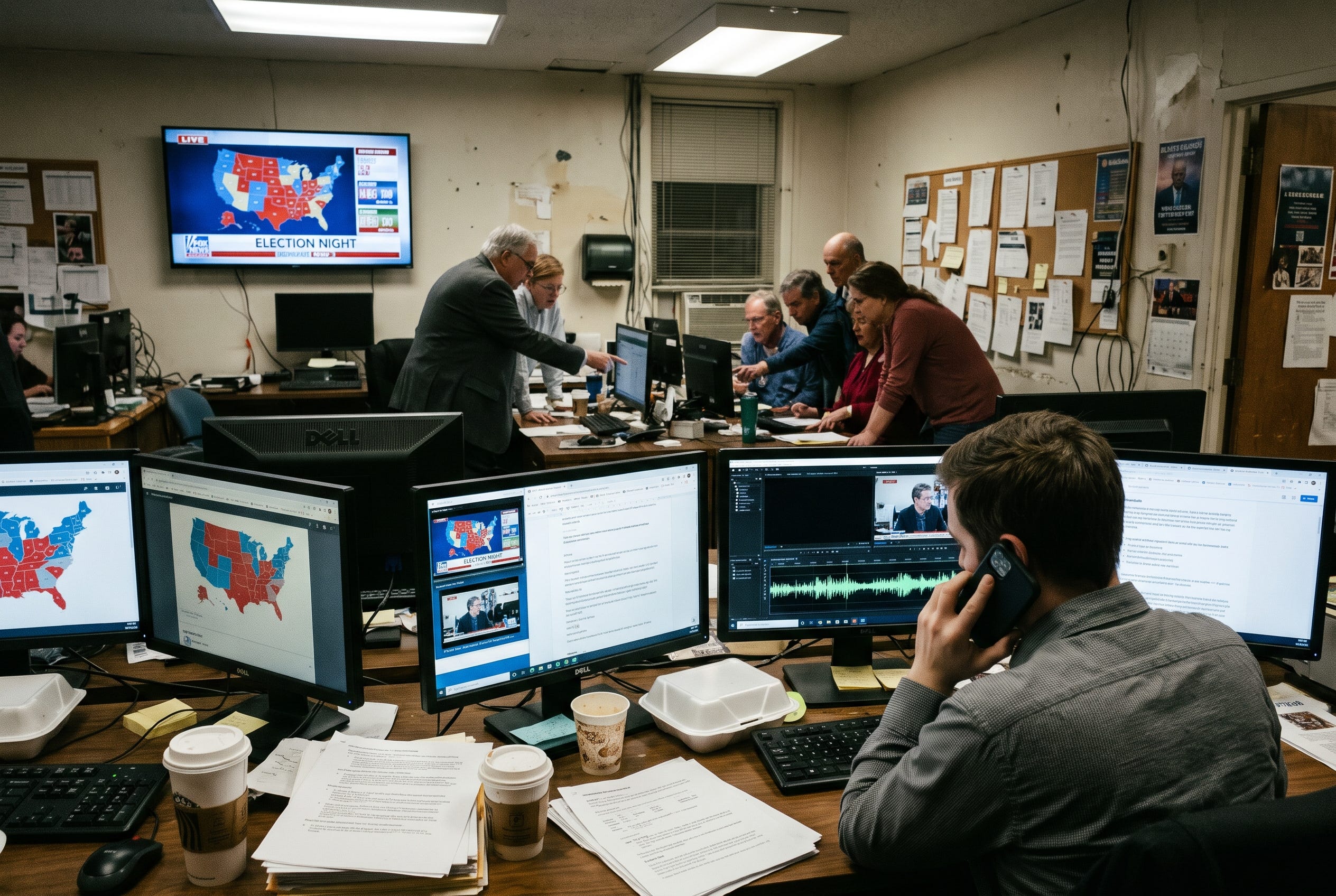
Election night for the remote desk is basically a 20-hour shift in sweatpants with a cold matcha. I made a 26-track playlist for it. Four phases, from morning Slack setup to the 3 AM “refreshing the county clerk site every 8 seconds” stretch. It’s collaborative, so add your survival tracks. What’s your 3 AM song?
Most went for low-visibility, high-friction targets: local Facebook pages, non-English WhatsApp groups, and down-ballot school board races where nobody has a budget and nobody is checking the receipts. But when campaigns got bolder, they went straight for local TV. Right here in Pennsylvania, Republican challenger Stacy Garrity put an AI-generated Josh Shapiro on broadcast airwaves, putting words in the governor’s mouth while the disclaimer didn’t show up until forty-five seconds into the spot. Broadcast stations legally had to air it, and Harrisburg still has no law stopping it. Low visibility or high visibility, with nineteen states still having zero laws on the books for AI campaign ads and Washington completely asleep at the switch, the regulatory guardrails are completely missing.
And the liar’s dividend isn’t just a talking point anymore—it’s become standard campaign tradecraft. As researchers at the Brennan Center and across academia have documented, the threat isn’t just false information fooling voters. It’s that any candidate caught on a hot mic can simply shrug and claim it’s an AI fake. It costs them zero effort, and they get away with it every single time.
Eight months later, we are still missing the basic tools small newsrooms need tonight.
There isn’t a hotline you can call as a local journalist on deadline. There isn’t a pooled defense fund to protect a local news outlet that gets hit with a bad-faith lawsuit for calling out a synthetic campaign ad. And we still haven’t found a plain-English way to explain trust. We have labels and digital watermarks that studies prove humans completely ignore before hitting share anyway. People don’t want an algorithm from a tech company giving them an eighty-percent confidence score. They want a human being looking them in the eye and telling them what’s true.
Meanwhile, the journalism support circuit will spend the next year and a half doing what it always does: talking on panels and building curriculum that can’t keep up with the actual threat.
If you’re running a desk tonight, here are a few things to keep in mind:
Report on how they deployed it. Don’t amplify a dirty tape if you only have two hours until your deadline. How they are distributing the material is just as important as the claim itself.
Get ahead of the liar’s dividend. If you have a real, damaging tape, make sure you have the receipts to prove it’s authentic before you publish. Talk to the people who were physically in the room. There is zero margin for error when a politician cries “AI.”
Speak like a human. If an audio track has no natural room echo, or a voice cuts off mid-breath, just explain that plainly to your readers. Skip the tech jargon.
Talk to the desk next door. If your county is seeing dirty tricks, chances are the next town over is dealing with the exact same op. Pick up the phone and give them a heads-up.
There will be plenty of post-mortems in the morning about turnout models and how the suburbs shifted.
It’s far too late to change anything for the midterms. But remember this: the 2028 presidential cycle starts tomorrow morning. These dirty little local races were just the test run. The operatives using these tactics now have two full years to spread across the country and multiply their budgets by ten.
Tonight, I’ll drink to hoping we finally learn how to build the tools we actually need.
Join the Conversation
Did your newsroom run into cloned robocalls, whisper campaigns on WhatsApp, or candidate denials claiming “that’s an AI audio leak” this cycle?
Drop a comment below with what you ran into on deadline, or hit reply to share your notes from the desk.
Backstory & Strategy is read by newsroom leaders, editors, and media strategists who care about building infrastructure that actually survives contact with reality. If you were forwarded this email, tap below to get every analysis straight to your inbox:
Platforms keep building deepfake protection for reputation at scale, not people at scale, so a school board race in a WhatsApp group gets nothing. The liar's dividend scares me more than the fakes, since 'that's AI' now works on a real tape and costs nothing.