


A Quick Disclaimer: Backstory & Strategy is a personal, independent publication. The views, analysis, and commentary expressed here are strictly my own and do not represent the official position, strategy, or endorsement of the American Press Institute, its leadership, or its board. This is my personal space for analyzing the media landscape, testing new frameworks, and thinking out loud.
The $7 billion that wasn’t
Earlier this week I was staring at a number that made no sense. Morris County, New Jersey, population a little under half a million, was showing $7.2 billion a year in grants paid by private foundations based there. That is more than Cook County, home of the MacArthur Foundation. More than Los Angeles. I know Morris County. It is wealthy. It is not that.
So I pulled the pool apart, foundation by foundation. Three names accounted for 94 percent of it: the Sanofi-Aventis Patient Assistance Foundation, the Novartis Patient Assistance Foundation, and Bayer’s. Their “grants” are free prescription drugs, valued at retail, reported on Form 990-PF as grants paid. The IRS counts that as foundation giving. So does anyone who downloads the IRS file, which is most people who have ever told you how much philanthropic capacity a place has.
Nationally, 61 of these pharmaceutical programs account for about $24 billion of the $122 billion in private-foundation grants in the latest extract. One dollar in five. None of it is money.
I fixed the data. But the exercise left me with the question I had been circling anyway. If you can’t trust the headline figure for how much philanthropic money sits in a place, what do local nonprofit newsrooms actually collect from the places they sit in? Not what foundations give in general. What newsrooms receive.
What 93 newsrooms told the IRS
The field’s main membership directory, INN’s FindYourNews.org, lists 248 U.S. nonprofit newsrooms with a local, regional or statewide scope. Ninety-three of them file a Form 990 with financials. Many of the rest file the postcard version, which carries no numbers at all, and others are fiscally sponsored, which typically means their money runs through a sponsor’s return rather than their own. INN itself sponsors 20 news organizations, and its finance director says as many as 100 members may be fiscally sponsored in total. For each of the 93 I took the line every nonprofit reports, total contributions and grants, for the two most recent years, and averaged them. Then I matched each outlet to its home county: how many households live there, how much the foundations based there give away (after taking the drug programs out), and how much the county’s residents deduct in charitable gifts each year.
That gives you a question you can actually answer. Set against everything this county gives to charity, how much does its local newsroom raise? The 990 doesn’t say where a newsroom’s donors live, so this is a comparison of two totals, not a trace of dollars from one to the other. I matched households to the place a newsroom serves, but the contributions line can’t be traced to a place: an online appeal reaches well beyond the county line, and where a newsroom’s money comes from national funders, the ratio flatters it.
I set aside the outlets that aren’t what a reader pictures when they hear “local newsroom”: the street papers sold by vendors as a homelessness program, public media, the multi-city networks, and the magazines. Where a newsroom covers a town or a city rather than its whole county, I used the households in the place it actually serves: Evanston, not Cook County; Chicago, not Cook County; New Bedford, not Bristol County. Then I set aside the dozen whose service areas are under 25,000 households, because a per-household number in a town of 6,000 says more about the map than the money; I’ll come back to them, because they turn out to matter. That leaves 40 local newsrooms, which is where the rest of this piece lives. Two things to carry with you: the IRS only sees newsrooms big enough to file, so the smallest and newest outlets, the ones raising the least, are not here; and the statewide outlets are set aside because a county frame makes no sense for them. Both mean the numbers below are the optimistic version. The details are at the end.
The median one raises $2.28 per household in the place it serves, per year. The top tenth raise more than about $15. The Baltimore Banner raises $61.59, which is not the top of a distribution; it is a different phenomenon, and I’ll come back to it.
Measured against the county’s foundation pool, the median newsroom collects a quarter of one percent. The 90th percentile collects five percent. Add in what residents give to charity and the median falls to about a tenth of a percent. Where a county hosts more than one of these newsrooms, I summed them, so no metro is penalized for having several newsrooms. It doesn’t change the picture.
Take Cook County. Its six local nonprofit newsrooms together raise about $7.6 million, which is $3.62 per household and three-tenths of a percent of the county’s foundation pool. Cook County households deduct $3.8 billion a year in charitable gifts. All six newsrooms combined collect two-tenths of a percent of it.
The median newsroom in the sample raised about $754,000. That is roughly a six- or seven-person operation in most of the country, and it is the middle of the field, not the bottom. And it is not a case of earned-revenue businesses looking like weak fundraisers: for the median outlet, contributions are 95 percent of total revenue. A few at the low end do run mostly on sponsorship and events, and counting every dollar they bring in moves them up the list, but none of them past $2 per household.
Foundation money doesn’t predict what newsrooms raise
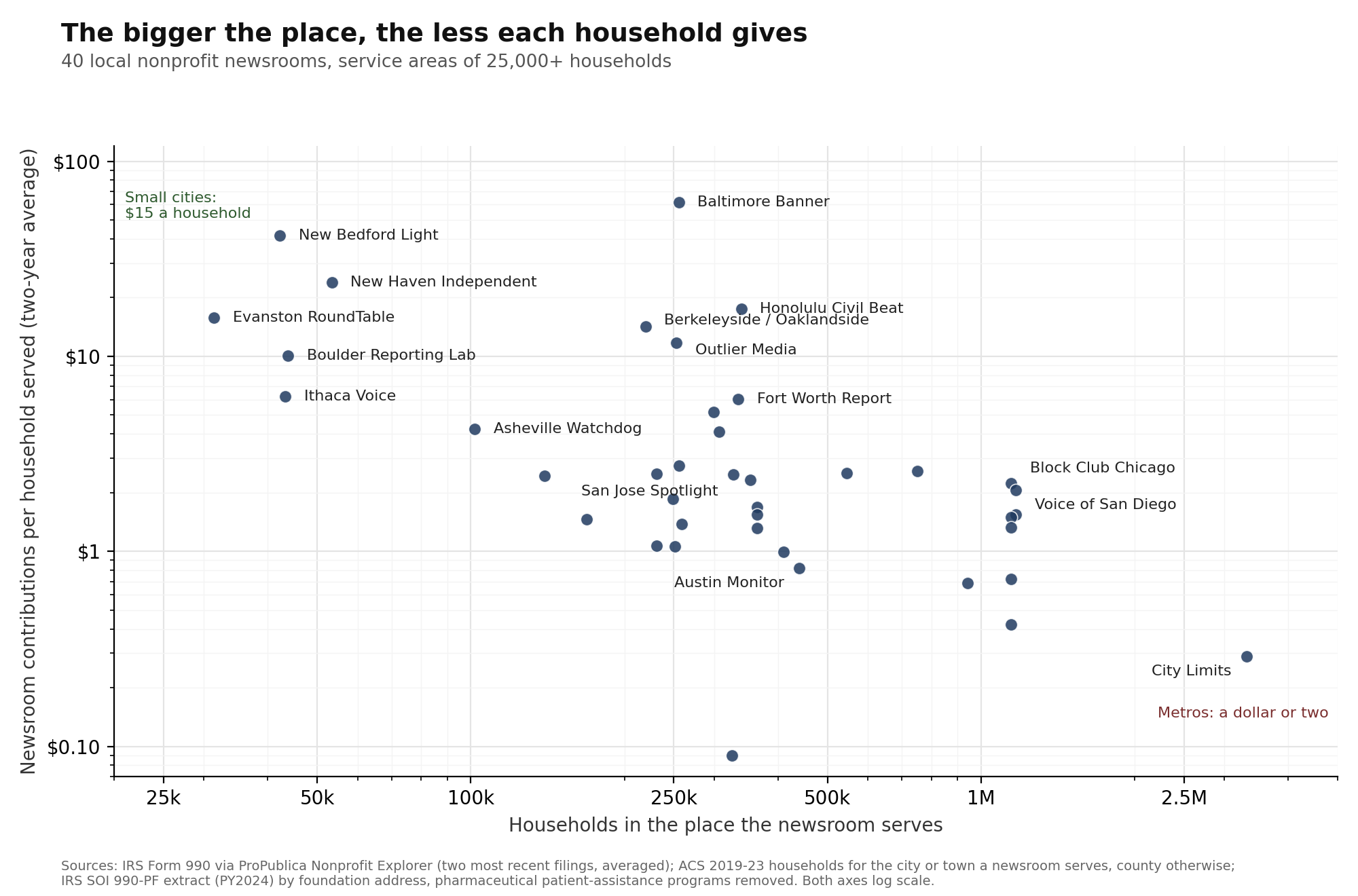
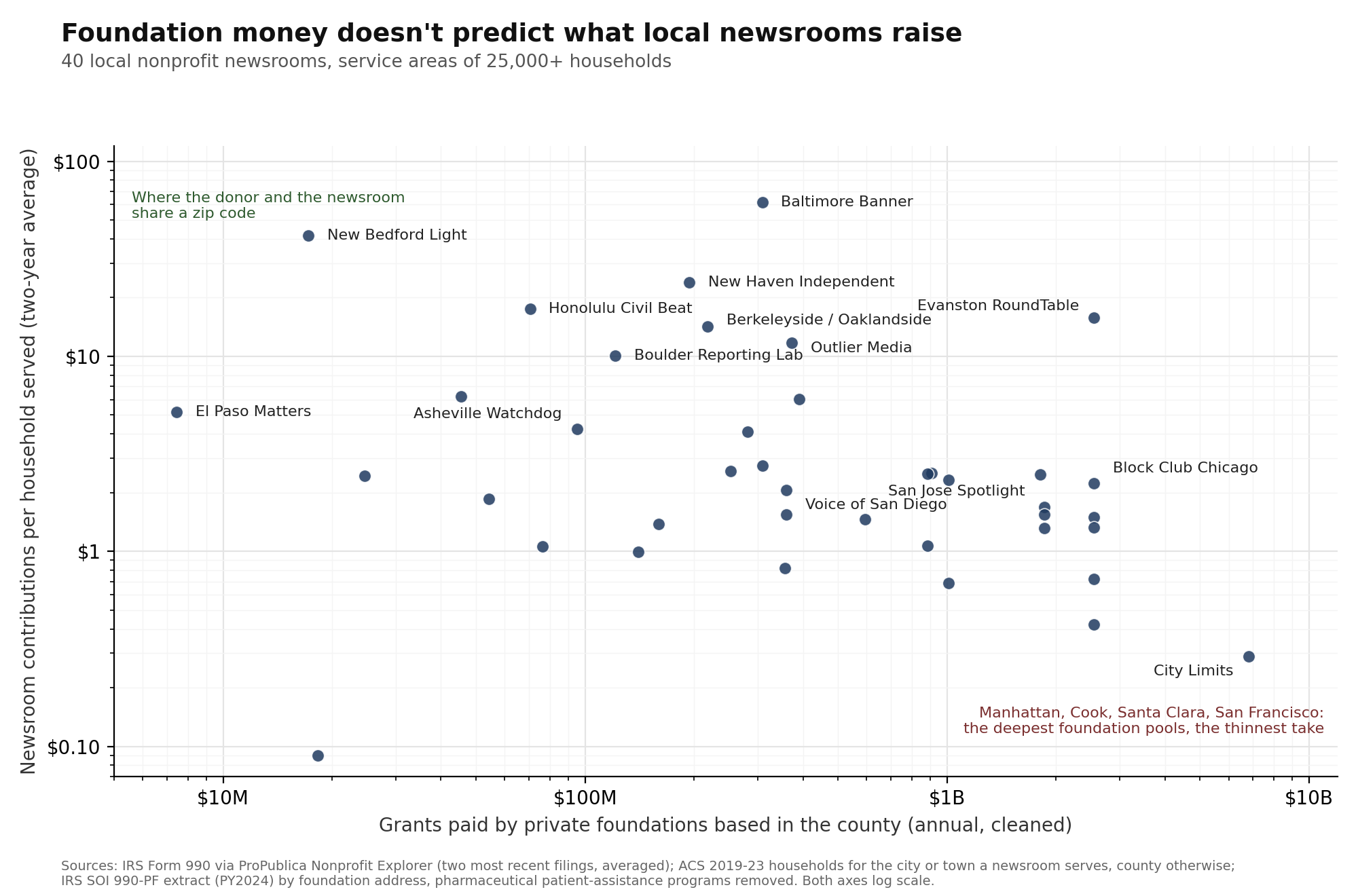
Here is the finding I did not expect. The size of a county’s foundation pool tells you almost nothing about what its newsrooms raise. What does predict it is the size of the place the newsroom serves, and the relationship runs backward: the bigger the place, the less each household gives. Newsrooms serving 25,000 to 100,000 households raise a median $15.81 per household. Those serving 100,000 to 400,000 raise $2.45. Those serving more than 400,000 raise $1.33. An order of magnitude, from small city to metro. Newsrooms do not scale with their markets; a newsroom in a city of a million households raises more dollars than one in a city of 50,000, but nowhere near twenty times more.
City Limits covers all five boroughs of New York, 3.3 million households, in the county with the largest foundation pool in the United States even after you strip the drug programs out: $6.8 billion a year. It raises 29 cents per household. Block Club Chicago raises $2.23 per household across Chicago’s 1.15 million, against a $2.5 billion county pool. San José Spotlight raises $2.47 in a city that sits in $1.8 billion of foundation giving and houses a fair share of the people who made it. Voice of San Diego and inewsource together raise $3.60 across San Diego County. Those four counties hold a tenth of all private-foundation grant dollars in the country. Their local newsrooms are a rounding error on that money.
Now look at the other end. The New Bedford Light, launched in 2021, raises $41.51 per household in New Bedford. The New Haven Independent raises $23.96. Honolulu Civil Beat raises $17.48 in a county whose foundation pool is one percent of Manhattan’s. Evanston RoundTable raises $15.81. Asheville Watchdog raises $4.24 in Buncombe County, three times what the Chicago outlets manage. And the dozen town-level newsrooms I set aside from the statistics make the point louder than anything in them: Lexington Observer raises about $141 per household in Lexington, Massachusetts; Aspen Journalism $50; Charlottesville Tomorrow $42; Montclair Local $32; Ipswich Local News $23.
The foundations in those counties give nationally; what they fund near home is a line item on their books and the whole budget of a newsroom. Meanwhile the places where newsrooms raise real money per household are places where the donor and the newsroom share a zip code, and often a dinner table. The pool is a measure of where wealth incorporates. It is not a measure of where it gives. And it misses the most local giving there is, by design: community foundations and donor-advised funds are public charities, not private foundations, so a gift that passes through one never appears on a 990-PF at all. The Omidyar money behind Civil Beat shows up in no foundation pool anywhere. The pool is biased toward national money and away from the dollars that fund newsrooms like these, which makes the finding stronger, not weaker.
The News Revenue Hub, which runs membership programs for dozens of these newsrooms, arrived at the same place from the other direction. Its audience research found that market median income predicts member revenue, especially for nonprofit newsrooms: wealthier places give more. Household wealth predicts giving. The foundation pool does not. Put those together and the statement is simple: the money is where people live and have means, not where foundations file. The Hub’s benchmarks also say something about why the per-household numbers are so low. Across its local clients, each additional 100 email subscribers was worth about $102 a month in member revenue, and its rule of thumb is that every email address is worth about $10 a year in donations. Newsrooms that ask do convert. The median newsroom isn’t failing to convert its list. It doesn’t have the list.
What the outliers have in common
Everyone cites the Banner. Fifteen million dollars in contributions, a newsroom bigger than most metro dailies, in a city of 255,000 households. It is the example people reach for when they want to argue that philanthropy can rebuild local news, and it is a terrible example, because there is one of it. The Banner exists because Stewart Bainum Jr., a Maryland hotel magnate, pledged $50 million to create it in 2021 and has kept writing checks since; by this spring his institute had enough left over to buy the Pittsburgh Post-Gazette. The filing in my data predates Pittsburgh. That is not a model. It is a patron.
But look at who sits behind the Banner on the per-household list, and a pattern shows up that is a model. Charlottesville Tomorrow was founded in 2005 by two local businessmen who wanted a website about land use, and the American Journalism Project now describes it, in its own grantee profile, as “20 years of locally funded news”; its longtime director told CJR that an overwhelming majority of its gifts come from local sources. Aspen Journalism lives in a county with 9,000 households and more second homes than first ones. Civil Beat was launched by Pierre Omidyar, who lives in Hawaii, and his support arrives through a donor-advised fund at the Hawaiʻi Community Foundation, which is to say through the most local giving vehicle there is. The New Bedford Light was started in 2021 by a small group of residents, among them a retired editor of the Standard-Times, who were tired of what Gannett had done to their paper; within two years it had more than a thousand donors. The 990 doesn’t show where a donor lives, so I can’t prove this from the filings. But the public record of each launch tells the same story: the money came from someone whose name is already on the hospital wing or the library, and the ask came from someone they knew.
What these places do not have in common is a large foundation pool. Pitkin County’s is $27 million. Charlottesville’s is $59 million. Honolulu’s is $70 million. Small pools, high capture, because the giving is personal and the newsroom is close enough to be asked for by name.
The data can’t see inside a newsroom. I spent seven years inside one. At Lehigh Valley Public Media, every time I talked about margins or revenue, someone in the newsroom would ask, reasonably, why a nonprofit needs to make money. And every time, the board’s answer was the same four words: no money, no mission. Both of them were right. The room between those two sentences is where a development function is supposed to live.
In most newsrooms I have known, it is an empty chair.
Whose chair
The obvious answer is that the chair belongs to the board. In most of the nonprofit world, that is where fundraising starts: a give-or-get expectation, a trustee who hosts the dinner, a name that gets the meeting. Journalism nonprofits tend to recruit boards for something else. Ours at Lehigh Valley Public Media was, with a few exceptions, not a fundraising board; most members rarely gave in any meaningful way. Across the Lehigh Valley, I knew nonprofits whose board members gave ten thousand dollars a year and up, and understood that to be part of the seat. That is not a criticism of the people. A board that was recruited to advise on governance, to watch the fiduciary line, to lend a marketing eye, was told what its job was, and asking it to become a board of donors and askers midstream is a conversation with its own complications. Some members will leave rather than write the check, and some of those are the ones you can least afford to lose. But a newsroom with no development staff and a board that does not give has nobody whose job is to ask, and I suspect that describes a good many of these 40 newsrooms.
The stewardship signal
Two more numbers, and they are the ones that should worry anybody running one of these organizations.
First, concentration. Five of these 40 outlets account for half of all the contributions among them. The Institute for Nonprofit News’s annual Index has reported the same skew among its largest members for years; what the county frame adds is that the concentration is geographic as well as organizational. The field’s philanthropy story is really five organizations’ philanthropy story, and the other 35 are dividing what’s left.
Second, volatility. Thirty-three of the 40 have two years of filings. In about half of them, contributions fell from one year to the next. In roughly one of four, they fell by more than 20 percent. A 20 percent swing at a $600,000 newsroom is one grant. It arrived, or it did not. Some of that is accounting; a multi-year grant is booked in the year it’s pledged, so a big year is often followed by a thin one on paper. Some of it is real. The donor list itself is private, so I can’t tell you which, but I can tell you what the pattern looks like from the outside: a funding base built on a handful of institutional renewals, where a single foundation’s program officer changing jobs is a budget event.
The newest edition of that Index, out this summer, adds the piece the 990s can’t show. Individual giving across the field is plateauing even as total revenue grows, and the average major gift, about $32,000, is nearly 300 times the average small donation of $110. So the concentration isn’t only across organizations, with five outlets holding half the money. It’s inside each one, where a handful of major donors hold most of the base. Lose one and the year moves.
The tried and true funders are tried and true for a reason. They have been generous, and they have been patient. They are also the same twenty names on every newsroom’s donor page, and when one of them cycles out of local news, as they do, every newsroom on that page has the same bad year at the same time. That is not a diversified base. It is a shared dependency with good branding.
So yes, the field needs to get better at stewardship. But the data points somewhere more specific than that. The money that is not being raised is not sitting at another national foundation. It is sitting in the county, with people who have never been asked.
Fund the ask
Here is what the gap is worth. The 40 newsrooms in this sample raise $61 million a year between them. Their counties give $55 billion a year to charity. If every county that sits below today’s median capture rate merely reached the median, about a tenth of a percent, these newsrooms would collectively raise $34 million more. If every county below the 75th percentile reached it, a quarter of a percent, they would raise $85 million more, bringing the total to nearly two and a half times what they raise today. No new donors need to exist for that. No foundation needs to change its priorities. The 75th percentile isn’t an aspiration; a quarter of these counties are already there.
The constraint is not generosity. The median county in this sample has hundreds of millions of dollars a year in itemized charitable giving, and the newsroom collects a tenth of a percent of it. The constraint is capacity. A four-person newsroom has nobody whose job is to ask. And every staffing model I have ever built, including the one I use now, says the same thing: the organization cannot afford a dedicated development hire until it is two or three times that size. Some get there sooner by folding the job into a combined marketing-and-development role. Voice of OC, on a budget that has long hovered in the mid-six figures, has had one since 2022. But a combined role is a start, not a function. You need the person to raise the money to afford the person. That is the trap, and it is structural, not a failure of effort.
Four ways out, none of them new, all of them more defensible now that there are numbers.
For funders: fund the ask, not the output. The know-how already exists. The American Journalism Project has financed business-side and revenue capacity rather than content since 2019, and several of the stronger outlets in this sample are its grantees. The field’s support organizations run NewsMatch, the largest collective fundraising campaign in nonprofit news, and train newsrooms to ask. INN’s own account of three newsrooms that have taken part since the start, published October 23, shows what the ask looks like from inside: one calls the match an extra rather than make-or-break, and Voice of OC has secured 15 local matches over five years, mostly from about 70 donors who give $1,000 or more. The match is part of the value. The habit of asking, and finding the people who can give more, is the rest. The News Revenue Hub runs the membership machinery for dozens more, keeps a subsidy fund for newsrooms that can’t pay for it, and says it is expanding its major-donor and stewardship support this year. What’s scarce is not the expertise. It’s the money for a four-person newsroom to use it, and AJP’s portfolio is a few dozen organizations in a field of more than 400 nonprofit newsrooms. A three-year grant for a development director is the cleanest sunset grant in journalism: when it ends, it leaves behind a donor base the newsroom owns, which is more than most program grants leave behind. It also has a payback period you can write down. At the Hub’s benchmark of ten dollars a year per email address, a $70,000 revenue lead breaks even on 7,000 addresses; at the Index’s average major gift of $32,000, on two or three. For a newsroom with a list and a board that opens doors, that is a year-two outcome, and a funder can hold the grantee to it. I argued in Fund Depth, Not Gaps that funders should finance what a newsroom is already good at. This is the exception that proves it: the one thing almost no small newsroom is good at, and the one investment that compounds.
For the support organizations and the regional funders: share the function. A single development professional serving five or six newsrooms in a region is an old idea in public media and a rare one in nonprofit news. Shared training exists, from INN’s major gifts cohort to its office hours; a shared staffer who knows the local donors is a different thing. The economics work the way shared back-office services work anywhere. The relationships are local; the infrastructure doesn’t have to be.
For the newsrooms: count your funders. The median county in this sample has 364,000 households and $623 million a year in charitable giving. A tenth of a percent of that is $623,000, which is roughly what the median newsroom raises. Half a percent is $3.1 million, which is a thirty-person newsroom. The difference between those two numbers is not the county’s generosity. It is whether anyone is asking. So count your funders. If you can name every one of them from memory, you don’t have a fundraising problem, you have a concentration problem, and the fix is not a better pitch to the names you already know. The next funder is not on the national list. The next funder lives in your county, reads you, and is waiting to be asked by someone who knows their name.
For policymakers: make the ask eligible. The journalist tax credits moving through statehouses count newsroom employees and not the person who raises the money to pay them. If the ask is the binding constraint, a credit that covers one development hire per newsroom is the public-policy version of everything above, at a fraction of the cost of the reporter credits, and it leaves behind something the reporter credits don’t: a donor base that outlasts the credit.
The money is local. The ask isn’t. That is the whole gap, and it is closable.
How I did this, and what it can’t tell you
The newsrooms come from the Institute for Nonprofit News’s public member directory, limited to U.S. members with a local, regional or statewide scope. I used it because it is the most complete list of nonprofit newsrooms that exists, and because, as the next paragraphs explain, it is where the IRS filings are. Their financials come from IRS Form 990 as published by ProPublica’s Nonprofit Explorer, the two most recent filings for each, averaged. Household counts are the Census Bureau’s: ACS 2019-2023 for the place a newsroom serves where that is a defined city or town smaller than its county, and ACS 2020-2024 for the county otherwise; the 25 service-area assignments are listed in the repo. The other county figures are private-foundation grants paid from the IRS 990-PF extract for 2024, assigned to the county where the foundation is based (community foundations and donor-advised funds are public charities and are not in that file, so the pool understates local giving), and itemized charitable deductions from the IRS county income-tax file for 2023. The pharmaceutical patient-assistance programs described at the top were removed from the foundation figures, along with one trust that was double-counting its own foundation. The full table, with every outlet and every county figure, is here.
A word on who is missing. The 28 statewide outlets in that directory, CalMatters, the Texas Tribune, Spotlight PA, Mississippi Today and the rest, are not in these numbers, because a county frame makes no sense for them. Mississippi Today raises roughly twice the entire foundation pool of the county it sits in, which is a fact about statewide donors and a capital city, not about Hinds County. They are a different business, and they deserve their own piece.
Readers will also ask why that directory and not, say, the Tiny News Collective’s or LION’s. I checked. Of the 99 outlets on the Tiny News Collective’s member list, 81 have no IRS record under their own name, 13 have an EIN but have filed only the postcard version of the 990 that carries no financials, and exactly one has a full return showing contributions as a local newsroom. That isn’t a gap in the Collective. It is how fiscal sponsorship usually works. An established nonprofit holds a newer one’s money and, in the most common arrangement, files for it. So their philanthropy sits on the Collective’s own 2023 return, $1.9 million in contributions spread across roughly a hundred outlets, or about $19,000 apiece. The 51st, the most talked-about of them, was incorporated in 2024 and has filed one postcard; its first real numbers won’t be public until late this year. LION’s members are mostly for-profit, and its nonprofits are largely the same organizations. The IRS can see the newsrooms that have survived long enough to file. The ones it can’t see are the ones raising the least, which means every median in this piece is an optimistic one.
Five things the data can’t tell you. The county is the one the outlet’s IRS filing lists as its mailing address, and the service area is my assignment of the place it covers; Chicago’s neighborhood outlets are assigned the whole city, which overstates their denominators. The contributions line includes everything an outlet received, including national foundation money, government grants, and the odd bequest, so “local capture” here is an upper bound; the true local share is lower. The sample is directory members with 990 financials, so it skews toward outlets above about $50,000 in revenue; the ones too small to appear are, almost by definition, raising the least. INN itself fiscally sponsors 20 news organizations, and its finance director says as many as 100 members may be fiscally sponsored in total. Depending on the arrangement, a sponsored outlet’s contributions may run through the sponsor’s filing rather than the outlet’s, so some members, possibly a good many, are missing from the sample, and a few that recently began filing on their own show a thin first year; where a newsroom’s contributions look implausibly small next to its revenue, that is the likely reason. And this is a census of survivors. Houston Landing is not in it.
Two earlier pieces of work sit next to this one. The Institute’s annual Index reports revenue concentration among its largest members, from the members’ own surveys. Researchers at UNC’s Center for Innovation and Sustainability in Local Media mapped where local-news philanthropy lands by county, which is the recipient side of the question I’m asking from the donor side. Neither put a newsroom’s take against its own county’s giving, which is the number I wanted.
If you run one of these newsrooms and your numbers tell a different story, I’d like to hear it.