


A Quick Disclaimer: Backstory & Strategy is a personal, independent publication. The views, analysis, and commentary expressed here are strictly my own and do not represent the official position, strategy, or endorsement of the American Press Institute, its leadership, or its board. This is my personal space for analyzing the media landscape, testing new frameworks, and thinking out loud.
Don’t judge a newsroom by how it covers a hurricane, or a school shooting. Crisis coverage gets a pass. Nobody plans for chaos, and improvising under pressure is forgivable.
Judge it by back-to-school instead.
You know exactly what’s coming. Same time every year, same audience, same list of decisions down to the letter: What’s the schedule? What does my kid need? How do they get to school? What do I need to sign, pay, or show up for? There’s no “we didn’t see it coming” available here. You get twelve months of lead time, and you’ve run this exact play a dozen times before.
That’s exactly why it’s the perfect place to check the industry’s instincts. So I went looking. A consultant’s newsletter that landed in my inbox last week, a trade association’s evergreen idea list from 2018, and the wire-syndication model itself. What I found was the same failure at three different altitudes of the business, and it wasn’t laziness or a skills gap. It was a pattern in what the industry considers a good idea in the first place.
I’ve been building a framework for this over the past year, most recently in a Kiplinger Fellows workshop called “The Last Mile.” It’s simple. For journalism to actually change what a reader does, it needs a Moment, the specific instant a decision has to get made. An Action, something concrete the reader can do with what you handed them. And a Channel to reach them at the moment, not after it. Miss a leg and you’ve made content. Hit all three and you’ve made a tool.
Back-to-school coverage, almost everywhere, is missing at least two of the three.
Here’s why. This time every year, in newsrooms across the country, an editor stands up in the morning budget meeting and asks the same question: anyone got anything new for back-to-school? Nine times out of ten, somebody pulls up last year’s list, swaps the dates, and calls it done. Not because anyone’s lazy, and not because the idea’s bad. There’s a school board meeting to cover tonight and a council budget vote tomorrow, and reworking a seasonal package isn’t where the day’s spare fifteen minutes are going. I know this pattern cold. I sat in that chair for years, and “anyone got anything new” is a sentence I said out loud most Augusts, right before somebody handed me the same list from the year before.
It doesn’t help that education reporters are a disappearing breed. Walk into a lot of midsize newsrooms today and the education beat, if it still exists as its own line at all, is one reporter juggling three districts on top of a general-assignment rotation. Budget cuts did that, the same way they’ve hollowed out statehouse and courts coverage. Which is its own kind of irony, because education is one of the only beats that doesn’t respect a coverage boundary. Most local news lives and dies on a specific street or neighborhood. Education is something almost everybody has a stake in, whether their kid started kindergarten last week or graduated twenty years ago. You’d think that would make the beat easier to defend at budget time, not harder to staff.
If this kind of thing is useful to you, subscribe. Backstory & Strategy goes out most Tuesdays and Thursdays, on journalism economics and media strategy, no fluff, no filler, just the stuff I’d want someone to tell me if I were still running a newsroom.
Exhibit A: The consultant’s playbook
A newsletter landed in my inbox from David Arkin, a well-regarded digital media consultant, with three ideas for back-to-school coverage. He mentioned, almost in passing, that his own kids in Texas were starting school in a matter of days, one of them beginning her senior year. Then came the playbook: turn school calendars into a string of stories, long breaks, homecoming, graduations, sports schedules. Build a standing page for every school in your coverage area. Chase content partnerships with local districts, things like Student of the Month, Teacher of the Month, a recurring superintendent column.
None of it’s bad advice. It’s smart SEO thinking, and a genuinely good way to build durable relationships with the district. But look at what it’s actually optimizing for: discoverability, search traffic. You’re standing in the pickup line wondering if Thursday’s an early dismissal, and what you get is a story with a link back to the calendar. That’s one click removed from the answer, dressed up as content. The Action here is “read about the schedule,” not “know what to do about the schedule.” Those tag pages are an archive of what’s been published, not a tool for what you actually need to decide.
Good tactics. Wrong question.
Exhibit B: The industry’s own idea bank
Back in 2018, the Local Media Association published a list from Lindsey Estes titled “8 Story Ideas and Features for Your Back-to-School Coverage.” It’s aged almost perfectly, which is itself the point. Eight years, and nothing meaningful has shifted.
The eight ideas: school district data management, school-shooting preparedness, student-athletes self-promoting for scholarships, teacher hiring trends, emotional-support animals on campus, a nostalgic look back at shopping costs, a staff photo gallery, and eighteen suggested questions to ask on back-to-school night.
That’s a solid trend-and-feature package. It’s also almost entirely Moment-free. Half of these could run in March with a word swap and nobody would notice. The one that gets close, those eighteen questions, still misses Channel, because the same generic list handed to every parent everywhere isn’t the same as telling you what’s actually different at your kid’s school this year.
A trade association’s own idea bank is a decent proxy for what the whole field thinks a good back-to-school story looks like. And the whole field is still answering “what can we publish” instead of “what does the reader need to do.”
Exhibit C: The syndicated wire model
Then there’s the national layer. AP alone moves copy into more than a thousand member newsrooms. By construction, that copy has to be generic enough for all of them to drop onto a page as-is. Great for reach. But it’s also a wall, because national syndication can’t know your specific family’s bus route, or your specific district’s paperwork deadline. Scale and utility are in direct tension, and utility almost always lives at the hyper-local level, exactly where the wire model isn’t built to go.
Widest-angle version of the same failure. And it’s probably the one your own newsroom is unknowingly leaning on to fill the gap when nobody has time to build something local.
The pattern, not the excuse
Line these three up and you get an uncomfortable escalation:
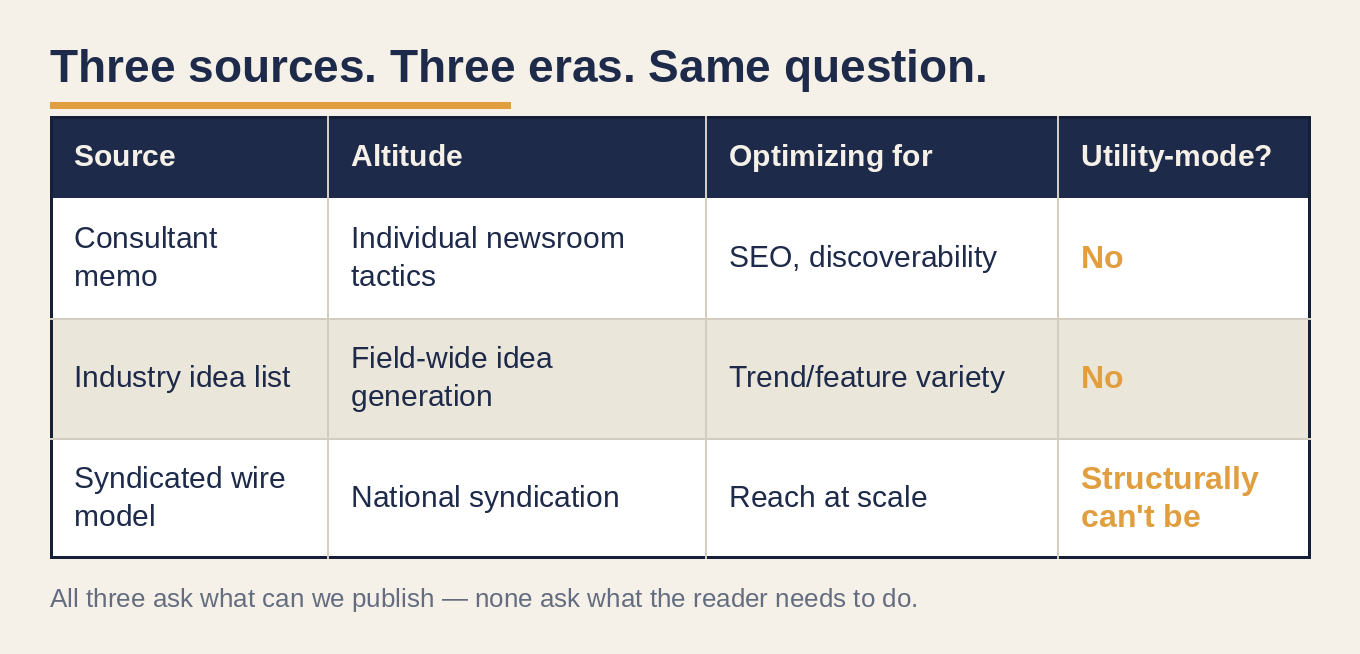
Three sources. Three eras, eight years and one newsletter cycle apart. Three completely different reasons to think about back-to-school coverage. All three ask the same question: what can we publish about school starting again? None of them ask what you, the parent, need to do this week, and how to put it directly in front of you.
That’s the real finding, and I say this having sat through plenty of budget meetings on the other side of it: this isn’t about any of these three being bad at their jobs. Arkin’s tactics are sound, Estes’s list is a fair feature package, and the wire model is a legitimate response to running at scale. The problem sits one level up. “What can we publish” is the default operating question of the industry’s entire idea-generation apparatus, from the consultant level to the trade-association level to the wire-service level. Utility isn’t a style choice you bolt on at the end. It’s a different question you ask at the start, usually in that same budget meeting, before anyone’s pulled up last year’s list.
And it’s not just an editorial preference. It’s a business one. A story you read once and never need again is a single pageview that decays the moment school starts. A tool you actually use, a bus lookup, a supply-price tracker, a deadline checklist, is something you come back to, bookmark, open again next year. One’s a spike. The other’s a habit. Habits are what zero-party data, newsletter sign-ups, and subscription intent are actually built on. Telling is a transaction. Helping is a relationship.
Here’s the sharper version of that point. A standard back-to-school roundup almost never converts a casual, one-time reader into anything. A tool does. “Get a text when your kid’s bus route changes” is a reason to hand over a phone number that “here’s our back-to-school roundup” simply isn’t. Utility isn’t just stickier. It’s the thing that actually earns the contact info local news has been chasing for a decade.
Speaking of utility over telling: I built NewsGrade to do exactly what this piece is arguing for, but for your own site instead of somebody else’s back-to-school coverage. Run your homepage through it and get a real, specific readout on how AI crawlers, licensing signals, and content structure treat your work, not a generic checklist. It’s pay-what-you-wish, including $0, so there’s no reason not to see where you stand.
What the utility version actually looks like
Run the same territory through Moment, Action, Channel, and the shape changes completely.
The supply-list scramble. Moment: the list comes home the week before school, $180 spread across three stores, because it always is. Action: compare prices, substitute, find what’s already in the junk drawer. Channel: a text alert when the dollar store restocks, or a “supplies” segment in your existing morning newsletter. Not a story about rising costs.
The bus-route reshuffle. Moment: routes change every August, and half of parents don’t find out until a kid’s standing at the wrong corner at 7 a.m. Action: look up your stop. Channel: a push notification or a text sent the week before school starts. Not a PDF buried three clicks deep on the district site.
The paperwork cliff. Moment: immunization records, free and reduced lunch forms, enrollment deadlines, all landing the same week, usually the week everyone’s also trying to buy shoes. Action: check off what’s due for your kid’s grade. Channel: an email reminder timed to the actual deadline. Not a listicle published once in July and forgotten.
None of this is exotic. It’s the same reporting, the same relationships, the same institutional knowledge you already have, just pointed at a different question. The Moment is already sitting there, fully predictable, twelve months out. The only thing missing is the discipline to ask what the reader does with what you give them, instead of what they read.
How to actually build one
This is usually where a piece like this stops: right idea, no path to Monday morning. So here’s the path.
The method. Take a story you’re already planning to run and ask three questions, in order.
What decision is the reader trying to make when they read this? No decision, no Moment, just information. That’s fine, but it’s not this.
What would it look like if the reader did the thing instead of read about the thing? Compare instead of learn about prices. Look up instead of read about a route. Check off instead of read about a deadline.
Could that “doing” happen right on the page? If yes, you don’t need a developer or a six-week project. You need to change what you’re building, not add a second thing to build.
That’s the whole translation, and it works on almost any evergreen or seasonal story, not just this one.
What it actually takes, by example.
Take the supply-price tracker. It’s a spreadsheet with a form on top. Google Sheets plus a free tool, Glide, Softr, even a plain Google Form feeding a public sheet, gets you a working version in an afternoon. No developer, no budget line. The reporting is the same legwork the “shopping costs” story already required. You’re just pricing items at three stores instead of writing three paragraphs about it.
The bus-route lookup is the one that benefits most from AI-assisted building right now. Feed a district’s route PDF or spreadsheet into an AI coding tool, describe what you want in plain language, test it, ask for fixes the same way. A few hours, not a few weeks. Used to need a developer. Increasingly doesn’t.
And the deadline checklist is closer to a smart newsletter segment than a standalone tool. A parent picks their school and grade, gets back a short, specific list with dates. Same no-code stack as the price tracker.
No product team required. Just the smallest version, shipped, and treated like the recurring feature it already is, refreshed every August, same as the calendar story.
If you can’t clear that bar on the single most scheduled, least chaotic event of your entire year, it’s worth asking what that says about how you’re covering everything else.
If your newsroom is already doing something closer to the second column than the first, I’d genuinely love to hear about it. That’s the harder story to find. Reply and tell me what you built.
If you know an editor who's about to greenlight another back-to-school roundup, do them a favor and send this their way. Sometimes the best pitch you can make in a budget meeting is someone else's argument.
Really interesting analysis, and IMHO it highlights the difference between the legacy organizations that are fighting to perpetuate an obsolete model with poor product/market fit and new entrants. MendoLocal.News doesn't do "back to school" stories. We are too busy covering real news, including education news. I like your product idea, but the first product is real news reporting.
The challenge is your asking a leopard to change its spots. You’re asking news organizations to become software organizations, and that requires fundamentally different skill sets, roles, economic models etc.
Rather than expect local publishers to build tools, the bigger opportunity is probably for software companies to build software that can be leveraged locally vs a thousand publications all building ad Hoc crud.
Agree with your position wholeheartedly, just don’t think the ask is that realistic.