
The Platform Is the Exposure
What the FTC’s latest workshop reveals about the hidden legal risks of renting your journalism infrastructure.

When the Federal Trade Commission announced a July workshop titled “The Dangers of Gender-Affirming Care for Minors,” most of the journalism conversation focused on the obvious: what it signals about the Trump administration’s posture toward trans coverage, which outlets might face scrutiny, and whether the agency could actually reach editorial content. Those are real questions. They are also the wrong ones to be asking.
The more durable question is structural. And it doesn’t require you to have any opinion about gender medicine at all.
Here it is: creator journalists built businesses on infrastructure they do not own, with legal exposure they did not map, on the assumption that platform neutrality was a permanent condition. That assumption is now being tested. What the FTC’s move actually demonstrates is not the danger of covering any particular subject. It is the danger of confusing your distribution platform with your business foundation.
Enjoying this deep dive? Support independent media strategy by subscribing.
The Revenue Cut Is the Hook
Substack charges writers a 10 percent cut of paid subscription revenue. That fact, unremarkable when you are thinking about it as a transaction fee, looks quite different when a federal agency is scanning for commercial actors with a financial stake in the content they host.
The Federal Trade Commission Act gives the agency broad authority to pursue unfair or deceptive practices “in or affecting commerce.” The standard is elastic. The agency has stretched it before, against social platforms, against health supplement advertisers, against influencers who failed to disclose paid relationships. The legal theory doesn’t require that Substack wrote anything. It requires that Substack profited from it.
FTC Chair Andrew Ferguson has signaled clearly that he sees his mandate extending well beyond medical providers. An internal memo obtained by The Daily Wire refers to “doctors, therapists, hospitals, and others” as potential targets. That word “others” is load-bearing. It is an invitation to expand the perimeter.
A revenue-sharing arrangement is what puts Substack inside that perimeter. A neutral utility charges a flat fee to move content from one place to another. It has no stake in what the content says or whether it succeeds. A platform that takes 10 percent of every dollar a writer earns is not a utility. It is a financial partner. An aggressive regulator does not need to stretch far to argue that a partner in the revenue is a partner in the practice. That framing does not need to prevail in court to be useful. It needs to be plausible enough to justify an investigation.
No enforcement action against a publishing platform is imminent. That is not the point. The point is that Substack, by design, is a commercially entangled intermediary in a way that creates exactly the kind of regulatory surface area an aggressive agency can exploit. Whether or not they choose to do so, the option exists. And the existence of the option is itself consequential

.
Section 230 Does Not Save You
The instinctive response from people with some platform policy background is to reach for Section 230. Platforms are protected from liability for third-party content. That protection is real, and it matters in tort contexts.
It does not apply here. Section 230 shields platforms from civil lawsuits and certain state criminal laws predicated on user content. It does not shield them from federal regulatory action. The FTC is not a plaintiff suing Substack for defamation. It is a federal agency asserting that a commercial practice is unfair or deceptive. That is a different legal category entirely, and Section 230 sits outside it.
The distinction matters because it reframes what the FTC is actually looking at. The product under scrutiny is not the article. It is the transaction the article sits inside. A writer publishing health claims on a platform that takes a cut of every subscription sold as a result is not, in the FTC’s analytical frame, purely a press actor. They are a participant in a commercial chain. Section 230 was never designed to protect that chain.
The FOSTA-SESTA legislation of 2018 is the clearest precedent for how this works. Congress carved out a specific category of harm, sex trafficking, and made platforms liable for content facilitating it regardless of Section 230. The mechanism was legislative rather than regulatory, but the psychological effect on platforms was identical. Craigslist shut down its personals section the day the bill passed. Not because a court ordered it. Because the legal uncertainty was enough to make the business calculation obvious. That is the template. The FTC does not need a FOSTA-SESTA equivalent to produce the same result. It needs to make the uncertainty expensive enough that platforms act first.
This distinction has practical consequences for writers who believe their platform’s legal team stands between them and enforcement. It does not, in any situation that actually matters.
The Realistic Threat Is Not a Lawsuit
The FTC does not need to win in court to achieve a chilling effect. The mechanism is cheaper and more reliable than that.
A Civil Investigative Demand, the agency’s equivalent of a subpoena, requires no judicial approval. It demands documents, communications, and records. Responding to one costs money and time that a solo operator does not have. Even a writer with an airtight legal defense faces the economic reality of mounting that defense without institutional resources. The investigation becomes the punishment before any finding is made.
More likely still: Substack moves on its own. When federal regulators signal hostility toward a category of content, platforms historically do not wait for enforcement. They update terms of service. They add warnings. They demonetize. They make friction. This happened in the opposite political direction during the COVID-era misinformation push, when platforms implemented content policies not because they were legally required to but because they calculated that proactive compliance was cheaper than regulatory conflict.
That dynamic works in any political direction. The writers on those platforms had no vote in the decision and no exit path that preserved their business model intact.
The international record makes this concrete. When Canada passed its Online News Act in 2023, the regulatory goal was explicitly to help publishers by forcing platforms to pay for news content. Meta’s response was to block all news on Facebook and Instagram for Canadian users. News outlets lost 85 percent of their engagement on those platforms overnight. Small independent publishers in rural areas, where Facebook was often the only meaningful distribution channel, had no recourse and no alternative. The regulation was designed to protect journalism. The outcome for writers was the same as if it hadn’t been. Australia’s experience with its own News Media Bargaining Code added a second lesson: even when platforms did negotiate, they decided unilaterally which outlets counted as legitimate journalism worth bargaining with. Small publishers were largely cut out of deals entirely. The pattern across both cases is identical to the one the FTC action threatens to trigger here. When a regulatory confrontation forces a platform to choose between its business interests and its hosted publishers, it chooses its business interests. The intent of the regulation does not change that calculus.
Is your newsroom or newsletter prepared for this shift? Share this with your leadership team.
Ghost Is a Different Architecture
This is not a piece about any one platform. Medium’s curation function pushes further toward publisher behavior than Substack’s relatively passive hosting posture, which cuts both ways legally: more editorial involvement makes the platform look more like a publisher, and the writer less like an independent press actor with First Amendment protection standing on their own. Medium also controls the subscriber relationship entirely, so a writer pressured off the platform loses distribution, audience, and income in a single move with no portable business underneath.
Beehiiv, the fast-growing newsletter platform founded by Morning Brew alumni, occupies a different position. It charges a flat monthly software fee with no percentage cut of subscription revenue — a deliberate structural choice designed to compete with Substack’s 10 percent. On that dimension, it looks safer. But roughly a third of beehiiv’s revenue comes from its native ad network and its Boosts marketplace, where it takes a 20 percent cut of transactions when creators pay other newsletters to acquire subscribers. That is a different kind of commercial entanglement, not in the subscription revenue but in the advertising and audience acquisition infrastructure. The regulatory surface area shifts rather than disappears. Any platform that intermediates financial transactions in the content ecosystem has exposure. The specific mechanism varies. The structural vulnerability does not.
Patreon represents a third variant, and in some ways the most instructive one. Like Substack, it takes a percentage cut of creator earnings — 8 to 12 percent depending on tier, with most creators on the 8 percent Pro plan. That alone puts it in the same commercial entanglement category. But in November 2025, Patreon announced a significant expansion of its on-platform discovery features, combining editorial, human, and algorithmic recommendations to surface creators to new audiences within the platform. The stated goal was to reduce creator dependence on social media. The structural effect is something else. By controlling the discovery engine, Patreon — not the writer’s audience — becomes the arbiter of which creators grow. The platform is not just a landlord collecting a percentage. It is now also the algorithm deciding whose work gets seen. On Substack, the platform is a landlord you pay. On Patreon, the platform is a landlord you pay that also controls whether anyone finds your door. That is a compounding of the same structural vulnerability, not a different one.
The contrast that illuminates the structural problem most clearly is between Substack and Ghost, because it illustrates that the vulnerability is not inevitable. It is a design choice. The technical term for what Ghost represents is decoupled architecture: the publishing layer, the payment layer, and the hosting layer are separate, owned independently, and not bundled through a single commercial intermediary.
Ghost is open-source publishing infrastructure. Most Ghost publications are self-hosted, meaning the publisher controls the server, owns the data, and has no ongoing commercial relationship with Ghost the company. There is no revenue-sharing arrangement. There is no centralized host making editorial decisions. A self-hosted Ghost publication does not have a platform in the regulatory sense. The FTC would have to go after the publisher directly, on the merits of the content, where First Amendment protections are strongest.
Ghost Pro, the company’s managed hosting product, has some commercial exposure. But even there the relationship is closer to a web host than a publishing partner. Ghost does not take a percentage of subscription revenue. It charges a flat hosting fee. Critically, the payment relationship on Ghost Pro runs directly between the creator and Stripe. Ghost the company does not sit in the middle of the money flow. On Substack, the platform intermediates every transaction. That distinction matters because it determines who the regulator sees as the commercial actor when it goes looking.
The simplest way to describe the difference: on Ghost, the platform is a tool you use. On Substack, the platform is a landlord you pay. When the landlord gets a notice from the city, the calculation is straightforward. They evict the tenant to save the building.
There is one infrastructure decision that cuts across all of these platforms and meaningfully changes the stakes: the custom domain. A creator who publishes at their own domain — not substack.com/yourcreatorname, but yourpublication.com — owns a portable address. If the platform shuts the valve, they can point that domain to new infrastructure overnight. What would otherwise be a business continuity crisis becomes a technically demanding weekend. Subscriber lists are still theirs. The brand equity does not evaporate. The audience has a place to find them. A custom domain is not a substitute for sound infrastructure choices. But it is the minimum viable lifeboat, and a surprising number of creators have never bothered to set one up.
Self-hosted infrastructure is more technically demanding. It prices out solo creators who lack the capacity to manage their own servers. That access gap is real and worth naming. But for organizations and creators with the means to make the choice, the architecture has implications that go beyond editorial independence in the abstract sense.
The Sustainability Argument Nobody Is Making
The journalism support field has spent years thinking about revenue models, audience development, and organizational capacity. It has not spent much time thinking about regulatory exposure as a sustainability variable.
It should. A solo creator who loses their primary distribution and monetization platform to regulatory pressure, or to a platform’s preemptive response to that pressure, faces a business continuity crisis with no institutional backstop. The journalism support organizations that fund and advise these creators are not currently equipped to help with that problem. Most of them are not even tracking it. They are, in effect, training people to build houses on rented land without checking the zoning laws.
The creator journalism model, in its current form, assumes that the infrastructure layer is inert. Platforms are pipes. Content flows through them. The business risk lives in the editorial and audience-development work, not in the choice of pipe.
That assumption was always debatable. It is now visibly wrong. The pipe has a financial relationship with the content, a terms of service it can update unilaterally, and a calculation to make when a federal agency applies pressure.
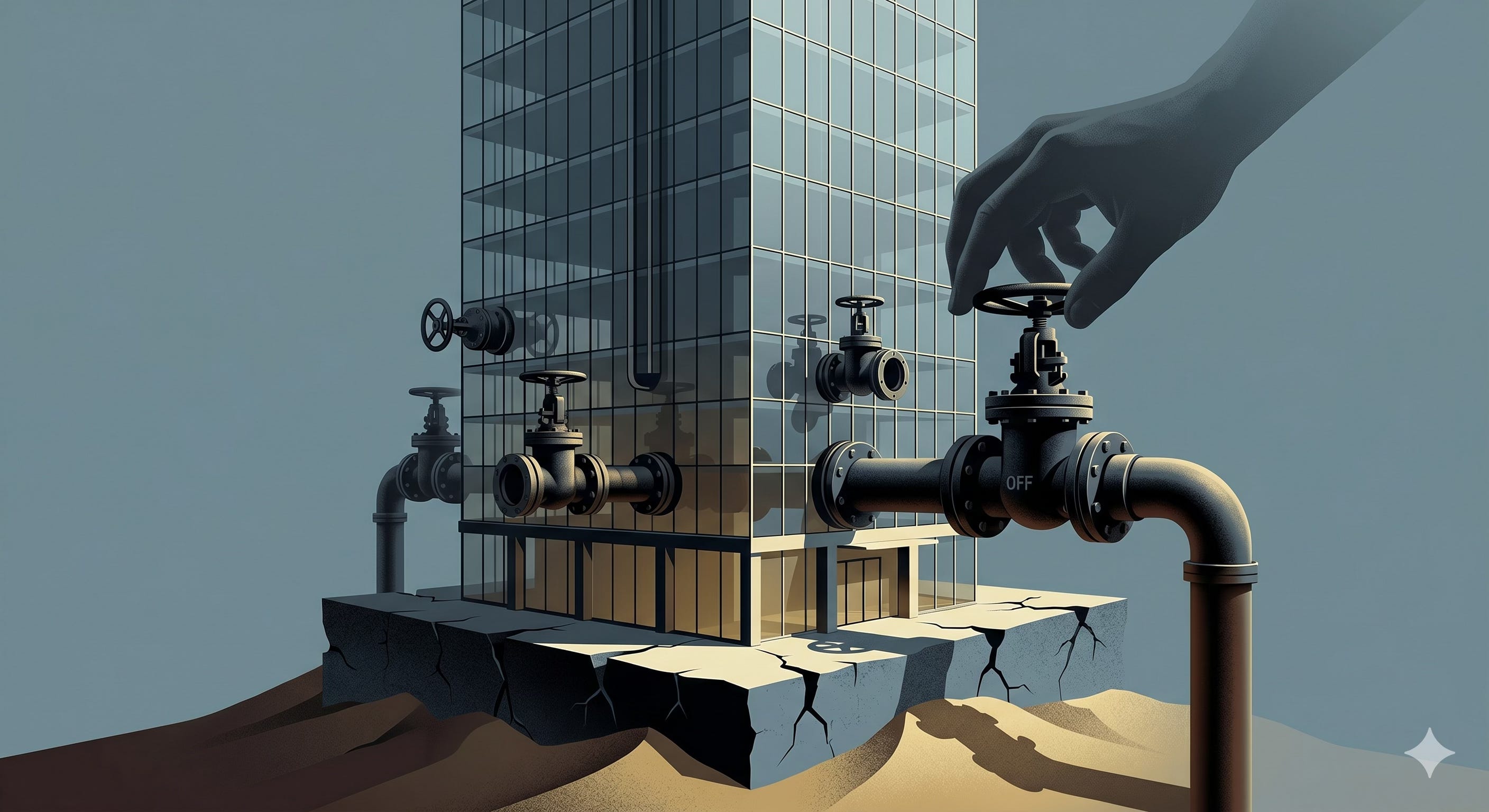
If the FTC decides the water is toxic, it does not sue the water. It shuts off the valve. And on most platforms, the creator does not own the valve.
Join the Conversation
Is the convenience of Substack worth the structural risk, or is it time for more creators to move toward decoupled architecture? Let’s discuss in the comments.
Found a typo or a factual error? Help me stay sharp.
Thanks for writing this! I’ve been considering launching something new and have been torn between using substack, Beehiiv and Ghost. I already knew that there were other pros/cons for each, but hadn’t thought about the legal differences for each.