
The Pod and the Press: What Mutual Aid Can Teach Local News About Survival
There's a tool from the disability justice movement that's just beginning to find its way into journalism. It hasn't arrived yet. It should.

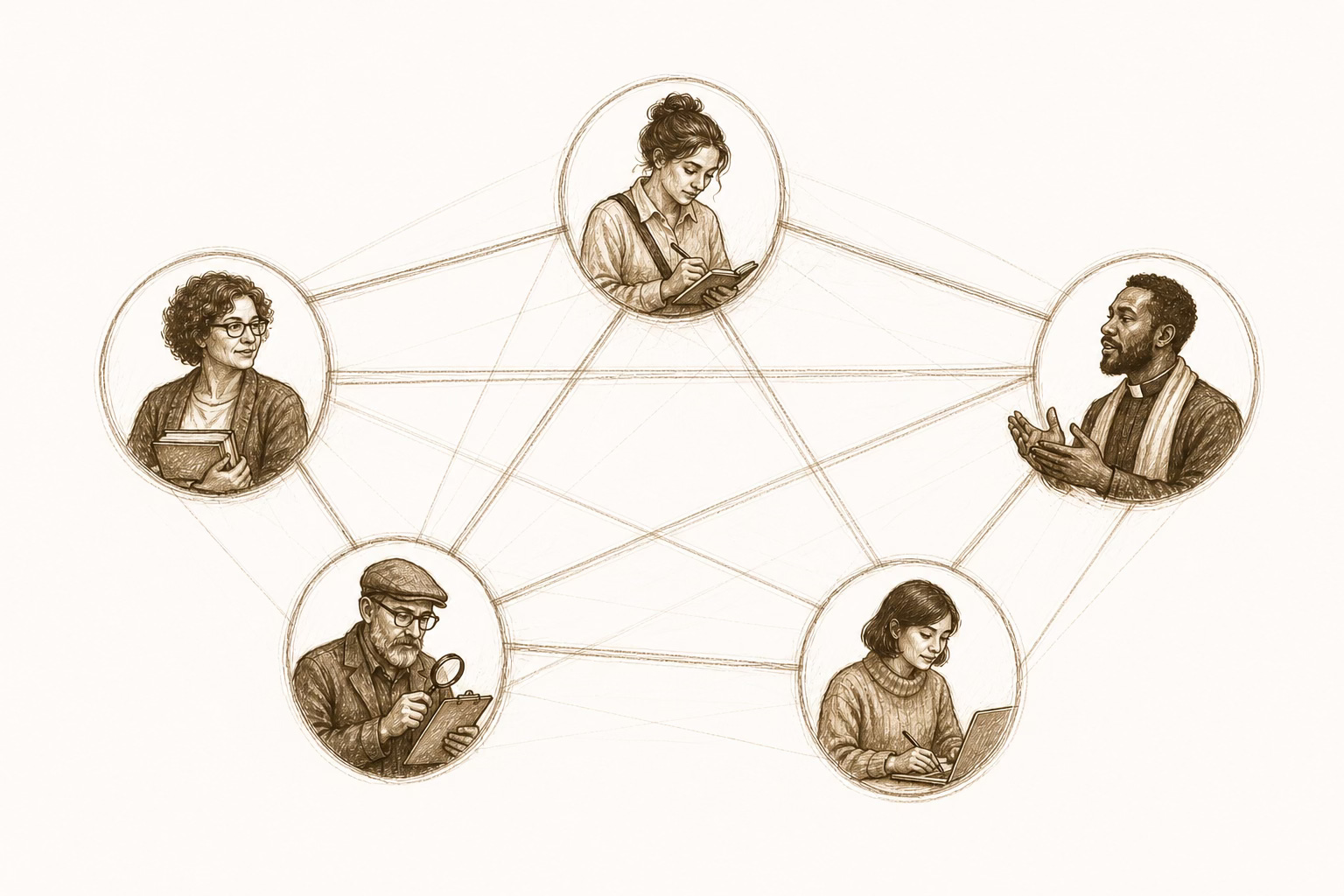
Here’s a thought experiment.
Imagine you run a small local news organization. You have a beat reporter covering housing, a part-time photographer, and a community editor who’s also doing audience analytics. It’s Tuesday morning and your housing reporter calls in sick — the same day the city council is voting on a zoning change that will displace 400 families.
Who do you call?
If you’re like most local newsrooms, you start improvising. You scroll through your contacts. You text a freelancer who may or may not be available. You post something vague on social media. You cobble together coverage that’s half what it should be, filed late, by someone who doesn’t know the players. By the time you find a body to cover it, the vote is over, the families are displaced, and your “coverage” is just a rehashed press release.
Now imagine a different scenario. You have a map. Not a geographic map — a relationship map. It shows you exactly who in your community covers housing issues, who attends those council meetings anyway, who has built trust with the affected residents, and who has already agreed to call you when something breaks. You built that map six months ago, when nothing was on fire.
That’s pod mapping. And journalism hasn’t discovered it yet.

Where It Comes From
Pod mapping was developed in 2014 by the Bay Area Transformative Justice Collective, originally as a tool for communities experiencing violence and harm — a way to identify, in advance, who you’d call on in a crisis and what you could offer in return. It has since spread to disability communities, mutual aid networks during COVID-19, LGBTQ+ safety planning, and permaculture collectives. City Bureau’s Documenters Network ran a pod-mapping workshop just last week — using it to help community members build mutual support systems with one another. That’s a meaningful step. But the tool still hasn’t been applied to the more fundamental question: how should a newsroom use it to structure its relationships with the community it covers?
The tool is deceptively simple: draw a circle with yourself at the center. In the inner rings, place the people you can count on and who count on you. Note what each person brings. Note what you bring to them. Establish how you’ll communicate. Do this work now, before the crisis, when you’re calm and resourced — not when you’re scrambling.
The core insight isn’t the map itself. It’s the timing and the reciprocity. You’re not building a Rolodex. You’re building a relationship infrastructure — one that functions under pressure because it was maintained under normal conditions.
Journalism has never formally adopted this. It should.
A Census vs. a Covenant
To be fair, the field isn’t starting from zero. Asset mapping — identifying a community’s existing resources, influencers, and information nodes — has gained real traction in community-centered newsrooms. The American Press Institute has championed it. PublicSource in Pittsburgh built genuine relationships by canvassing neighborhoods, documenting gathering spaces, and mapping community connectors before they needed them as sources. The Journalism + Design Lab recently introduced a “Community News Roles” framework at ONA that reframes journalism as a set of actions — documenting, sensemaking, facilitating, navigating — that community members already perform every day, with or without a newsroom’s involvement.
These are good tools. But they share a structural limitation worth naming clearly.
Asset mapping is a census: it asks what exists? It identifies the organizations, connectors, and information nodes in a community. It tells you the landscape. It’s valuable, and most newsrooms should be doing more of it.
Pod mapping is a covenant: it asks who shows up when things break? It doesn’t just identify people — it establishes mutual obligation. The difference is the difference between a contact list and a relationship. A census tells you who lives on the block. A covenant tells you who has your spare key.
Consider what that distinction looks like in practice. Sarah Stonbely, a senior research associate at Columbia’s Tow Center for Digital Journalism, recently used AI to map the information landscape in Charlotte, N.C. Her findings reframe the whole premise: many communities, she argues, are better described as “information oceans” than news deserts. Of the 66 local information providers she catalogued in Charlotte, fewer than half are staffed newsrooms. The rest are podcasts, newsletters, Instagram accounts, faith-based weeklies, sports blogs — and civil society organizations like schools, libraries, and city agencies that fill gaps the press leaves open.
Asset mapping revealed all of that. It’s an extraordinary census. But here’s what the map can’t tell you: which of those 66 providers would answer your call at 11pm on a Tuesday. Which ones would flag a story before it broke. Which ones have already earned trust in the neighborhoods your newsroom hasn’t reached. The census shows you the ocean. The covenant is how you stop drowning in it.
Journalism has built tools for the census. It hasn’t built tools for the covenant. That’s the gap.
Building a newsroom that survives requires more than just better tools—it requires a different mental model. If you’re finding value in these frameworks for the “Last Mile” of journalism, join a community of media leaders rethinking the infrastructure of trust.
The Reciprocity Gap
Consider what local newsrooms are actually asking of community members when they do engagement work: attend our event, fill out our survey, respond to our callout, trust our coverage. The exchange is largely one-directional, even when the intentions are generous.
Pod mapping introduces a different logic — one borrowed from mutual aid theory — in which the relationship is the infrastructure. You don’t extract value from it when you need it. You maintain it continuously, because everyone in the pod has something at stake.
For a local newsroom, a “coverage pod” built on this logic might look like this:
A housing beat reporter maintains explicit relationships with three community members who attend every council meeting and have agreed to text her when something unusual happens. In exchange, she gives them early access to her stories for community review before publication.
A neighborhood newsletter editor and a local public radio station have a standing agreement: when one has a tip they can’t pursue, they pass it to the other. When one needs a quote from a community member they don’t have access to, the other makes an introduction.
A small nonprofit newsroom maps the connectors in each of its five coverage neighborhoods — not just as sources, but as partners. Those connectors know what the newsroom can and can’t do, and the newsroom knows what crises are coming before they become front-page news.
None of this is revolutionary on its face. Reporters have always had sources. Newsrooms have always had informal networks. What pod mapping adds is intentionality and reciprocity — the explicit acknowledgment that these relationships require maintenance, that they involve mutual obligation, and that they need to be documented somewhere other than one reporter’s head.
That last point matters more than it sounds. When that reporter leaves — and in local news, they always leave — the pod doesn’t dissolve. The map survives.

What a Journalism Pod Map Could Look Like
Step 1: Define your pod’s purpose. Is this a beat-specific pod (housing, education, public safety)? A geographic pod (the northeast quadrant of your coverage area)? A resilience pod (who can help you publish when your staff is depleted)?
Step 2: Map the people. Who already knows things your newsroom needs to know? Who attends the meetings you can’t staff? Who translates — literally or culturally — between your newsroom and communities you underserve? Who trusts you, and who doesn’t yet but could? Stonbely’s Charlotte map is instructive here: the information providers worth mapping aren’t just journalists. The faith-based weekly, the neighborhood Instagram account, the library’s digital literacy program — these are pod candidates too.
Step 3: Define the exchange. For each relationship, be explicit: what does this person offer, and what does your newsroom offer in return? Early story access? Credit? Community review? A standing agreement to amplify their work? Mutual aid has to be mutual.
A word for the traditionalists in the room: offering community review before publication isn’t the same as surrendering editorial control. You’re not giving anyone a veto. Think of it less as “early access” and more as a fact-check for nuance — a chance for pod members to validate their own lived experience before the story goes out. The reporter still decides what runs. What changes is the quality of information she’s working with — and the degree to which the community believes she actually tried to get it right. That’s not a compromise of independence. It’s an upgrade to accuracy.
Step 4: Set communication norms. How do you stay in contact between crises? A monthly check-in? A group text? A shared document? The specific channel matters less than the commitment to use it.
Step 5: Review and refresh. Pods change. People move, burn out, change jobs. Set a cadence — quarterly is reasonable — to review who’s in your pod, what’s changed, and what relationships need investment.
The Pre-Crisis Principle
The most underappreciated element of pod mapping is its insistence on doing the work before you need it.
Most newsroom community engagement happens reactively: a crisis hits, a story demands sources the newsroom doesn’t have, a community erupts in distrust over coverage that missed the mark. The newsroom scrambles to build relationships in the middle of a fire.
Pod mapping treats this as a design failure. The relationships have to pre-exist the crisis to be functional during it. A neighbor you’ve never spoken to cannot meaningfully help you when the flood comes. A community connector you’ve never invested in will not answer your call at 11pm on a Tuesday.
This is the Last Mile problem applied to relationships, not just distribution. Journalism tends to fixate on the pipe — the story, the platform, the delivery mechanism — and neglect the porch, the last few feet where information actually lands in someone’s life, in a form they trust, from a source they recognize. The gap between the newsroom and the community it ostensibly serves isn’t just geographic or demographic. It’s relational. And unlike coverage gaps, which are visible and embarrassing, relationship gaps are invisible until they’re catastrophic — until the community you needed to warn you didn’t pick up, because you’d never given them a reason to.

A Note on Scale
Pod mapping doesn’t scale the way a database does. That’s a feature, not a bug.
The journalism field has spent a decade trying to solve the community trust problem through technology: better analytics, smarter CMS tools, AI-driven personalization. What the research consistently shows is that trust is built through repeated, human, reciprocal contact — not through optimized content delivery.
A newsroom with three carefully maintained pods — one per major beat, 10-15 relationships each — has more genuine community infrastructure than a newsroom with 50,000 email subscribers and no one who will answer the phone.
This doesn’t mean scale doesn’t matter. It means relationship density is a precondition for scale that works. You can’t distribute to a community you don’t have relationships with. You can’t cover a community you don’t have access to. And you can’t maintain access if the relationship is purely extractive.
The crisis in local news is a design failure, but the solution is relational. If you know an editor or a journalist who is currently “scrambling in the fire,” pass this framework along. Let’s build the map together.
Why Now
The timing argument for this isn’t subtle.
Local newsrooms are shrinking. Beats are being consolidated. Reporters are covering more geography with less institutional knowledge. The redundancies that used to exist — the veteran reporter who knew every alderman, the editor who’d covered the school district for 15 years — are gone or going.
Pod mapping is a response to that attrition. It externalizes relationship knowledge that used to live in individual journalists’ heads. It distributes the work of community maintenance across more people, some of them not on payroll. And it builds the kind of mutual accountability that makes communities invested in a newsroom’s survival — not just as a civic abstraction, but as a concrete relationship they’ve participated in building.
The tool wasn’t designed for journalism. But the problem it solves — how do you maintain the relationships you need before you desperately need them — is exactly journalism’s problem right now.
The field has built tools for the census. It’s time to build tools for the covenant.
The American Press Institute has published extensively on asset mapping for newsrooms — including Letrell Crittenden’s step-by-step guide and a framework for identifying your role in the information commons. Their work is a useful complement to the pod mapping approach described here — and a good starting point for newsrooms ready to begin. A companion Coverage Pod Worksheet — a one-page practical tool for newsrooms — is forthcoming.
Join the Conversation
Who is in your pod?
I’m curious to hear from those of you already doing this work—perhaps under a different name. What does reciprocity look like in your community? What “spare keys” have you been offered lately?
Drop a note in the comments; I’d love to learn from your infrastructure.
I strive for the same nuance I advocate for. If you spot a factual error, a missing link, or a point that lacks necessary context, please report an error here. Your feedback is a vital part of this publication’s accuracy.