

A Quick Disclaimer: Backstory & Strategy is a personal, independent publication. The views, analysis, and commentary expressed here are strictly my own and do not represent the official position, strategy, or endorsement of the American Press Institute, its leadership, or its board. This is my personal space for analyzing the media landscape, testing new frameworks, and thinking out loud.
At Premium Times in Nigeria, every AI-generated podcast goes past an editor before it goes out. The newsroom imports its own articles into Google’s NotebookLM, tweaks the prompt, and gets back a two-host conversation that sounds like it was recorded in a studio. Then an editor checks it against the reporting. Akinola Oyewobi, an assistant head of digital strategy and technology there, described the workflow at INMA’s Africa summit in September 2025. Human oversight, he said, remains critical.
I believe him. It is exactly what a careful newsroom should do. It is also, as far as I can find, written down nowhere. Premium Times has no public AI policy. The listening rule lives in the habits of the people who happen to be doing the listening. When one of them leaves, the rule leaves with them.
That is the pattern I kept running into when I went looking at newsrooms that have embraced NotebookLM. I started with a narrower hunch, that their AI policies were written for a different threat and didn’t fit the tool. That turned out to be true. But the bigger problem is that the newsrooms doing the riskiest thing with it, publishing synthetic audio to audiences, mostly have no written rule at all. What they have instead is Google’s product terms and a few conscientious editors.
Three uses, one policy
Newsrooms are doing three different things with NotebookLM, and they deserve three different kinds of rules.
The first is licensing. The Economist and The Atlantic didn’t adopt the tool so much as move into it. Both built “featured notebooks” that live inside Google’s product, with the Economist’s World Ahead report and Arthur Brooks’ columns from The Atlantic as the source material, complete with pre-generated audio. Press Gazette called it a way to explore AI reader experiences while keeping editorial control. That’s a distribution deal with lawyers on both sides, and the real governance is in a contract none of us will read.
The second is research. This is where the tool shines and where most of the sober adopters sit. La Dépêche du Midi in Toulouse loaded 700 archive articles on the Jubillar murder case to find angles for a pre-trial series. The New York Times uses it to trace citations. Gazeta do Povo in Brazil checks drafts against its style guide. The tool reads only what you give it and shows you where each answer came from, which is the whole point.
The third is output. Premium Times publishes the audio. Nine publishers in an INMA lab with Google, including Le Devoir, Der Spiegel, Daily Maverick and Nexstar, built election guides and “interactive, source-grounded journalism” meant for audiences. This is where a 12-minute file with two cheerful hosts leaves the building with your name on it.
Now look at the policies. Of the newsrooms I could document using the tool, I found public policy text for three. Nexstar’s says all writing and reporting must be the work of its journalists. Spiegel’s principles, from 2023, cover labelling AI images. Chalkbeat’s internal rules, described to Poynter this spring, call for company-approved tools and no AI-generated images or stories. Every one of them is written for a fourth scenario, the one everybody feared in 2023: a chatbot drafting a story and someone passing it off as their own.
None of them name NotebookLM. None mention audio. None distinguish between using the tool to understand a document and using it to manufacture something a reader will consume. The categories are text, images, and approved tools. A synthetic podcast is none of those, so it slips through.
Forward this to the editor who signs off on AI in your newsroom.
When the vendor’s promise becomes your policy
La Dépêche is the case that stuck with me. Its deputy editor-in-chief, Christophe Rauzy, has been open about why the paper chose NotebookLM for the Jubillar trial. A team of about ten journalists had five years of notes and documents, some of them, in his words, sometimes confidential. A “classic” AI, he worried, might absorb that material into its memory. NotebookLM promised to read only what you upload and not to train on it. So in went more than 700 articles, and the notes, and the documents (PHRases, October 2025).
That is a reasonable judgment. It is also a judgment resting entirely on Google’s assurance, which for consumer accounts carries a clause: your uploads aren’t used for training unless you provide feedback. I could find no charter, no “charte IA,” at La Dépêche or its parent group that says which account type reporters use, what may go in, or who decides. The confidentiality rule is whatever Google says it is this quarter.
Vía País in Argentina says the quiet part out loud. Nothing from NotebookLM is published without an editor, its newsroom wrote for INMA, and notes that Google itself discourages auto-generated content. Read that again. A search company’s guidance on what it will rank is doing the work of an editorial policy.
I spend a good part of my day job on AI governance, and I understand why this happens. Writing policy is slow and the tool is free and the demo is astonishing. But a newsroom that lets a vendor’s terms of service stand in for its own rules has outsourced the one thing it can’t outsource, which is deciding what it will put its name on.
The trainer, the vendor and the distributor are the same company
Here is the part that belongs in a newsletter about strategy rather than ethics.
Google’s News Initiative gave Gazeta do Povo thirteen training sessions on its AI tools in 2025, and 85 staffers learned NotebookLM, then published the result as a case study. The INMA lab cohort held office hours with the NotebookLM product manager and presented their final projects to the NotebookLM team. The same company runs AI Overviews, which have been taking referral traffic from every one of these newsrooms for two years.
I wrote on last week about the one-way mirror in Google’s cloud terms, where the agent sees your data and you can’t see what it does with it. This is the newsroom-floor version. Free tool, free training, a case study with your logo on it, and a dependency that deepens every time a reporter builds a notebook. Nothing about that is sinister. It’s good product strategy. But none of the policies I read mention vendor dependency, account type, or what happens to the notebooks if the terms change. The organization that’s drafting your reporters’ habits is not the organization that answers to your readers.
Three things that happened while nobody was writing policy
First, the product changed its name. On July 16, Google announced that NotebookLM is now Gemini Notebook, brought under the Gemini brand, though Google calls it the same standalone product. Google’s own help pages add that a notebook opened inside the Gemini app falls under the Gemini Apps privacy notice, which allows human review, a different bar from the standalone tool. This is a small thing with a large lesson. A policy that governs by product name has a hole in it every time the vendor rebrands, and vendors rebrand constantly. A rule that says “no NotebookLM audio without review” stopped applying to anything on July 16. A rule that says “no synthetic audio without review” never noticed. Govern the category of output, not the logo on the login screen.
Second, the voice got sued. David Greene hosted NPR’s Morning Edition for eight years. In January, he filed suit in California claiming the male host in Audio Overviews imitates his voice, his cadence, even his filler words. Google says the voice comes from a paid professional actor, and the claims are baseless. It moved the case to federal court, arguing copyright law preempted it. On July 23, Judge Charles Breyer sent it back to state court, holding that Greene’s claims are about the output, an alleged imitation of his voice, not the copying of his recordings, and that a voice isn’t copyrightable subject matter in the first place. Nothing has been decided on the merits. But notice who carries the exposure. Google’s terms of service cover Google. Whether a newsroom that distributes that voice under its own masthead shares the exposure is an open question; California’s statute has a news exemption, but nobody has tested where a synthetic podcast falls. I found no policy that so much as imagines the question.
Third, the audio has a known failure mode. Ian Flynn at Pitt and Sean Peters at Middlebury fed three published papers into Audio Overviews and listened. Every episode contained errors, and the errors were always at the end, sometimes as unjustified extrapolation, sometimes subtler. One overview took a volcanic feature on Mars and arrived at the possibility of life. Google’s own help text says Audio Overviews may contain inaccuracies or audio glitches.
The mistakes live in the last stretch, which is precisely the part a deadline editor skips.
Put those three together and the Premium Times listening rule stops looking like diligence and starts looking like the minimum.
A rule you could adopt Monday
The fix is not a longer policy. It is a policy that knows the difference between reading and publishing. Three tiers, one page.
Tier one: research use. Reporters may use the tool to interrogate documents, transcripts, and archives. Specify the account type, because consumer and Workspace terms differ on human review of your uploads. Say what may never go in: unredacted source identities, documents under a protective order, anything you’d refuse to email to a stranger. Require that every claim pulled from the tool be checked against the cited passage, not the summary.
Tier two: licensed or shared notebooks. If your journalism lives inside someone else’s product, as the Economist’s does, the policy names who approved it, what rights were granted, how attribution works, and who reviews the pre-generated audio Google attaches to it.
Tier three: published synthetic media. Anything the tool makes that an audience will hear or watch gets three things before it ships. A named human listens to the whole file, not the first half. The audio itself discloses that the hosts are synthetic, in the audio, not only in the show notes. And someone has asked the voice-rights question, because the publisher’s exposure is untested and, as of July, a court says the underlying question is live.
None of this is exotic. Última Hora, a daily in Paraguay, already bans publishing any text, audio, image, or video produced entirely by AI and bars reporters from putting confidential-source material into AI tools at all. Conexus Financial, a trade publisher in Australia, publishes the list of AI tools its editors are approved to use. A Paraguayan daily and a publisher of Australian pension-industry trade titles have out-governed the INMA cohort on this.
Nor is it only small publishers. New York’s legislature passed the FAIR News Act in June, 53–7 and 130–1, and it is waiting on the governor. It requires a spoken disclosure at the start of any AI-generated audio, review by a person with editorial authority before publication, and safeguards that keep confidential source material away from AI systems. Press groups argue it is overbroad, and they may be right. But notice what it is: the three-tier rule, written by Albany because the newsrooms didn’t.
The categories can be written. Somebody has to decide to write them.
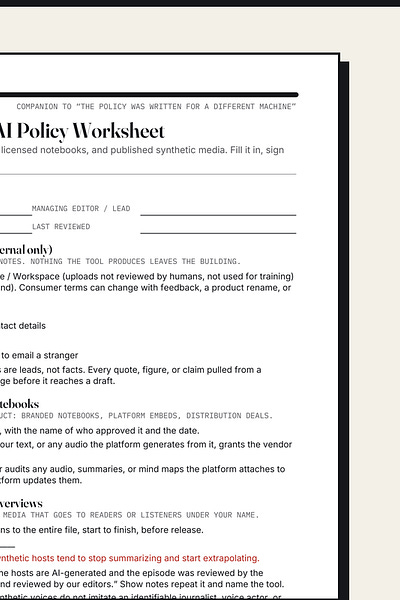
I’ve put the three tiers into a one-page worksheet a managing editor can fill in over coffee. It’s at the bottom of this post.
The unwritten rule
I want to be fair to the newsrooms in this piece. Premium Times is doing more than most. La Dépêche thought hard about confidentiality. Vía País edits everything. These are not careless people. They are people doing the right thing without writing it down, which works until the day it doesn’t, and on that day nobody can point to the page that says what the standard was.
A practice nobody wrote down is a policy nobody can defend.
Does your newsroom have a written rule for synthetic audio? I’d like to read it, and I’d like to hear from the editors who’ve decided not to publish it at all. The comments are open, or reply to this email, and it comes straight to me.
A note on method: this piece is built from public statements, conference write-ups, Google’s own case studies, and court filings, not interviews. Of the newsrooms I could document using the tool, I found public policy text for three; “no policy found” means I couldn’t locate one, not that none exists. The Greene case is Greene v. Google LLC, No. 3:26-cv-01773 (N.D. Cal.), remanded July 23, 2026.
Backstory & Strategy is free and stays that way. If someone forwarded this to you, subscribe for the next one.
A note on method: this piece is built from public statements, conference write-ups, Google’s own case studies, and court filings, not interviews. Of the newsrooms I could document using the tool, I found public policy text for three; “no policy found” means I couldn’t locate one, not that none exists. The Greene case is Greene v. Google LLC, No. 3:26-cv-01773 (N.D. Cal.), remanded July 23, 2026. The NY FAIR News Act (S8451/A8962) passed both chambers in June 2026 and had not been signed as of publication.