

Philadelphia had newspapers by 1771. Washington didn’t exist as a capital until 1800. Chicago’s first paper predates its city charter by four years. Los Angeles had a press before it had a courthouse.
This is not a coincidence, and it’s not a footnote. It’s the actual sequence of how American civic life got built. Someone had to write down what was happening in a place before that place could organize itself into a functioning polity. The press didn’t grow up alongside American self-governance. It preceded it, and it made self-governance possible. Today, a lot of people will celebrate the document that protects the free press without noticing the causality runs backward from how it’s usually told: the press created the conditions that made the First Amendment necessary, not the other way around. Philadelphia already had a paper for two decades by the time the Constitution existed to protect one.
If this is the kind of thing you want in your inbox — journalism, media economics, and the occasional argument about founding-era printing presses — subscribe to Backstory & Strategy.
That distinction matters more this year than most. Two local newsrooms are closing every week in this country. Not shrinking. Closing. The argument usually made when that happens is a legal one: we’re losing a right the First Amendment guarantees us. That’s true, but it’s not the right register. Local news didn’t emerge to serve democracy in the abstract. It emerged because someone in Philadelphia in 1771, or Chicago in 1833, had a printing press and used it to say: here is what happened here today. Democracy built itself on top of that habit. It didn’t invent it.
So when a newsroom closes now, the loss isn’t downstream of some constitutional harm. It’s closer to the original harm, older than the Constitution, plainer than a legal argument. A place stops having anyone whose job it is to say what happened here today. Everything else — the civic trust, the informed electorate, the accountability — is the second-order effect. The first-order effect is just: nobody’s writing it down anymore.
I started a small apparel brand called Editorial Style, building it out over months of nights and weekends around the actual job, not because journalism needed more merchandise, but because I’ve become convinced journalism has a lot to learn from e-commerce, and the only way to actually learn something is to go do it, badly at first, and see what breaks. Running a Shopify store teaches you things a newsroom budget meeting never will: how thin the margin is between someone reading your argument and someone acting on it, how much trust erodes at every point of friction, how unforgiving an audience is when you ask them to do something instead of just read something. Those are journalism’s problems, too. I just didn’t want to theorize about them anymore.
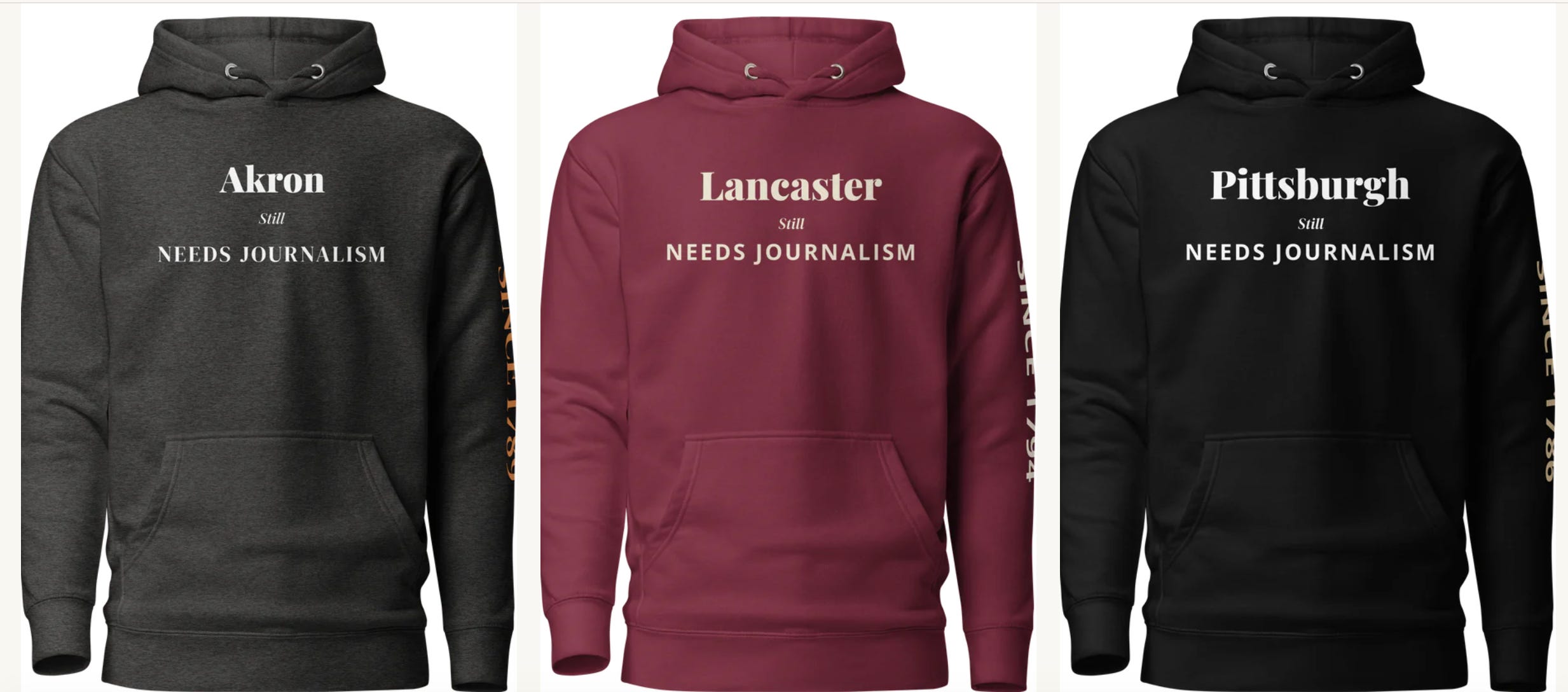
The Press Was Here First started with four cities and the founding-sequence argument behind them: Philadelphia, Washington, Chicago, and Los Angeles. It’s grown since — Boulder, Denver, Pittsburgh, Akron, Lancaster — because it turns out most places have a version of this story, not just the ones with a 250-year head start. Available in hoodies and t-shirts, each piece carries a city’s newspaper founding date as a detail. If you want to wear the argument instead of just reading it, it’s up.
The story isn’t over. Whether it stays that way is still being decided.
P.S. — Readers of Backstory & Strategy get 15% off Editorial Style with code BACKSTORY15. Orders over $50 ship free.
Does your city have a founding-press story worth telling? Reply and tell me the name and the year — I’m always looking for the next one to add.
If this one landed, the best thing you can do is forward it to one person who still thinks the First Amendment came first.