
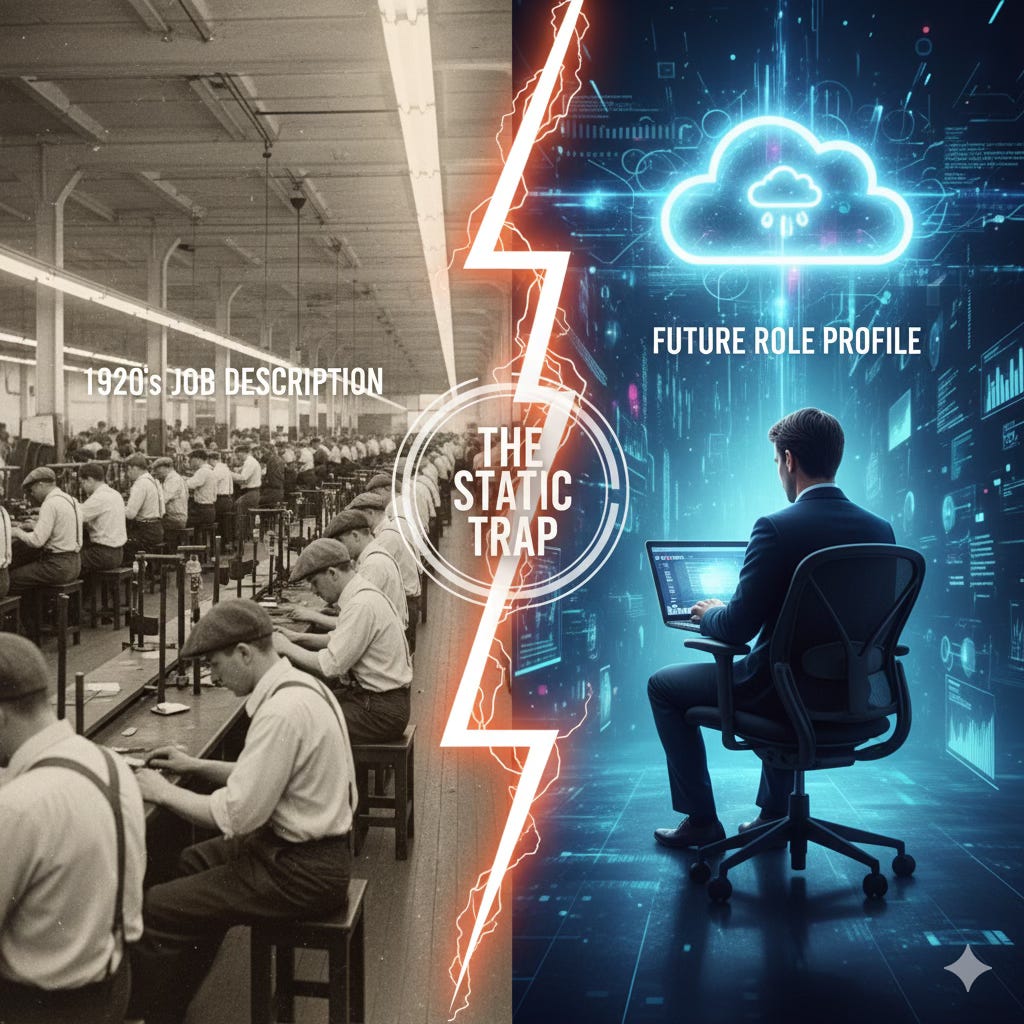
The Static Trap: Why Your Job Description Is a Relic of the Factory Floor
The industrial-age JD is actively failing the world of dynamic work and AI. It's time to replace fixed tasks with three strategic shifts focused on impact, skills, and clear career growth.

For many people, the job description is perhaps the most important document in their career. It dictates their pay. It sets their goals. It defines their role. And yet, it’s often a piece of paper they read once on day one and never look at again.
If the job description is so critical, why does a tool so central to the HR machine feel so utterly irrelevant to our day-to-day work life?
The answer lies in where the job description actually came from.
The Backstory: A Tool Built for Standardization
Job descriptions emerged from the scientific management movement of the late 19th and early 20th centuries. Frederick Winslow Taylor pioneered the work of breaking down factory jobs into standardized, measurable tasks.
Taylor’s big idea was elegant. You could engineer efficiency by analyzing exactly what each worker did, eliminating wasted motion, and creating one “best way” to do any job. To make that work, you needed to document what that job actually entailed. Thus: the job description.

This practice went mainstream during WWI and WWII. Governments and military organizations needed to rapidly train huge numbers of people for specific roles. Standardized job descriptions made that possible. You could slot someone into a position and hand them a document explaining exactly what they were supposed to do.
After WWII, job descriptions became fixtures of corporate HR departments. They served multiple essential purposes:
Legal protection: Clear documentation of expectations and requirements.
Compensation frameworks: Justifying salary bands and hierarchies.
Hiring standards: Defining what “qualified” meant.
Performance management: Setting measurable objectives.
The Digital Gap: When Task Lists Fail Knowledge Work
Here’s the irony.
Job descriptions were invented to standardize repetitive industrial work, but we now use them for knowledge work that resists standardization.
A factory worker in 1920 might do the same task 500 times a day. Your average content strategist or data scientist? Every project is different. The role changes every six months.
We inherited a tool designed for assembly lines and keep trying to make it work for jobs that look nothing like assembly lines.
That’s why modern job descriptions often feel either too vague (“strategic thinker with excellent communication skills”) or absurdly specific (“must have 5+ years’ experience with our proprietary CMS that we launched 18 months ago”).
To make matters worse, job descriptions are typically created as static documents. They cannot keep pace with the dynamic nature of modern work. The rise of automation and AI, in particular, means that the routine tasks listed in a JD today are the very things an algorithm or an AI agent will handle tomorrow. This causes them to become outdated quickly and completely misaligned with the day-to-day reality of a role.
The traditional job description is a straightjacket that discourages growth and innovation.

Here’s What Replaces It
The future of organizing work isn’t about better task lists. It requires three fundamental shifts in how we define roles. We need to move from fixed responsibilities to fluid skills and measurable impact.
1. From Tasks to Impact
Stop listing what people do. Start defining what they achieve.
The shift is simple but profound. Replace activity-based job descriptions with impact-focused Job Profiles that clarify the problems to solve and outcomes to create.
Here’s what that looks like in practice:
See the difference? The first version tells you what to show up and do. The second tells you what success looks like. It gives you room to figure out how to get there as tools and tactics evolve.
This approach also identifies the key capabilities required for the role—Negotiation, data fluency, ambiguity management. These matter more than a rigid list of responsibilities. When the CMS changes or AI handles routine tasks, the skills remain relevant even as the how changes completely.
2. Keep It Current
A Job Profile can’t be a set-it-and-forget-it document. It needs to be a living development tool, not a compliance artifact you file away after onboarding.
Make it a quarterly conversation. The Job Profile should be revisited every 90 to 180 days, not just during annual reviews or when someone’s role officially changes. These check-ins keep the document aligned with reality and turn it into an actual development tool.
Use these check-ins to ask: What parts of this role have shifted in the past 90 days? What skills are you using more, or less? What’s likely to change in the next 6 months?
This prevents the document from becoming obsolete six months after you write it. More importantly, it encourages both managers and employees to think forward. “What will this role likely become?” is a far more valuable question than “What did we agree to last year?”
3. Show Them What’s Next
The modern Job Profile must answer the question every good employee is asking: “Where am I going in this organization?”
Build explicit career pathing into the document. Map the role to the next one or two potential steps, lateral or vertical, and spell out the skills required to get there.

By outlining a growth trajectory, the Job Profile becomes a roadmap for the employee’s future. They’re not just doing a job. They’re building toward something specific. This transforms the document from a hiring tool into a retention strategy.
When someone can see where they’re headed and what skills will get them there, they’re far more likely to stay and build those skills with you rather than elsewhere.

The Bottom Line
The factory is gone. The assembly line is gone. It’s time for the job description to join them.
Your team is already doing work that doesn’t match their job descriptions. The question isn’t whether that’s happening. It’s whether you’ll acknowledge that reality and build something better, or keep pretending the factory floor model still works.
Build Job Profiles that match how your people actually work and how they want to grow. The static task list had its moment. That moment was 1920.
Now over to you:
Your company is already shifting to value skills and impact over rigid tasks. Which of the three proposed shifts—the Role Canvas, the Living Document, or the Career Compass—would make the biggest difference in your organization right now?
Share your perspective in the comments.
P.S. - If you found this post helpful, would you please consider restacking it and sharing it with your audience?
This spreads the word and keeps me writing the types of content that you have enjoyed.