

A Quick Disclaimer: Backstory & Strategy is a personal, independent publication. The views, analysis, and commentary expressed here are strictly my own and do not represent the official position, strategy, or endorsement of the American Press Institute, its leadership, or its board. This is my personal space for analyzing the media landscape, testing new frameworks, and thinking out loud.
The Transaction Problem
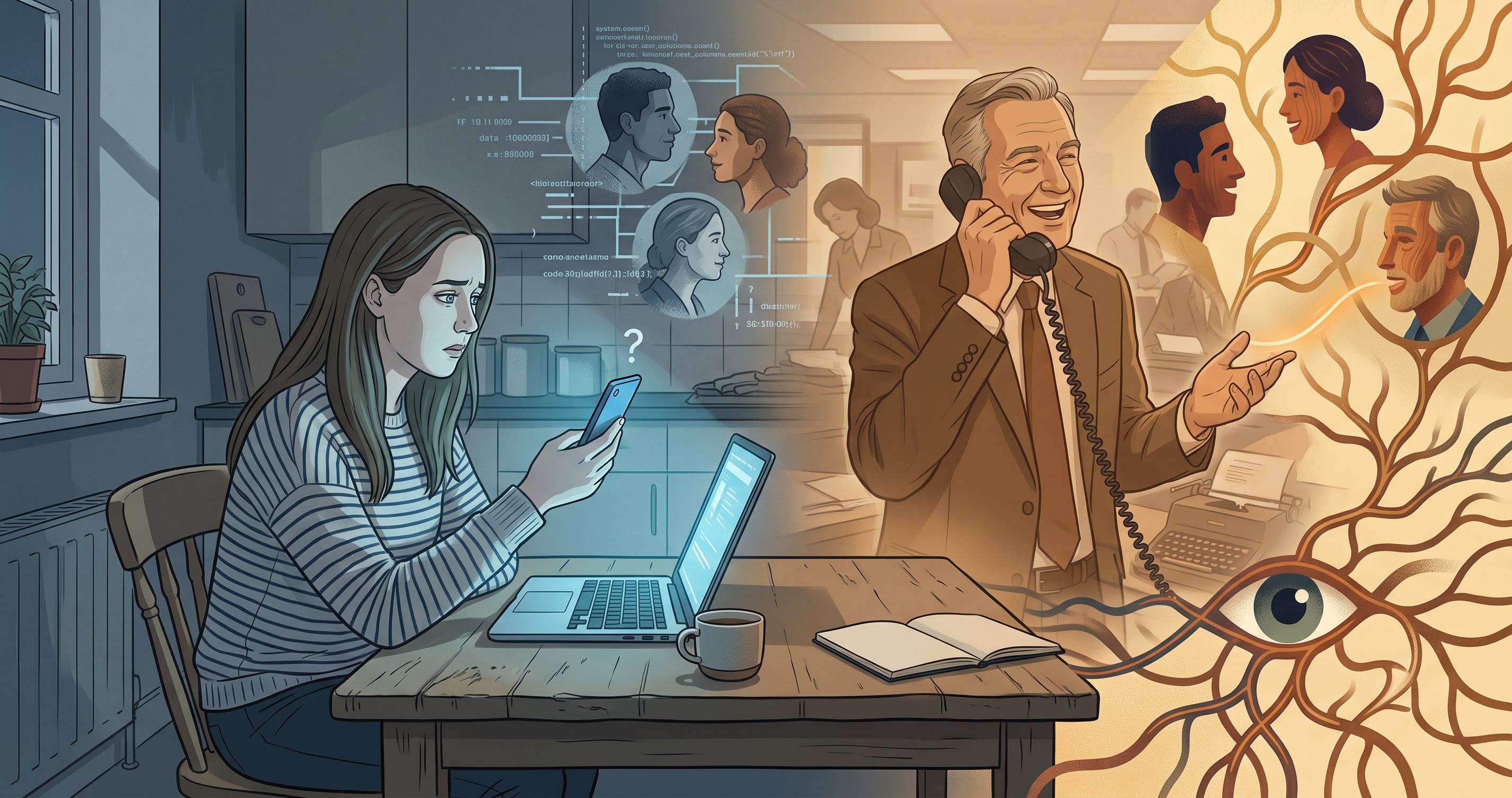
Get a group of editors together, and you will inevitably hear a version of this story: young reporters struggle to build their beats and develop sources. They are too comfortable working from a desk or a kitchen table. The idea of cold-calling someone causes them to break out in a sweat.
The easy explanations are the ones everybody reaches for first, and they are not wrong. Newsroom staffs have been gutted. The senior reporter who used to sit two desks away—the one a cub reporter could watch make forty calls a day, absorb a hang-up, and try again—often does not exist anymore. A lot of what is left of that staff works remotely now. Even the newsrooms that still have experienced reporters have lost the ambient, absorbed-by-osmosis mentorship that used to happen just by being in the same room.
Both of those things are real. Neither one is sufficient.
Here is what I think is going on underneath the staffing story, and it is uncomfortable enough that I do not hear many newsroom leaders say it out loud.
Source development is an intimacy-building skill. You have to tolerate rejection. You have to sit in ambiguity without a clear signal of whether it is working. You have to escalate trust slowly, in small increments, often over months, with no guarantee of payoff. You have to risk being disliked, ignored, or told no, and go back anyway.
Those are the exact same muscles required to build any close personal relationship. An entire generation is arriving in newsrooms having had drastically fewer reps at exercising them.
Social interaction has migrated to asynchronous, low-stakes, screen-mediated formats. A text you can leave on read carries none of the vulnerability of a phone call. A DM you can ignore forever is not the same as a source standing in front of you deciding whether to trust you. When researchers look at why young adults are dating less and delaying partnerships, the barrier they point to is not a lack of interest — a 2026 dating-recession survey found only about a third of young adults are actively dating at all, and researchers point directly to a lack of practiced social mechanics as one of the causes. The reps just have not happened.
I have seen this up close, outside of any newsroom.
If you’re new here, subscribe — Backstory & Strategy comes out regularly on journalism economics and media strategy.
My son goes to a sleepaway camp that does not allow any devices with a screen or an internet connection. No phones. Nothing. Camp leaders will tell you that for the first week or two, the kids can barely look at each other. Not won’t. Can’t, in the sense that the muscle is not there yet. It comes back, because that is the whole point of the camp. But watching how long it takes to return, and how visibly absent it is at the start, is about as clear a demonstration of this atrophy as I can imagine.
If a week without a screen exposes how little practice kids have looking another human being in the eye, it should not be a mystery why those same kids, a few years later, freeze up the first time an editor tells them to sit across from a hostile city commissioner who might tell them to get lost.
If that camp story landed for you the way it landed for me, share this piece with someone who’d get it — an editor, a parent, anyone who’s watched a kid rediscover eye contact.
If you are not getting practice reps at initiating an uncomfortable relationship with a stranger in your personal life, you will not be equipped to do it cold, under deadline pressure, as your job.
There is a second problem sitting on top of the first one. This one is not generational. It is structural, which means we can actually fix it.
Most people’s only mental model of a journalist contacting them is extraction. Someone wants a quote. Someone wants a comment before deadline. Someone wants a document. That is the only version of reporter-contacts-community most people have ever experienced, and it trains an entirely reasonable defensive posture: assume the journalist is here to take, not invest.
You cannot build a real source relationship on top of that assumption. Trust does not grow in soil where the other person thinks the whole interaction is a transaction with them on the losing end. I’ve made this case before: the best journalism happens when we remember we’re talking to humans, not extracting from them — see “Making Journalism Relational Again”.
The fix is deceptively simple, and almost nobody makes time for it: show up with no ask attached. No deadline hanging over the conversation. No story that needs a comment by five o’clock. Just time.
It is the exact inverse of how most community contact happens in journalism, and that inversion is the point. You are not there to take something today. You are there so that six months from now, when you do need something, you are not a stranger making a cold demand. You are someone who already showed up once just to listen.
Call this what it actually is: relationship before request. It is not a tactic bolted onto reporting. It is the operating principle that reporting should run on. It also happens to be the single skill young reporters have had the fewest personal-life reps practicing and the fewest professional structures left to learn from.
I’ve made this same case before in a different frame: treating audience as a verb instead of a demographic — something you do with people, not something you measure at them. The lesson transfers directly. Reporters who show up at a farmers market with a sign asking what stories they should be covering learn more in thirty minutes than they will from weeks of cold calls, for the same reason no-ask visits work: showing up with curiosity and no immediate ask is what makes people start talking in the first place.
So if newsrooms are not doing this anymore, who is?
The reflexive answer is Poynter. It is the name everyone reaches for. But look at what is actually in their current catalog, and you will find leadership academies, editing certificates, AI-adoption programs, and investigative seminars. It is real, valuable training, delivered mostly through online courses and cohort-based virtual sessions. All of it assumes you already have a beat. None of it teaches you how to get one.
That is not a knock on the quality of Poynter’s faculty. It is a structural observation. This particular skill cannot be delivered as a digital course, live or otherwise. An online module can teach the theory of active listening. It cannot put a reporter in a room with a wary school board member and have someone standing beside them afterward saying, Here is what just happened in that room, and here is what you missed. That is coaching. It requires proximity and repetition, which are the exact two things online-course infrastructure was built to eliminate.
Go back a stage further, to undergraduate journalism programs, and you find the same gap in a different shape.
Plenty of schools know source development matters. It is on the syllabus. NYU’s intermediate reporting course, “The Beat,” is built around it. Fordham explicitly bundles beat reporting and source-building into its curriculum. Albany runs sequences that move from evaluating source reliability into covering community beats.
The problem is what a syllabus does to a skill like this.
Source development does not happen on a semester schedule. It happens in the space between the third phone call and the tenth, after someone has watched you show up consistently enough to decide you are not just there for the one thing you need this week. You cannot compress that into fourteen weeks with a grade attached.
A semester has a start date, an end date, and a deliverable. Real source relationships have none of those, which is what makes them real. Ask any of these programs to grade whether a student built a trusting relationship with a source over eighteen months, and you understand immediately why coursework defaults to what is actually gradable: public records requests, interview transcripts, story architecture. Important mechanics. Not the thing itself.
Undergrad gets you the vocabulary. Continuing ed gets you when you already have traction. The actual gap—patient, unglamorous, low-yield relationship-building with no deliverable attached—does not have an institution standing in it at any stage of a journalist’s development.
I was fortunate enough to come up around some of this in person. Early in my career, my newsroom role models included Pulitzer winners like Sydney Schanberg, Murray Kempton, and Jimmy Breslin, and beat reporters like Jim Dwyer and Ellis Henican. I did not get formal instruction from any of them. I got something better: I watched how they approached a story, and I listened to how they talked to sources on the phone. Those were not lessons anyone designed. They were just what happened when you worked in the same room as people like that.
What I took from watching them was less about technique and more about temperament. The best reporters I came up around were patient, empathetic, and above all, great listeners.
I learned that the best material in an interview rarely came at the beginning. It came at the end, after the notebook had effectively closed and the conversation stopped feeling like an interview. Years later, when I was a business editor writing my own weekly feature, my best interviews were the ones where I abandoned the script entirely and just had an honest, open conversation with the person in front of me.
The story gets better the moment the other person stops feeling like they are being worked.
None of this is fixable by memo. It will certainly not be fixed by inventing more corporate training modules, setting bureaucratic source quotas, or pretending a twenty-three-year-old will figure it out if an editor simply tells them to work the phones harder.
If we want reporters who can build relationships, newsrooms have to manufacture the human exposure they used to get by accident:
Institute the zero-notebook conversation. Ban the notebook on the first two meetings with a prospective beat source. If a young reporter walks in with a pad out, their brain defaults to extraction mode: get the quote, fill the bucket, get out. Send them to coffee with instructions to leave the pen in their pocket. Tell them to learn what the source actually does all day, what keeps them up at night, and what their commute looks like. It forces the reporter to actually listen instead of scanning for soundbites.
Bring back the shadow shift. If you have an experienced reporter or an editor who still knows how to talk to human beings, take the new hire along on a routine, boring beat check. Do not make it a formalized seminar. Let them sit in the car on the way over. Let them watch how you shoot the breeze with the clerk at the records counter, or how you handle dead air when a conversation stalls. Mentorship is not a slide deck. It is watching someone else navigate an awkward silence without flinching.
Manufacture the uncomfortable reps on purpose. Do not wait for a high-stakes breaking story to force a young reporter to approach an intimidating stranger for the first time. Send them out on a quiet Tuesday with a plain assignment: go to a zoning board hearing, a church basement dinner, or a diner counter, sit down next to someone you do not know, and stay in the conversation until you find out why they live in this town. Then bring them back to the newsroom and talk about it. Where did you get nervous? At what point did you want to look at your phone? What made them open up?
Manufacture the reps directly, since the industry can’t wait for organic mentorship to come back. Steal a page from event hosting: build a scavenger hunt where the answers aren’t places, they’re people — specifically, people a reporter has to actually talk to, in person, to get the answer. Call it The Cold Open. Round one is low-stakes: strangers on a public street, no real vulnerability required. Round two raises it slightly: someone with a little authority — a shop owner, a coach, a librarian. Round three is the one that matters: someone who has real reason to be wary of a reporter, a local official, someone burned by bad coverage before. Each round is a deliberate rehearsal of escalating trust, and none of it can be solved by looking something up — if the clue can be answered from a Yelp review, it’s not doing its job. The debrief afterward is where the actual coaching happens: who got turned away, what that felt like, what you did differently on stranger three versus stranger one. That’s the modeling and repetition Poynter’s course catalog can’t deliver and a syllabus can’t grade — compressed into an afternoon instead of eighteen months, on purpose.
Normalize getting rejected. Editors love to tell war stories about the massive scoops they landed. That only makes cub reporters feel like failures when a door gets slammed in their face. Talk openly about the sources who hated your guts for six months, the calls that went straight to voicemail, and the times you pushed too fast and blew up a relationship. If young reporters think rejection is an anomaly, they will avoid the situations that cause it.
None of this fixes itself. The mentors are not walking back into newsrooms that no longer employ them. A generation that has had fewer reps building relationships in their personal lives will not develop that instinct just because an editor sighs and tells them to be more aggressive.
Newsrooms are not as powerless here as the staffing cuts make it feel.
If the thing that actually built me as a reporter was not a class or a syllabus, but proximity to people who knew how to listen, then the job is not to mourn that proximity. The job is to build the floor back underneath them. Put them in front of strangers before the deadline matters. Take away the notebook until they learn to hear. Let them watch an editor abandon the script.
The story gets better the moment the other person stops feeling like they are being worked. That is not a trick for landing a better quote. It is the entire difference between a source and a transaction. An industry that has spent years fighting the perception that it only shows up when it wants something cannot afford to keep sending out reporters whose only instinct is to prove that perception right.
The fix is not complicated. It is just patient, unglamorous, and largely invisible until years later, when a young reporter puts down the notebook, stays five more minutes, and gets the sentence that makes the whole story.
Did you come up in a newsroom with mentors like mine? Has your newsroom tried anything like The Cold Open, or something like it? I’d genuinely like to know — leave a comment, I read all of them, and some of the best material for future pieces comes directly out of that conversation.
P.S. — If part of what’s on your mind after reading this is how your own newsroom’s digital presence holds up, I built NewsGrade to answer exactly that: an AI-powered tool that grades any news site on trust signals, AI-readiness, and site health. The initial scan is free; the full plain-language report is $49.