

A Quick Disclaimer: Backstory & Strategy is a personal, independent publication. The views, analysis, and commentary expressed here are strictly my own and do not represent the official position, strategy, or endorsement of the American Press Institute, its leadership, or its board. This is my personal space for analyzing the media landscape, testing new frameworks, and thinking out loud.
KEET-TV in Eureka, California, started 2025 with 13 employees. By early 2026, it was down to 4.5.
That’s not a rounding error. That’s a station running on pure institutional memory and goodwill, keeping the lights on after losing more than half its operating budget when Congress defunded the Corporation for Public Broadcasting. Then-GM David Gordon couldn’t promise the station would even survive. “I can’t guarantee that KEET will be here once the dust settles,” he said over the summer. He was speaking for himself, he noted. Not the station.
And yet: the transmitter is still on.
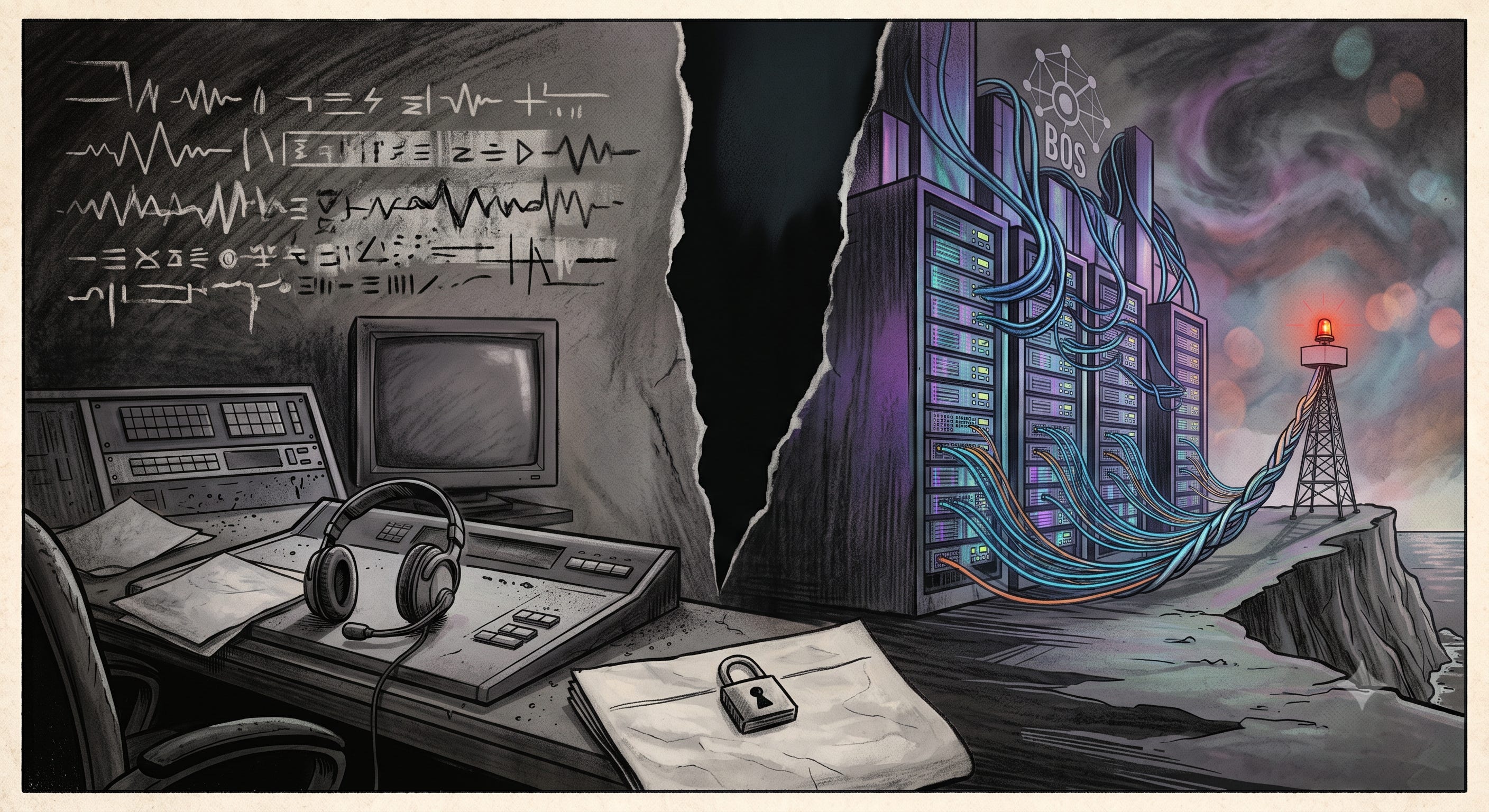
Part of the reason is a cloud-based master control platform that now monitors KEET’s entire broadcast chain from a Network Operations Center in Boston. The local engineering staff they had to cut? They don’t need them the same way anymore. The monitoring happens remotely. The operations continue. The station is still, technically, a station.
I’ve been arguing for a while that the infrastructure layer is the missing piece of the local media sustainability puzzle. Right now, that missing piece is finally arriving. Just not the way anyone planned.
If you found this analysis useful, consider sharing it with a colleague or subscribing to receive every issue of Backstory & Strategy direct to your inbox.
What Just Got Worse
First, we need to talk about how bad this actually is.
The Corporation for Public Broadcasting officially dissolved on January 5, 2026. Its board voted to shut down rather than remain a defunded, politically exposed shell. Just like that, 58 years of institution-building were gone by resolution—all because Congress rescinded $1.1 billion in funding at the administration’s request. The CPB was the single largest source of funding for more than 1,500 locally owned and operated public TV and radio stations across the country.
The damage to small-market stations was immediate and brutal.
The big-market stations had runway. GBH in Boston launched a $225 million, three-year fundraising campaign the day federal funding officially expired. But stations like KEET have no such cushion. No university backer, no institutional endowment, no wealthy metro donor base. Just a community-owned PBS affiliate in Humboldt County trying to keep the lights on.
KIXE in Redding lost more than 40% of its revenue. KZYX in Mendocino lost its news director after losing a quarter of its operating budget. These are not abstract budget lines. These are the actual people who cover city council meetings, school board decisions, and fire and flood emergencies in areas where KEET is sometimes the only station still broadcasting when the power grid goes down.
The cloud infrastructure story isn’t a silver bullet. It’s just a piece of a much harder puzzle.
The Ghost Market Fallacy

Why chasing non-existent markets while automating core operations creates the illusion of survival without the reality of community trust.
What Already Worked in Commercial Broadcasting
Here’s the thing about the technology KEET is now depending on: it’s not new, and it’s not experimental. Commercial broadcasters have been doing this for years.
Sinclair Broadcast Group announced its partnership with Amagi back in 2023 to migrate on-premise local broadcast automation to the cloud. The problem they were solving should sound incredibly familiar. Every station had been bought and sold multiple times, accumulating different hardware stacks, different workflows, and different support requirements. It was expensive, fragmented, and a nightmare to manage at scale.
The cloud migration normalized everything. More than 115 Sinclair stations have now moved onto Amagi’s platform, running on AWS infrastructure. One centralized management layer. Browser-based control. Local markets can still do what they need to do locally, but the economics are materially better.
Marc Hand, the CEO of Media Management, shared some CFO-level savings figures with me that are consistent with what’s been publicly reported from the Sinclair migration: millions in OpEx and CapEx savings as the migration progresses. I’m not going to pin down exact numbers I can’t independently verify, but the directional truth is well established: moving to cloud-based broadcast infrastructure cuts costs significantly.
Public media leaders didn’t need to be convinced that the technology worked. They just needed to figure out how to get there before the money ran out.
The Platform That’s Actually Moving
Public Media Management, known as PMM, has been around in various forms since 2015, when GBH (then WGBH) and Sony launched it specifically for public stations. The model was simple: replace expensive local master control infrastructure with a shared cloud-based platform, reduce capital and operating costs, and let stations focus on the content and community work they actually exist to do.
The person now running that platform is the same Marc Hand mentioned above. He’s also the founder of the Public Media Venture Group (PMVG), a cooperative that owns and operates more than 100 public stations reaching nearly 250 million people. Hand has spent more than 30 years in public and commercial media, co-founding Public Radio Capital (which became Public Media Company), and he’s been building toward this infrastructure model for the better part of a decade.
He is not a neutral observer. He has a deep strategic and financial interest in making this platform succeed. But he’s also one of the few people who has actually tried to build it at scale, which gives his perspective a different weight than most.
What’s changed is the sheer urgency. In February 2026, PMM launched PMM Cloud in partnership with LTN—the same IP video transport network used by major commercial broadcasters, sports leagues, and digital publishers. The timing is not coincidental; it’s a direct response to the CPB crisis. Core services run about $4,000 per month, with no required capital investment in traditional hardware, 99.9% reliability, and 24/7 monitoring from the NOC. KEET is one of the first deployments.
PMM is also in conversations with more than 25 other stations, ranging from Bridge-funded stations like KEET to statewide networks and major market stations. That’s a meaningful pipeline if it converts.
The commercial proof-of-concept is real. The platform exists. The technology works. The question now is whether the public media ecosystem can move fast enough to matter.
The 3-to-5-Staff Station
This is the part of the conversation I keep coming back to.
Hand’s argument is that cloud-based broadcast infrastructure makes it possible for a small-market station to operate with three to five staff members focused primarily on content and community engagement. The engineering overhead, the capital equipment refresh cycle, the full-time broadcast operator—those costs get absorbed into the shared platform.
Is that model actually viable? Honestly, it depends on what we mean by “station.”
If a station is defined by its transmitter, its license, and its obligation to air local content, then yes. Three to five people can keep that going with the right infrastructure underneath them. KEET is basically proving that right now with 4.5 staff.
But if a station is defined by its journalism capacity—its ability to cover local government, education, and public safety—then three to five people is a floor, not a model. You can keep the signal alive. You cannot cover the county commission, the school board, and a wildfire at the same time.
That’s not a knock on the platform. It’s just a clarification of what the platform is actually solving. Cloud infrastructure reduces the cost of keeping a station alive. It does not replace the civic value that a fully staffed newsroom provides. Both things are true.
What an Apparel Brand Taught Me About News Websites

When I started Editorial Style, I wasn’t just building a hoodie brand. I was running a small, low-stakes experiment in how a different industry operates — because e-commerce, it turns out, treats “how is my site actually doing” as a solved, boring, table-s…
The Dependency Question No One Wants to Ask
There is a massive catch here that nobody wants to talk about.
If 50 small-market public stations all run through a Network Operations Center in Boston, what happens when that relationship changes? PMM’s ownership structure has already shifted four times in under a decade: WGBH/Sony, then Public Media Group, then Signal Infrastructure Group, and now its current incarnation as Media Management. What happens if it shifts again, pricing changes, priorities change, or the NOC relocates?
This isn’t an argument against the platform. It’s the same question you’d ask about any shared infrastructure service. Stations that outsource master control to a centralized platform are trading local redundancy for cost efficiency and operational simplicity. That’s usually the right trade. But it creates a new kind of dependency that public media hasn’t historically had to manage.
The Consolidation Risk: The risk public media was trying to avoid—being absorbed into large commercial broadcasting groups because they couldn’t afford to operate independently—doesn’t disappear just because the consolidating entity is mission-aligned. It changes shape. Governance, pricing, service agreements, and exit options matter.
The stations that are smart about this will negotiate those terms carefully before they sign on.
The Funding Gap Nobody Is Solving
Cloud infrastructure costs money upfront, and the stations that need it most are also the ones most cash-strapped. That’s the trap.
KEET got there because of Bridge funding—emergency philanthropic support from the Public Media Bridge Fund, which was designed specifically to help stations stabilize after the CPB defunding. KEET received $535,000. Most stations don’t have that kind of lifeline. The gap between “we could survive with better infrastructure” and “we have the money to get there” is real, and it’s not being closed by the platform providers. That’s not their job.
What the ecosystem needs, and doesn’t currently have in any organized way, is a transition fund specifically for infrastructure migration. Not operational support. Not journalism grants. Infrastructure. The capital to get stations onto shared platforms, reduce their fixed costs, and give them a fighting chance to be self-sustaining on the other side.
Press Forward. Community foundations. The philanthropy community that has watched the CPB disappear. If there’s a high-leverage intervention left for public media infrastructure, this is close to it.
What I Actually Think
The technology Marc described—and that KEET is now running on—is real, and it matters. The Sinclair migration at commercial scale proves the model works. The PMM Cloud launch with LTN is a serious infrastructure offering arriving at exactly the right moment.
What I’m more cautious about is the framing that infrastructure alone solves the problem. It doesn’t. It extends the runway. It lowers the floor for survival. It lets stations stay alive through a brutal funding transition that is still nowhere near over.
The public media stations that make it through the next three years will likely be the ones who moved faster on shared infrastructure, restructured their cost base, and found ways to focus their remaining staff on the community work that no platform can automate. That’s not a small thing. It’s actually most of the work.
The transmitter being on is necessary. It’s not sufficient.
What the Rest of Local Media Should Be Watching
KEET is a public television station. But this isn’t about broadcast licenses or PBS affiliates. It’s about what happens when organizations built for a larger cost structure try to survive on smaller revenue, and whether shared infrastructure can close that gap.
Digital and print outlets know this problem under a different name. The ghost-site local newspaper. A CMS that automatically pulls wire copy, syndicates regional weather, and auto-posts AP alerts while the local newsroom has been eliminated. The site is technically live. The community is functionally abandoned.
The digital equivalent of “the transmitter is still on” already exists across hundreds of markets. It doesn’t look like survival. It looks like the lights being left on in an empty building.
Local news outlets of every kind are running into the same underlying problem. The specific solution—cloud master control and remote NOC monitoring—is PBS-specific. The underlying logic isn’t.
The organizations that survive the next decade won’t be the ones that found more money. They’ll be the ones that restructured around the irreplaceable. Small, focused, with everything that can be shared or automated removed from the fixed cost base, and the humans left doing the work that no platform can do: covering the county commission, building trust with the community, being present in ways that a transmitter in a rack somewhere in Boston cannot.
That’s a design choice, not just a budget decision. And it requires being honest about what the technology actually solves and what it doesn’t.
Four things it doesn’t solve:
It doesn’t solve revenue. Cloud infrastructure cuts costs. It does nothing about the fact that local advertising is structurally broken, that digital ad revenue accrues to platforms, and that subscriptions are hard to sustain in low-income or low-density markets. You can run lean and still run out of runway.
It doesn’t solve trust. A station that keeps its signal on but loses the reporters who covered the community for years doesn’t automatically retain its audience. Signal is not a relationship. The efficiency gains from shared infrastructure only matter if there’s an organization worth sustaining on the other side—one that people actually need and use.
It doesn’t solve the transition. Getting from a legacy cost structure to a sustainable cost structure requires capital during the move. Funders love funding content; they rarely fund the underlying pipes that let content reach people. A grant for a single climate reporter looks great in a foundation’s annual report. Paying $100,000 to move a local station from aging on-premise hardware to a cloud platform is invisible, unsexy, and nearly impossible to explain to a board. So funders keep chasing the shiny object: the reporter, the series, the fellowship. Meanwhile, the physical and technical infrastructure those journalists depend on quietly goes dark. A reporter is useless if the station can’t broadcast. That’s worth saying plainly.
It doesn’t solve the political environment. CPB is gone because of a political decision, not an operational failure. Cloud infrastructure is not a hedge against a government that views public media as an adversary. It’s an efficiency. The stations that survive on lean infrastructure will still face the same legitimacy attacks, the same audience fragmentation, and the same hostile funding environment. They’ll just face it with lower fixed costs.
That’s not nothing. It might be enough. But it’s worth being clear-eyed about what “enough” actually means right now.
Join the Conversation
Is shared cloud infrastructure the survival mechanism local media needs, or are we risking single-point-of-failure consolidation? How is your organization approaching the trade-off between fixed infrastructure costs and editorial headcount?
Leave a comment below—I read and reply to every thoughtful perspective from subscribers.
Before You Go: How Healthy Is Your Infrastructure Layer?
Are your digital publishing systems keeping up with your editorial workflow?
If you’re evaluating your publication’s technical efficiency, performance, and user experience, check out NewsGrade. It’s a free 10-step audit tool designed specifically for newsrooms and independent publishers to benchmark site health, site speed, and digital reader user experience—giving you actionable data in under two minutes.