

A Quick Disclaimer: Backstory & Strategy is a personal, independent publication. The views, analysis, and commentary expressed here are strictly my own and do not represent the official position, strategy, or endorsement of the American Press Institute, its leadership, or its board. This is my personal space for analyzing the media landscape, testing new frameworks, and thinking out loud.
I’m in Boulder this week for the Knight Foundation’s Audience Engagement Convening. Smart room. Real energy. The kind of gathering where you leave with more questions than you arrived with, which is usually a sign something useful happened.
Trust has been all over the agenda here—including a session with Benjamin Toff, an associate professor at the University of Minnesota, director of the Minnesota Journalism Center, and currently splitting his time between the University of Minnesota and Pew Research on exactly these questions. He’s probably one of the foremost researchers on trusted media in the world right now. His presentation was rigorous, grounded in years of data across four countries, and genuinely useful. There were good questions from the room afterward.
But nobody asked him how to measure trust.
Not one person. In a room full of journalism professionals, with one of the world’s leading trust researchers at the front, the most practical question on the table—how do we actually know where we stand with our own communities?—never got asked. I don’t say that to criticize anyone in the room. I didn’t ask it either. But that silence has been nagging at me ever since. We had the expert. We had the agenda item. And we collectively skipped the most important question.
That gap is what this piece is about.
If you’re finding this useful, the best thing you can do is share it with someone in journalism who should be thinking about this. And if you’re not yet a subscriber, you can fix that here:
Start with a definition, because this is where the field usually skips a step.
Toff offered one that I think is worth sitting with: trust is ultimately a leap of faith. A willingness to be vulnerable. An acceptance of risk—in this context, the risk that you might be misled, manipulated, or misinformed. That’s what you’re asking of someone every time they read your reporting or share your story with their community.
That definition matters because it explains why so many trust-building efforts fall short. You can’t reduce someone’s sense of vulnerability by showing them your correction policy. Transparency—the field’s default answer to the trust problem—is an input, not an outcome. It’s what you do, not what results from it.
Rachel Botsman—Trust Fellow at Oxford University’s Saïd Business School, author of Who Can You Trust?, and probably the most cited thinker on how trust works in the modern world—puts it this way: most trust breakdowns don’t happen because of a competence failure. They happen because of a perceived misalignment of intentions. People don’t distrust a newsroom because it got a fact wrong. They distrust it because they believe the newsroom is serving someone else—advertisers, owners, a political tribe—rather than them. If that’s the actual problem, no amount of transparency labeling fixes it. Transparency assumes good faith on the part of the reader. It doesn’t work on someone who has already decided your intentions can’t be trusted.
Toff’s research surfaces four things that actually do move trust: familiarity, reliability, sincerity, and humanity. Not correction policies. Not funding disclosures. Familiarity—whether audiences can even recognize you and differentiate you from the noise. Reliability—whether you show up consistently for your community, not just when you need something from them. Sincerity—whether people believe your intentions are genuinely to serve them. And humanity—whether you read as real people embedded in a real community, not an institutional voice or, increasingly, an AI content machine.
These are harder to operationalize than a transparency checklist. Which is probably why the field defaulted to the checklist.
Here’s what got me thinking about trust in the first place.
PBS has been named the most trusted institution in America for more than two decades—22 consecutive years, according to the PBS Foundation’s own data. Not the most trusted news organization. The most trusted institution—period. Outranking universities, nonprofits, the federal government, all of it. Worth noting: this is PBS’s own annually commissioned survey, not an independent third-party study. Which, as we’ll see, makes the whole thing even more interesting.
And PBS is currently fighting for its life.
Federal funding cuts. Political attacks. Existential uncertainty about its future. None of it deflected by two decades of trust rankings.
So here’s the question: if trust is real, if it actually means something, why didn’t it save them?
I think the answer is that PBS has been measuring the wrong kind of trust. And so is almost everyone else in journalism.
Trust isn’t one thing. It never was.
Think about your own relationship with a news organization. You might trust a specific reporter because she’s been covering your neighborhood for five years and she gets it right. That same outlet’s editorial board might drive you crazy. You might trust the brand for breaking news but not for in-depth investigation. A city council member trusts the accountability reporting that keeps officials honest. A community organizer distrusts the framing those same stories put around her neighborhood.
Those are all real trust relationships. All of them matter. All of them are earned differently, through different interactions, over different amounts of time. And exactly none of them show up in a national poll that asks “do you trust the news media?”
Toff made this point directly in Boulder. There’s a difference between generalized trust and selective trust—and high generalized trust isn’t necessarily good. India has very high trust in news. But many reform-minded journalists there would prefer the public to be more selective, because the most dominant outlets are widely perceived as corrupt and aligned with the government. What you actually want isn’t a high trust score. It’s the right people trusting you for the right reasons.
I’ve started thinking about it like a Chinese menu. Reporter trust. Brand trust. Mission trust. Source trust. Funder trust. Policymaker trust. You can order from any combination, and the combinations look completely different from newsroom to newsroom, community to community. A number on a national survey doesn’t tell you anything about where your newsroom actually stands on any of those dimensions.
PBS scored at the top of their own annual survey for more than two decades. And when it mattered, it wasn’t enough.
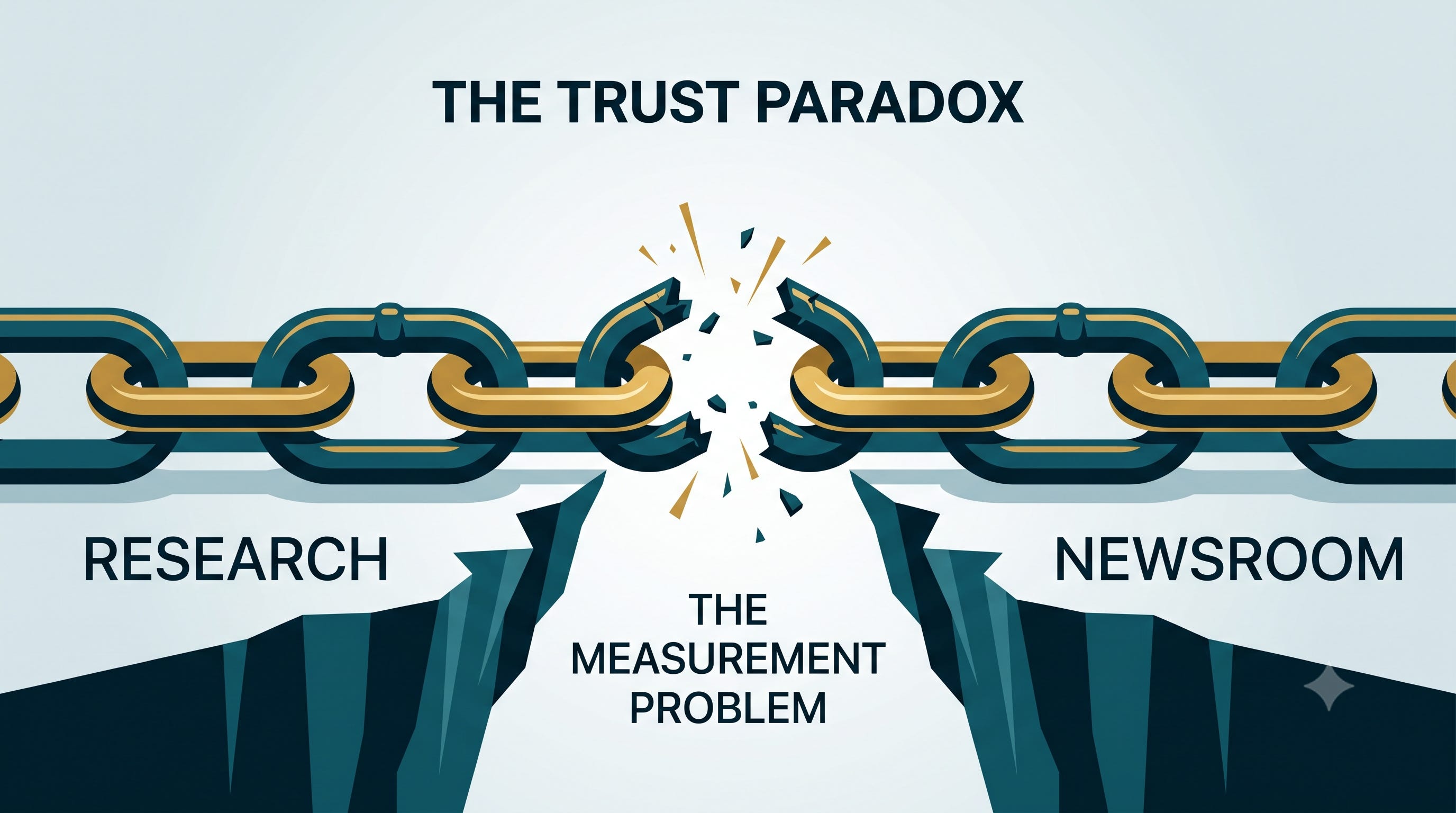
That’s not a paradox. That’s a measurement failure.
To be fair, the field hasn’t ignored this problem. There are organizations working on it seriously.
The Trust Project developed eight transparency standards—ways for newsrooms to show readers who’s behind a story, what the ethics policies are, how mistakes get corrected. Solid work. Adopted by hundreds of news sites globally. Trusting News works directly with newsrooms on practical trust-building strategies, testing what actually resonates with skeptical audiences. Their research is careful and their tools are useful.
I’m not here to take shots at either organization. They’re doing real work on a hard problem.
But here’s the thing. If you walked into most newsrooms in America right now and asked about the Trust Project or Trusting News, you’d probably get a blank stare. Most people in local news have never heard of them. The adoption just hasn’t happened at the scale the problem requires.
Part of that is a resource problem—small newsrooms are already stretched thin. But I think part of it is that nobody has made the real economic case for why trust should be a priority. Nobody has walked into an editor’s office and said: here’s what you lose, specifically, when your community stops trusting you.
And the reason nobody has made that case? Because we don’t have the data to make it.
Someone in Boulder pushed back on this during the Q&A in a way I’ve been thinking about since. The executive director of PolitiFact made the argument that for 45% of the country, trust in his organization is essentially unattainable—politically unreachable, full stop. So why focus on building trust at all? Why not focus on building need? Trust a lawyer or not, you still need one when you’re in trouble.
It’s a real argument. And I don’t think Toff fully answered it, though he gestured at the right response: the value proposition for journalism is mostly collective, not individual. Communities need quality journalism to hold leaders accountable, to tell stories that aren’t being heard. But for an individual reader, especially one who already distrusts you, it’s hard to manufacture urgency around that need on a Tuesday morning.
The more interesting response came from elsewhere in the room. Rocky Mountain Public Media in Colorado has essentially stopped trying to build trust in the traditional sense. They’ve replaced the membership and subscriber language entirely, calling their audience friends. And they’ve built a belonging dashboard—tracking five dimensions of belonging across more than a million touchpoints in Colorado, measuring not what audiences are doing for them, but what they’re not doing for their audiences. Where are people feeling welcomed? Supported? Connected? Their “friendships” went up. Revenue followed.
That’s worth sitting with. Maybe the field has been optimizing for the wrong variable entirely. Maybe trust is a byproduct of belonging, not the other way around.
So what does matter, practically? This is where I get stuck.
The instinct I keep coming back to is outcomes. If a newsroom covers the affordable housing crisis and six months later the city council creates a housing fund, that’s impact. And sustained impact, over time, should build trust. Right?
The problem is attribution. Did the coverage actually move that vote? Or was the policy already in motion and the journalism just gave it a moment in the spotlight? You’d need either direct testimony from decision-makers or some kind of control group comparison that simply doesn’t exist in local journalism.
Polling is the other option. The Heinz Endowments in Pittsburgh has been commissioning professional trust studies across their grantees—real, rigorous work. But that kind of study costs tens of thousands of dollars. Most newsrooms couldn’t afford it once, let alone annually. And even when organizations can afford it, the results aren’t always actionable at the local level. When I was at PBS39 in the Lehigh Valley, NPR’s national trust studies were a fundraising talking point, but they didn’t tell us anything useful about whether our specific community trusted us, or why, or what we could do about it. A national number is a PR asset. It’s not a management tool.
The most recent YouGov Trust in Media survey makes this concrete. NPR has a 70-point gap in net trust between Democrats and Republicans. Seventy points. What does “trusted” even mean in that context? The aggregate number is essentially fiction—an average of two wildly different realities.
Here’s the part that really gets me.
If a newsroom loses trust and nobody measures it, and there’s no visible consequence, then functionally the trust loss didn’t happen. The tree fell in the forest with nobody around.
Think about journalism’s most famous trust failures. Stephen Glass fabricating or partially fabricating the majority of his stories at The New Republic. Rolling Stone’s thoroughly reported and thoroughly wrong story about a gang rape at the University of Virginia. These were documented, undeniable trust failures. Glass lost his career. Rolling Stone paid out significant legal settlements—$1.65 million to a UVA fraternity, a separate confidential settlement to a university administrator who had won a $3 million jury verdict, plus legal costs. But The New Republic didn’t fold. Rolling Stone didn’t lose its audience in any measurable, attributable way.
The causal chain between a specific trust failure and specific harm to a specific newsroom is almost impossible to establish. Which means a reasonable editor can look at all of this and say: I hear you on trust, but prove to me that it matters to our survival. And we can’t.
That’s not cynicism. That’s rational behavior in the absence of measurement.
There’s a comparison that keeps surfacing in my head.
Libraries. A 2019 Knight/Gallup survey found that 73% of Americans express “a great deal” or “quite a lot” of trust in their local library, compared to 37% who say the same about local news organizations. The Trust for Civic Life’s most recent report, from Johns Hopkins’ SNF Agora Institute, found libraries, nonprofits, and community foundations averaging over 80% trust in local communities. Local news didn’t crack the top three.
“But we’re local too,” a newsroom editor might say. “We’re embedded in this community. We care about this place.” All true. Libraries can say the same thing. And libraries translated that into trust in a way news organizations haven’t.
The difference, I think, is intention alignment. Nobody thinks the library has an agenda. Nobody thinks the library is serving advertisers or distant owners or a political tribe. The library exists—physically, visibly, tangibly—to serve the people who walk through the door. Full stop.
That’s the perception news organizations are fighting. And here’s the interesting thing: newsrooms have started literally moving into library buildings—setting up desks in branches, embedding reporters in library spaces. Which makes sense as a trust strategy. But it’s also telling. You don’t borrow trust from an institution you’ve outgrown. You borrow it when you need what they have.
So where does this leave us?
What the field needs—and doesn’t yet have—is an affordable, standardized trust measurement framework that works across different newsroom models and captures trust at the stakeholder level, not just in the aggregate. Not a single trust score. A map of where your trust is strong, where it’s weak, and which relationships actually matter for your mission. It probably borrows from validated instruments—the World Values Survey, the Gallup institutional trust scale—rather than inventing new ones. It probably produces something a station manager or editor can actually use on a Tuesday morning, not just a slide for a funder presentation.
Or maybe it’s a belonging dashboard, like Rocky Mountain built. Maybe the right framework doesn’t measure trust directly at all, but measures the conditions that produce it.
Either way, that framework doesn’t exist yet. Not in a form the field has actually adopted.
Nobody even asked Toff for one. The field’s best researchers are still working on it. And we were all in Boulder this week, talking about trust seriously—which is more than we were doing five years ago—but still not asking the hardest question out loud.
PBS has more than two decades of “most trusted institution in America” behind them—their own data, their own survey, year after year. It didn’t save them. Not because trust doesn’t matter—but because the trust they measured wasn’t the trust that mattered when things got hard. The trust that actually protects an institution is the kind that lives in specific relationships, in specific communities, in the people who will show up and fight for you when the moment comes.
That kind of trust is genuinely hard to measure. But it’s time to get more serious about trying.
Postscript: Ben Toff Responds
After I shared this piece with Benjamin Toff, he replied with three additions that are worth putting on the record.
First, on measurement: he notes that most newsrooms are ultimately more interested in behavioral metrics—time spent, willingness to pay, use patterns—than in attitudinal ones like trust. Trust is related to those behaviors, but it’s messier to measure and isn’t synonymous with them. They correlate, but they’re not the same thing. That distinction matters, and it helps explain why the field keeps defaulting to what it can count rather than what it actually needs to know.
Second, and this is the one that stopped me: he argues that what matters even more than trust among the audiences you’re reaching is trust among the audiences you aren’t reaching—the broader public in a given community who may never show up in your metrics at all. Measuring attitudes and behaviors among non-audiences is harder and more expensive than measuring among those you’re already serving. And local surveys have become increasingly expensive to conduct. So the gap between what newsrooms know and what they need to know is actually wider than most realize—and widening.
Third—and here’s where it gets interesting—Toff is actively working to address exactly this problem. He’s building a cooperative survey effort through the Local News Impact Consortium designed to measure trust, news use, and information needs at the local level, at regular intervals, in a way that’s systematically available across local news ecosystems. The goal is to move the field away from disparate, hard-to-interpret case studies toward something that can actually track change over time.
His framing: the problem isn’t a lack of interest or know-how. It’s a massive coordination challenge, and it’s expensive. But he’s optimistic that building the infrastructure creates momentum.
So when I wrote that nobody asked how to measure trust—that’s still true of the room in Boulder. But someone is asking. And working on it. That’s worth knowing.
If you work in journalism and are wrestling with trust measurement—or if you’ve built something that actually works—I want to hear from you. Drop it in the comments below. This is a conversation the field needs to have out loud.
I’d argue there are several important discussions the field needs to have. But there’s a difference between “needs” and “wants,” “curiosity” and “denial,” “innovating” and “preserving.” And there’s a difference between listening and acting on what you hear.
Like you, plenty of observers have written that the field has exactly these problems. The diagnoses exist — this industry is a case study in organizational and management theory. What’s missing isn’t more evidence that the problems exist. It’s a willingness to let the evidence challenge the assumptions, institutions, and funding strategies already in place. As you point out, the more telling thing is often the question that never gets asked.
It’s a known problem. It’s serious. And time is short. Media companies are being bought and consolidated by people with the money to do it — roughly $203 billion in a single stretch of deals — while some cheer $1.45 million grants. We don’t need to keep studying problems everyone knows are happening while the ownership question gets settled without us.
What this industry needs most is curiosity and courage. The curiosity to listen to new ideas and the courage to fund them. From what I can see in the published solicitations, neither shows up as a funder trait or a sought-after applicant characteristic. That’s another discussion the field needs to have (but won’t).
Upton Sinclair had it right: “It is difficult to get a man to understand something when his salary depends on his not understanding it.”