

A Quick Disclaimer: Backstory & Strategy is a personal, independent publication. The views, analysis, and commentary expressed here are strictly my own and do not represent the official position, strategy, or endorsement of the American Press Institute, its leadership, or its board. This is my personal space for analyzing the media landscape, testing new frameworks, and thinking out loud.
Tuesday, I showed you what the NewsGrade data says about where nonprofit newsrooms stand on AI readiness. I said that the gap wasn’t really a website problem. It’s an operations problem. Here’s what I mean.
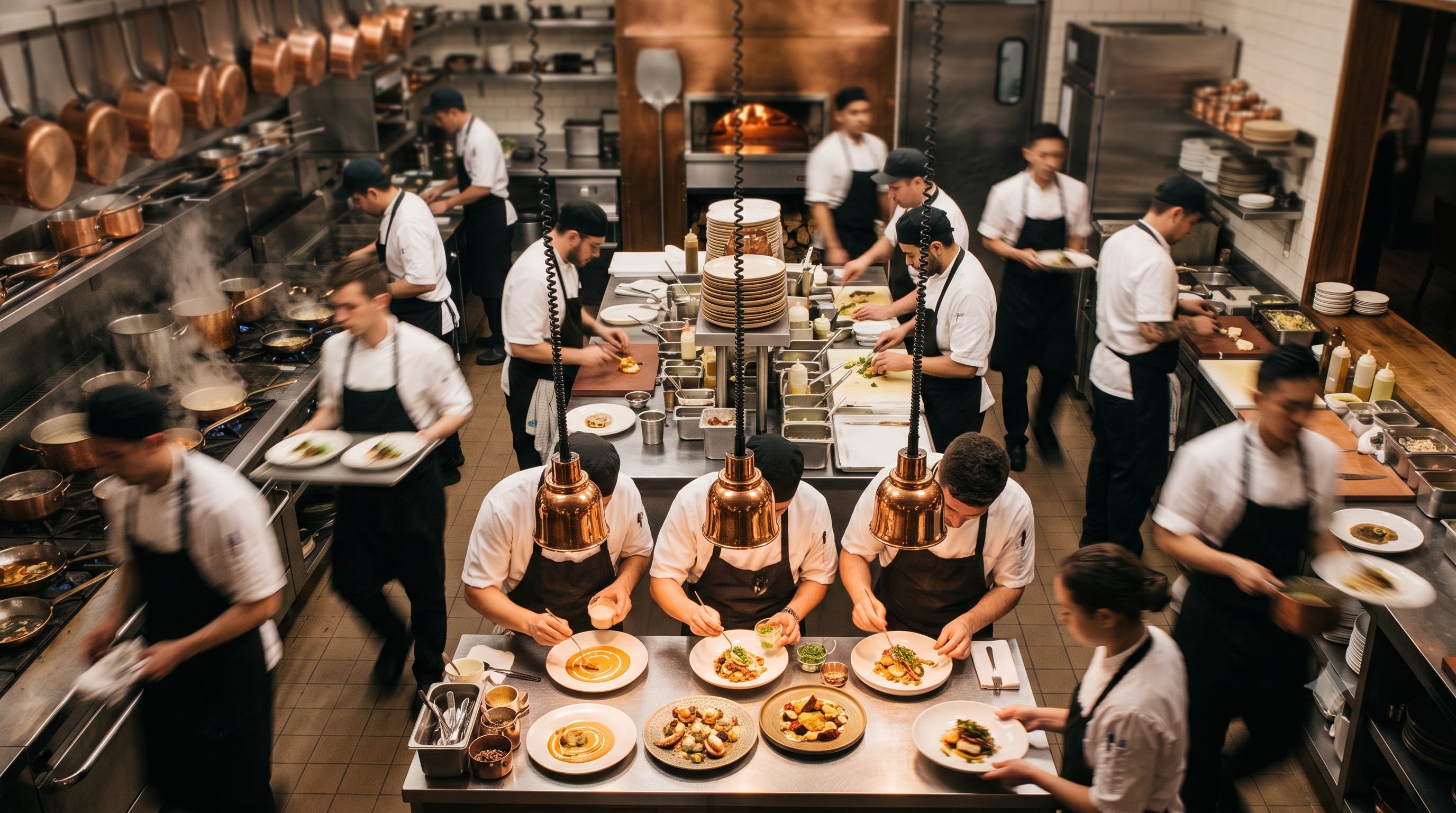
I was watching an AppleTV documentary about restaurants chasing Michelin stars, and a chef said something to his staff that stuck with me: he wasn’t coaching one station, he was talking about the entire operation’s muscle memory — front of house, back of house, timing, choreography, every person moving in sync without having to think about it.
That’s the good kind of muscle memory. Thousands of reps until precision becomes automatic, which frees everyone up for judgment in the moments that actually require it. It’s the foundation excellence gets built on — as long as the environment holding it up stays stable. The knife still cuts the same way. The pan still gets hot the same way.
Journalism had an operation like that, too. And its environment just changed underneath it.
If this is useful, subscribe to Backstory & Strategy for more of this — journalism economics and media strategy, twice a week, no fluff.
The Operation, Not the Habit
It’s tempting to describe what happened to newsrooms as “SEO stopped working.” That’s true, but it understates the problem, and it puts the blame in the wrong department. This wasn’t one bad habit in editorial. It was an entire operation that had synchronized itself — quietly, over about fifteen years — around a single assumption: Google and social platforms will keep sending people to us.
Look at how deep that assumption ran:
Editorial wrote and structured stories assuming search and social discovery — headlines built for click-through, pieces built for snippet-ability.
Product built templates and page architecture optimized for that same discovery layer.
Revenue monetized based on the pageviews those channels reliably produced.
Audience and growth teams measured success in referral traffic, because referral traffic was the thing that showed up and could be graphed.
Leadership planned budgets, staffing, and five-year strategy around that traffic holding roughly steady.
Every department had its own version of the reps. Every department got good at them. And every department was tuned to a stage that has now moved — global publisher search traffic dropped by roughly a third in 2025 as AI Overviews and zero-click answers took hold, and publishers now expect search referral traffic to fall another 43% within three years. That’s not a department having a bad quarter. That’s the floor moving under a synchronized operation that spent a decade-plus getting extremely good at dancing on the floor that used to be there.
Why This Is the Harder Problem
If this were just an editorial habit, the fix would be tactical: swap SEO headlines for AEO-friendly structure, adjust for how AI answer engines cite sources instead of how Google ranks pages. Newsrooms are already scrambling to do exactly that, and they should.
But a restaurant retraining its whole staff for a new service style isn’t a recipe swap. It’s new choreography, learned as a group, under real service pressure, with the old reflexes still firing by accident for months. Someone reaches for the plate the old way. Someone times the pass the old way. It takes deliberate, operation-wide practice to overwrite muscle memory — you don’t out-think it, you out-rep it.
Newsrooms are facing the same thing, at the same scale. It’s not “write differently for AI.” It’s rebuild the operation — editorial, product, revenue, audience — around a different theory of how readers find you and why they’d choose to stay found. The organizations already ahead on this aren’t the ones that tweaked their headlines. They’re the ones treating it as an operational retraining: pivoting toward owned-audience relationships (newsletters, subscriptions, direct membership) that don’t route through someone else’s algorithm at all, because you can’t out-optimize an answer engine, but you can build a relationship it can’t intercept.
The Craft Was Never the Problem
Here’s the part worth sitting with, though, because it’s not all bad news. The chef’s muscle memory — the actual craft, the judgment, the precision under pressure — that’s durable. It survives a changing menu. It survives a new dining room layout. It’s built on skill, not on a platform’s rules.
Journalism has an equivalent. Reporting, verification, sourcing, narrative judgment — that’s craft in the chef’s sense, and it hasn’t gone anywhere. What broke wasn’t the newsroom’s skill. It was the distribution reflexes bolted onto that skill — reflexes that felt like craft because they were so deeply practiced, but were actually just an adaptation to somebody else’s kitchen.
The operations that make it through this retraining won’t be the ones that mourn the old choreography the longest. They’ll be the ones who figure out fastest which of their muscle memory was craft, and which was just really well-practiced dependency.
Where’s your operation still running on the old choreography? Reply to this post or drop a comment — I’m curious which department’s muscle memory is proving hardest to retrain: editorial, product, revenue, or leadership.
And if you haven’t run your own newsroom’s numbers yet: grade your site free at NewsGrade. Ten minutes, full report, no guessing which parts of your operation are still dancing on a floor that isn’t there anymore.
Good insight 😃. Can i translate this article into Spanish with links to you?