
We Can Explain Your Money, But Not Our Own
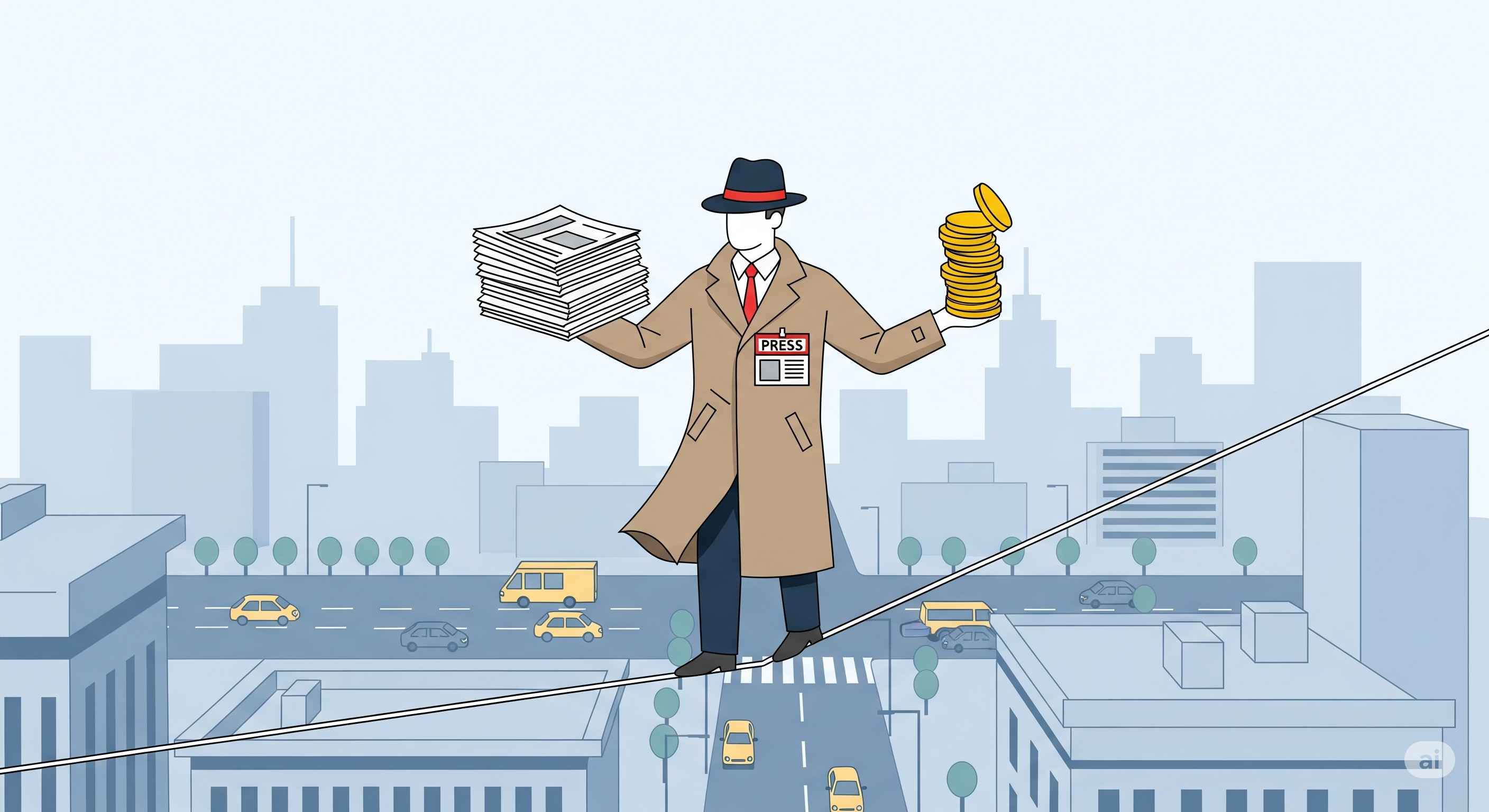
For generations, a "Chinese Wall" separated the newsroom from the business office. As journalists go independent, they must tear it down and finally master the one system they were trained to ignore:

Years ago, I worked with a brilliant newspaper journalist—someone who could dissect a municipal budget like it was a murder mystery.
Now, if you know anything about municipal budgets, you know they’re beasts: hundreds of pages long, full of capital funds, deferred costs, and formulas that would make an accountant sweat. But she loved them. She could find the story buried in the numbers faster than most of us could find the index.
One day, after she filed another killer piece, I told her, “I could never have done that. I can’t even balance a checkbook.”
She leaned in and whispered, “Neither can I.”
And there it was: the great paradox of journalism.
We’re trained to explain other people’s money—but not our own.
The roots of this paradox—and its solution—go back further than you might think. For the history nerds, the original American journalist was also an entrepreneur: Benjamin Franklin was a writer, editor, publisher, and postmaster, all in one. The idea of separating the craft from the business would have been alien to him.
That spirit of the journalist-as-owner-operator was carried into the 20th century by figures like I.F. Stone. With I.F. Stone’s Weekly (1953–1971), he proved that rigorous, independent journalism funded directly by readers could not only work but thrive. His meticulous sourcing of public documents and refusal to rely on access journalism made his one-man operation a kind of intellectual godparent to today’s independent Substacks.
But the model championed by Stone was the exception, not the rule. The dominant structure for 20th-century news organizations was one of deliberate separation. The phrase “Chinese Wall” was used to describe the stark divide between the editorial and business operations. Many journalists even wore their ignorance of business matters like a badge of honor—it was a "proud tradition of ‘not knowing’" that signaled independence, purity of purpose, and a refusal to “sell out.”
This divide shaped newsrooms from the top down. Take Ben Bradlee, the legendary Washington Post editor who steered the paper's coverage during Watergate. Despite having helped found a newspaper and playing a role in the purchase of Newsweek early in his career, he was famously disengaged from the business side of the Post. The wall between news and commerce was sacred.
That wall, however, began to show cracks with the dawn of the digital age. The groundwork for today's independent movement was laid as early as 2010, when digital tools, social media, and a collapsing legacy media economy combined to make independence feel not just necessary, but possible. The most significant modern inflection point arrived post-2017 with the rise of platforms like Substack, which finally made the technology simple enough for the writer to once again become the publisher.

So what’s changed now?
Journalists are fleeing traditional media for independence because the math finally works in their favor—and the old institutions are collapsing anyway. In 2023, roughly 2,700 journalism jobs were cut, with more than 3,800 lost in 2024 across the U.S. and U.K. Meanwhile, power is shifting “to the individual journalist from the news outlet,” as more people seek out trusted voices through search, email, blogs, and social media. Readers follow writers now—not mastheads.
The technology has finally caught up to the ambition. Platforms like Substack have obliterated the need for sprawling newsroom infrastructure. Politics and news subscriptions on the platform are expected to more than double in 2024, and a growing number of journalists—now in the double digits—are earning over $1 million annually. When Bari Weiss’s The Free Press can generate an estimated $9.6 million a year from subscriptions, the economic case becomes hard to ignore.
But it’s not just about money—it’s about editorial freedom and direct audience connection. Taylor Lorenz left The Washington Post seeking “autonomy to write, do, and say what she wants without institutional restriction” and “a more direct and vocal relationship with her audience.” The “stick to sports” mandate that killed Deadspin is just one example of how legacy media can misread its own value.
The cultural shift is real. Nearly one in ten reporters now work at nonprofits or independent ventures, and many describe freelancing or launching solo projects as a transformative experience. For talented journalists, going independent isn’t just possible—it’s often the smarter career move. The real question isn’t why they’re leaving, but what took them so long.
But here’s the problem: most of these journalists know far more about running a newsroom than running a business.
This dynamic, of course, isn’t unique to our field. It’s a familiar story across the nonprofit and mission-driven world. How many organizations promote their best practitioner to a leadership role, only for that new leader to have to learn management entirely on the job? A star social worker is made Executive Director; a brilliant curator is asked to run the museum. They are masters of the mission, but often novices when it comes to finance, operations, and governance.
For the modern journalist-turned-founder, the challenge is identical, but the stakes are often higher and the safety nets are gone. The complexities of 990 filings (for nonprofit newsrooms), annual audits, and working with—let alone assembling—a board of directors? That’s completely foreign territory for most of them.

So what can be done?
On one hand—and credit to them—organizations like the American Journalism Project, the Pivot Fund, and Tiny News Collective are stepping up. These philanthropic infrastructure builders for local and community journalism are putting more emphasis on developing the business side of the organizations they support.
As a representative from the Pivot Fund shared with me in a LinkedIn exchange:
“At The Pivot Fund, we’ve seen firsthand how business literacy can make or break a newsroom’s sustainability. That’s why our support goes far beyond editorial investment. Helping founders connect content to revenue is at the core of our work.”
And that’s important—and commendable. But it’s not enough.
Combined, these organizations only reach a small fraction of news startups. If we really want to build a future of sustainable, independent journalism, this can’t just be the work of foundations and intermediaries. It has to start earlier.
This work needs to be built into journalism education, from the classroom to the curriculum. We need to teach the business of survival alongside the craft of reporting.
Imagine programs that taught not just how to write a lede, but also:
How to read a P&L statement, so you understand your organization’s financial health, not just the headlines it produces.
How to calculate unit economics, so you know the true cost of producing a story versus the revenue or community support it generates.
How to manage burn rate and runway, the vital signs for any founder or nonprofit leader trying to keep the lights on.
How to build a grant budget with the competence and clarity that funders expect and that great reporting demands.
How to analyze audience metrics that actually matter for sustainability—like reader conversion and retention, not just vanity clicks.
Because journalists already know how to make sense of complicated systems. It’s time we applied those same skills to the one system most of us never learned: our own.
This piece is for everyone who believes in the future of sustainable, independent journalism. If you found this analysis valuable, please consider sharing it and subscribing to Backstory & Strategy for more insights into the changing media landscape.
What do you think? Are you a journalist who has faced this challenge, or do you see this paradox in your own field? Share your thoughts in the comments.