

A Quick Disclaimer: Backstory & Strategy is a personal, independent publication. The views, analysis, and commentary expressed here are strictly my own and do not represent the official position, strategy, or endorsement of the American Press Institute, its leadership, or its board. This is my personal space for analyzing the media landscape, testing new frameworks, and thinking out loud.
Get a group of people who work in news together, and the conversation will almost inevitably turn to engagement. How do we do it? How do we do it better? How do we compete for attention? Who has figured it out?
There are a lot of ways to think about audience engagement. When I ran a newsroom, I encouraged reporters to hold office hours and publicize them, so people could seek us out in an environment that didn’t feel transactional. People loved it.
I know reporters who have held office hours in pizza parlors and ice cream shops, and one who spread a picnic blanket in a park next to an ice cream truck. In every case, the vendor got a little foot traffic, and the reporters got tips, met interesting people, and, in some cases, developed sources who lasted. Parents told them how hard it was to get a crossing guard for a busy intersection. A business owner described getting nowhere with city officials on a growing rodent problem, made worse by vacant storefronts. A retiree wanted to know why a newspaper wasn’t covering the Shade Tree Commission anymore. All three were gifts of information, handed over simply because a reporter was there.
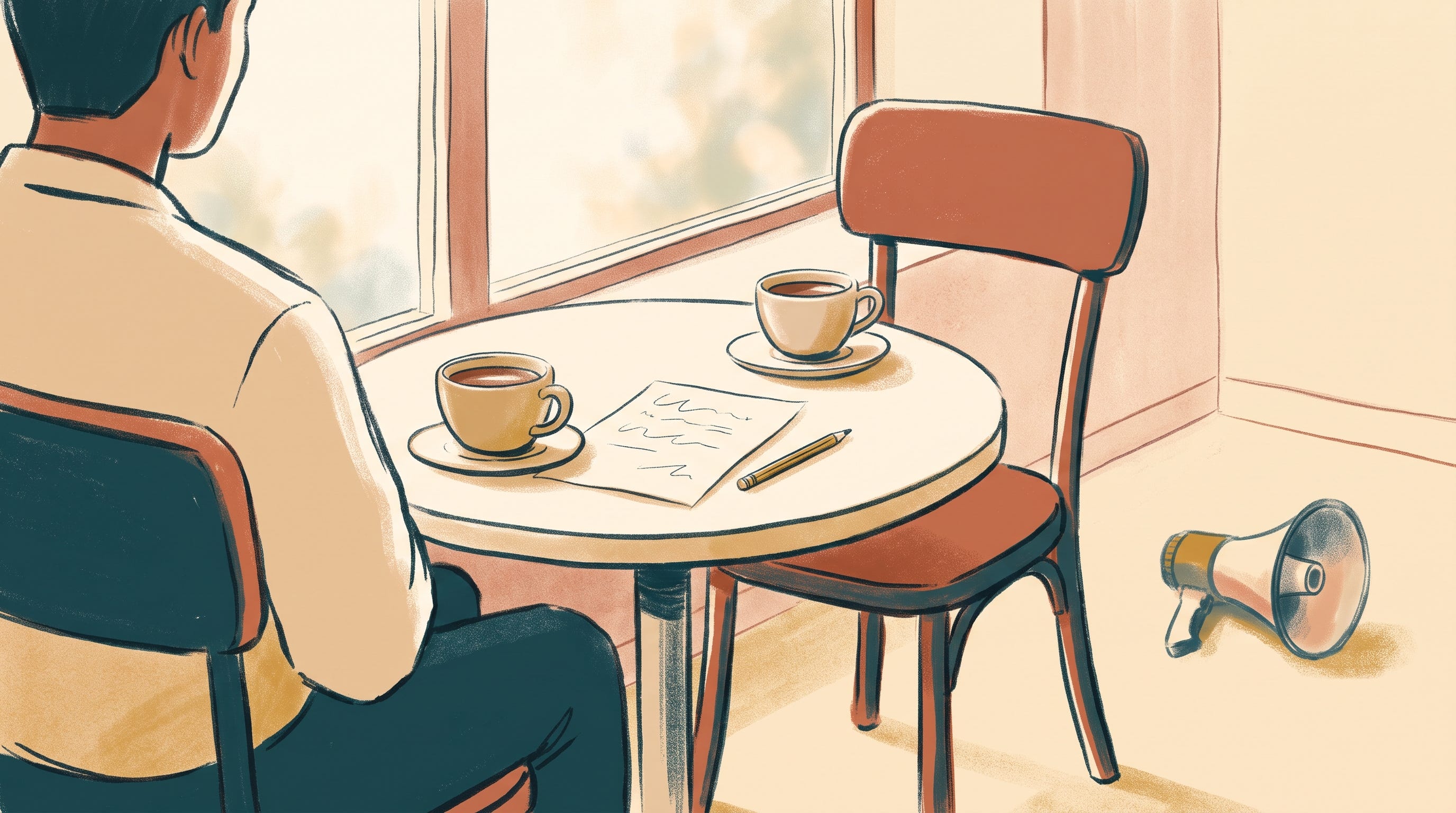
Recently, my wife, Tracy, and I watched Paralyzed by Hope: The Maria Bamford Story. If you don’t know Maria, she’s a successful comedian whose material often draws on her struggles with mental health. Plenty about her approach to comedy stands out, but one thing caught the eye of the filmmakers and drew real surprise from her colleagues. Maria uses social media to find fans, and sometimes strangers, willing to sit down with her over coffee, in person or on Zoom, and listen to her try out new material. It’s an audience of one. She buys the coffee, and over the years she has paid listeners in food, T-shirts and, according to coverage of the film, cash.
The habit goes back a long way. A 2014 New York Times Magazine profile reported that when Maria was building new material, she paid friends $75 an hour to listen to her run bits over the phone. The same profile described something even closer to our world. After reading that a strong sense of community helps people live longer, happier lives, she had a park bench installed on the median in front of her house and stenciled an invitation to sit on the sidewalk beside it. Neighbors used it often. She called it “a bird feeder for humans.”
That’s office hours with a bench instead of a picnic blanket.
I’m not suggesting reporters start paying community members for their time. But I do think Maria is on to something, and the money turns out to be only part of it.
Backstory & Strategy is free, and it lands in your inbox on Tuesday and Thursday mornings. The hard calls, explained by someone who’s made them. Subscribe, and send it to the colleague who keeps saying “we should talk to our readers more.”
Office hours were the easy part
Office hours work because nobody is asking for anything. There’s no deadline and no quote to extract, just a person who happens to be a journalist sitting at a table, and a local business glad to have the company. Look closely, and it’s a small exchange in which everyone leaves with something. That matters, and I’ve written about why.
But notice what the reporter is giving. Its availability. The reporter shows up with nothing except themselves, and the information still flows mostly one way, from the public to the newsroom, as tips and introductions. The work itself stays backstage until it’s published. We open the door, but we don’t open the workshop.
What Maria does differently
Three things stand out in her coffee dates.
First, she performs it for real. One of her recruiting posts asked for 45 minutes of a listener’s time, enough to run a big chunk of new material front to back. She has said she memorizes her sets and finds it helps to rehearse with a friendly person. The material has to leave her head and survive contact with someone else’s attention. That’s a different test than describing a bit or reading it off a page.
Second, the payment buys a witness, not a critic. Maria has said the witness “needs to be paid appropriately.” The payment turns a favor into a working session, and it acknowledges that the listener’s time has value. Most of us can’t say the same about the feedback we ask readers to give us for free.
Third, the setting is ordinary. Maria has said her last session before lockdown was at a diner in Manhattan. One ended up in a Dunkin’ Donuts parking lot, and she has described a five-year-old who heckled the entire set. That isn’t a flaw in the test. It’s the actual condition under which her material will eventually be received. And a single listener may not laugh at all, something she has acknowledged happens.
This is a real practice, not a stunt. Maria told the Duluth News Tribune in 2019 that she had gone looking for a listener on Twitter about 20 times in two years, and that one woman drove nine hours to take part.
The person across the table isn’t always sure what the job is, either. Ashley Neenan, a Duluth fan Maria picked from the replies, told the paper she “ran around my house screaming” when the invitation arrived. Over garden salads at a café, she said, the hard part was telling whether Maria was asking her a question or still in on-stage mode. That disorientation is exactly what you want to engineer out of any reader test. If someone can’t tell whether you’re asking for their reaction or just talking, you’re collecting confusion, not feedback. Say out loud what you’re asking people to do, and what you’re not.
I should be honest about the limits of the comparison. Maria recruits people who say yes, so her listeners are self-selected, and one listener is one data point. She isn’t running a study. She’s rehearsing. Newsrooms should be just as clear-eyed about what a handful of volunteers can and can’t tell them.
I have argued in this newsletter that newsrooms should ask their audiences more questions, and I still believe it. But notice that Maria isn’t asking anything. She isn’t running a survey or a listening session. She’s putting the work in front of a person and paying attention to what happens. Asking is where this starts. Showing the unfinished thing is the harder move.
Engagement is a marketing line item. For Maria, it’s R&D.
Where does engagement live in your organization? For most newsrooms, it sits with social, audience, membership, or marketing. Its job is to get people to show up, click, subscribe, or give. We measure reach, conversion, and retention, which are all measures of whether people arrived.
In Maria’s model, engagement is a stage of development. The audience is in the room before the thing exists in finished form, and the question isn’t “did they come?” but “what happened when a real person met this?”
That’s a different budget, a different owner, and a different scorecard. It’s also a very different relationship. Marketing asks people for something. Research and development brings them in on the making.
Working in media, in the day-to-day hustle, it’s easy to forget that you are in a bubble. It happens to lots of leaders, myself included, who spend their time going from meeting to meeting, office to home, and stop hearing from the people who matter most, their customers. Maria’s coffee dates, like that bench in front of her house, are bubble breakers built into the process.
The Diligence Gap

Local news gets funded on brand goodwill and grant narratives, while a franchise broker would never sign off on a territory without a feasibility model. PressViable sets a newsroom’s financials against its own county’s economics, then pairs them with live crawler data from AI Readiness Check, so funders and buyers can finally check the math before the money moves.
What this looks like without writing checks
Here is where I’d start, and where I’d be careful.
Sit with one reader, start to finish. Take something unfinished, such as a story package, a newsletter format, or a prototype of a data tool, and watch one person go through the whole thing while you stay quiet. Don’t ask what they think until they’re done. Where they slow down, skim or give up tells you more than a survey will. You can also share a draft reporting plan and ask what’s missing, but the full run-through is the Maria move.
Build a first-look panel. Eight to twelve community members who see pitches, formats, and launches before they go live, on a rotating basis so you don’t end up with the same enthusiastic insiders every time. They advise on usefulness, clarity, and format. They don’t weigh in on what’s news.
Pay in what you have. Tech companies pay participants in user research as a matter of routine, usually with a gift card or a credit, and nobody blinks. Newsrooms ask for the same time for free and then wonder why only the already-devoted show up. A comp membership, event tickets, a donation to a local nonprofit of the participant’s choosing, or a plain gift card all say what Maria’s payment says: this is a working session, and your time matters. It also gives people a reason to stay through the whole thing. The line to hold is between paying people to test a product and paying sources for information. The first is standard research practice. The second is a boundary you do not cross.
Close the loop. Tell the group what changed because of them. This is the cheapest step and the one most often skipped. People will forgive an unfinished product more easily than they’ll forgive being asked and then ignored.
City Bureau in Chicago is the closest working example I know. Its Public Newsroom began as a free weekly gathering where anyone could propose to host a session, and presenters were required to make the evening interactive, a space for feedback rather than a lecture. As one attendee put it, “the power lies in the person asking the question, not the one presenting.” When City Bureau redesigned the series in 2020, it said the changes came from what attendees told it, which is the close-the-loop step in practice. Its Documenters program goes a step further and pays residents to cover public meetings, at rates Nieman Lab put between $16 and $20 an hour in 2022. That’s paid labor, not a focus group, but it rests on the same premise as Maria’s payments: community time is worth paying for.
Two cautions, since I’d rather name them than have a reader do it for me. A small panel can feel like representation without being representative, so rotate it and say plainly who is and isn’t in the room. And none of this works if the feedback never has a chance to change anything, because then you’ve built a more elaborate suggestion box.
The price of attention
We ask audiences for a great deal. Attention, trust, time, loyalty, and, increasingly, money. In return, we offer a product and, if we’re feeling generous, a newsletter.
Maria’s fans get paid and get a seat in the room, and she gets better material. The reporter on the picnic blanket gave away an afternoon and got tips and sources that lasted. Different currencies, same principle: the engagement that works leads with something given, not something asked. It’s an exchange both sides can see, which is more than most engagement strategies can say. Engagement that costs the newsroom nothing tends to be worth about that much.
So here is a small experiment for this month. Pick one thing your organization is about to launch. Find six readers. Sit with each one while they go through the unfinished version, start to finish, and say as little as you can. Thank them in a way that costs you something. Then tell them what you changed.
Engagement isn’t the megaphone we use to announce that the work is done. It’s the coffee we buy the person helping us figure out if the work is actually any good.
Have you ever shown something unfinished to a reader, viewer, or community member before launching it? What did you learn that a survey would have missed? I’d love to hear it in the comments.