
What Parenting a Neurodivergent Kid Taught Me About Newsrooms
The real struggle isn’t motivation. It’s the missing bridge between wanting to act and being able to start.

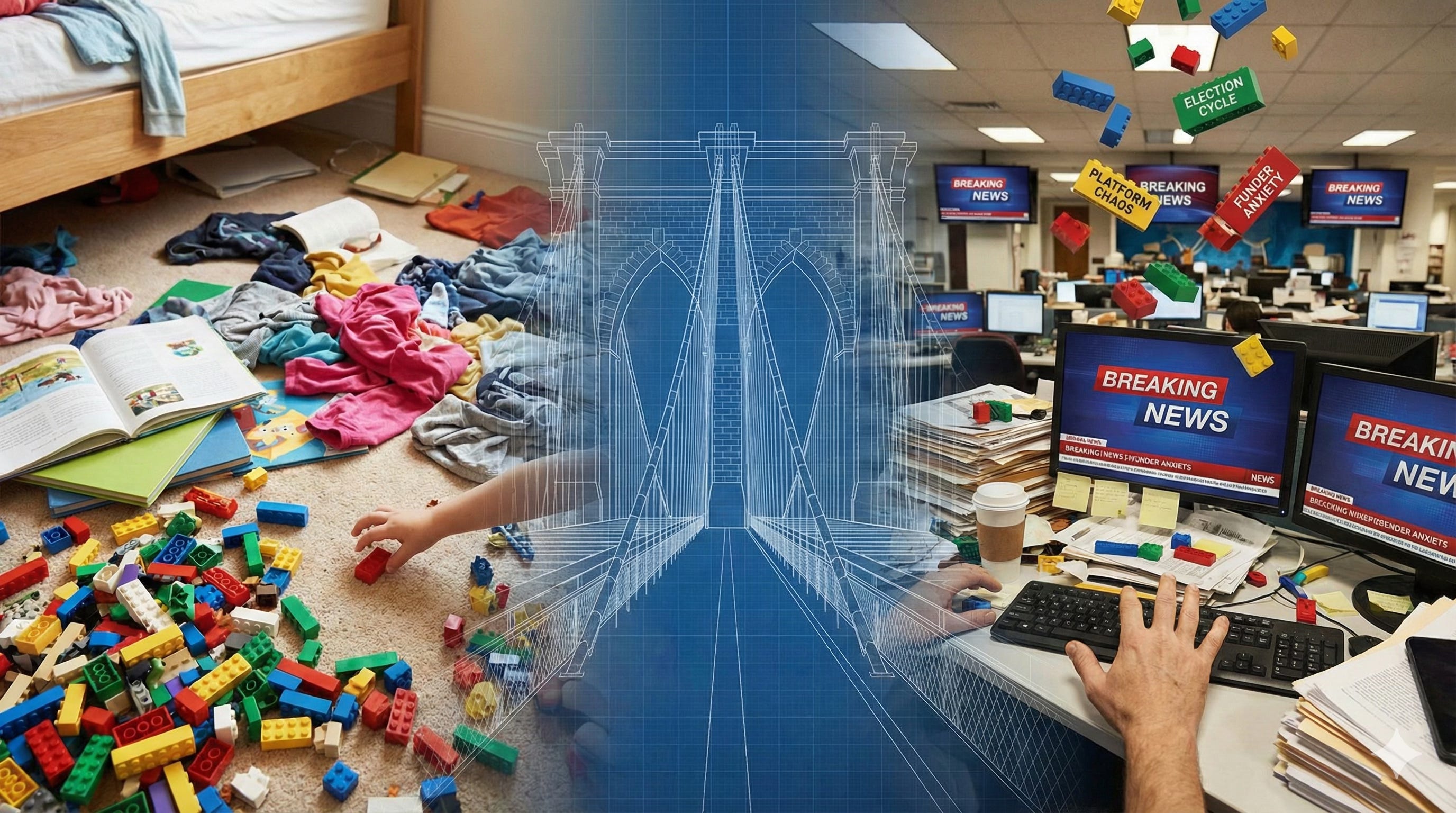
There’s a moment that occurs in Omari’s room.
The mission is always the same. Reset the space so that it is livable once more.
Dirty clothes in the hamper. Trash in the bin. Books on the shelf. Lego in their basket. Dirty cups back in the kitchen.
He knows what needs to happen. He cares about what needs to happen. He is proud when it is clean.
But he picks up a T-shirt, and underneath is a book he has not seen in a week. Or a Lego piece he has been searching for. Or a piece of candy still wrapped that sparks a tiny burst of delight.
Suddenly, he is not cleaning. He is off on a side quest.
I pass by his door a few minutes later, and there he is. Sitting in the middle of the mission.
Not lost. Not defiant. Still fully aware of the task.
But now too overwhelmed to know where to restart.
The order is unclear. The steps feel scrambled. The intention has not changed. Only the path has disappeared.
I remind him of the goal. I point to the hamper. The trash bin. The shelf.
I try to help with the order. I keep it simple. I keep it gentle.
“Why don’t you just start with putting your dirty clothes in the hamper?”
Another pause. Eyes down. A soft “…okay.”
Even if he does not say it out loud, his whole body is expressing defeat.
He might shift his attention. He might start tapping at his phone. But he is still in the room with the problem. Still trying to stay engaged with the mission.
And that matters.
Because there are other moments. Harder moments. When the overwhelm wins.
When he cocoons himself under blankets. When he builds a structure of sheets and pillows to visually block himself from the chaos around him.
Not because he wants to give up. But because his brain is waving a white flag.
“I can’t hold all of this anymore.”
Today is not that day. Today, he is still fighting to re-enter the task.
He picks up a sock. Looks around for where socks should go. Spots some Lego under a hoodie. Loses the thread again.
He does know.
He knows exactly what needs to happen. He knows we have talked about this before. He knows that if he cleaned a little each day, he would not be in this moment.
He truly knows. He just is not sure how to keep moving forward once he loses his place.
He hasn’t forgotten the plan. He just can’t find the entry point.
I used to think this meant he did not want to do the job. But now I understand something different.
Desire and action are not synonyms.
Especially when your brain is processing the world in stereo.
Parenting Omari has taught me a new language. The language of executive functioning. The quiet skills that convert motivation into momentum. The bridges that make follow-through possible.
And once I learned to see those bridges, and how easily they buckle, I started noticing something else.
I have seen these same struggles at work. Not in one or two newsrooms. In most of them.
The Organizational Version of the Bedroom Floor
Newsrooms do not stall because they do not care.
They stall because everything feels urgent. Because nothing feels startable. Because the steps are unclear and the consequences feel enormous.
And because new “Legos” drop from the sky every hour.
Breaking news. Board asks. Funder anxiety. Platform chaos. Internal politics dressed up as priority.

The room never stays still long enough to clean it.
I have watched people sitting inside a mountain of mission. Fully aware of what needs to get done, but unsure where to restart. Terrified to choose the wrong first move.
That is not apathy. That is cognitive overload.
You can see it in news cycles too.
Day One journalism is muscle memory. A fire breaks out. Adrenaline spikes. The sirens guide the story.
Day Two requires something harder. Less dopamine. More planning. Following the families who were displaced rather than the flames that made the headline.
And that is exactly where newsrooms get stuck.
The urgency has passed, but the cognitive load has not.
Sometimes they are still “in it.” Devices in hand. Trying to re-enter the task.
And other times, the overwhelm wins. They retreat into organizational blanket forts.
Old systems. Familiar workarounds. Those “this is how we’ve always done it” reflexes.
Not because they want to stop. But because the mission has become too heavy to hold upright.
The organization still wants to do the work. It just cannot get its arms around the sequence.
We Keep Misdiagnosing the Problem
When Omari gets stuck, the easy conclusion is to ask if he is even trying.
When newsrooms get stuck, the easy conclusion is to say we need more discipline. We need people to step up. We need to push harder.
But effort is not the missing ingredient. This is not a motivation issue. It is a capacity issue.
If the task is complex and ambiguous and consequential and constantly interrupted, then “trying harder” is like revving the engine while the wheels hang in the air.
Most newsrooms are running in a state of structural executive dysfunction.
This is not failure. It is overload.
And overload has predictable outcomes. Avoidance. Reversion to muscle memory. Fire-drill culture. Burnout disguised as loyalty.
We Built Systems for Robots and Staffed Them With Humans
Here is the irony.
Newsrooms attract exactly the kind of brains that see what others miss. Pattern recognizers. Creative problem solvers. People who hyperfocus on truth and feel the stakes viscerally.
These are strengths. But strengths without structure turn into struggle.
Because the system assumes infinite working memory. It assumes perfect prioritization. It assumes calm under constant threat and no need for recovery or reset.

We celebrate grit. We ask people to live in crisis. We treat burnout as a tax for caring.
It’s like training an orchestra and then handing out kazoos and broken music stands.
Talent is not the issue. The environment is.
Structure Is Not Control. It Is Accessibility.
This is the lesson parenting handed me right between the eyes.
The right structure does not restrict Omari. It unlocks him.
Clear order. Defined first step. Fewer simultaneous demands. Visible progress.
Then he flies.
News organizations need the same scaffolding.
Clarity of priority so we know what gets done first. Protected focus so there are fewer interruptions during the work. Externalized working memory so the systems hold the tasks rather than our brains. Predictable rhythms so progress is not dependent on adrenaline.
This is not bureaucracy. It is kindness engineered.
Stress Makes Everyone Revert to Muscle Memory
When Omari is overwhelmed, new skills vanish. He falls back to what feels safe.
Newsrooms do the same.
They make strategic progress and then an election cycle hits. Or a crisis. Or leadership turnover. Or a major funder’s sudden new hobbyhorse.
Suddenly silos snap back. Metrics become vanity. Decision-making centralizes. Innovation goes into hibernation.
Not because anyone forgot. Because the nervous system overrode the strategy.
If progress disappears every time stress rises, that is not weakness. That is a sign the system was not built to support progress under pressure.
Stop Confusing Struggle With Resistance
There is a turning point in parenting a neurodivergent child where you stop asking why they won’t just do it.
And you start asking what is getting in the way.
That shift changes the whole dynamic. You move from judgment to design. You reduce shame and increase agency.
Newsrooms need that same pivot.
When progress slows, I assume people still care. I assume they want to act. I assume the system is blocking them.
Because when paralysis is seen as a design problem and not a character flaw, you redesign the system. You free the people.
What 2026 Is Asking of Us
Not bigger hearts. Not thicker skin.
After the grind of 2025. The elections. The constant platform shifts. The relentless pace. Those wells are already running dry.
What we need now is humane architecture for mission-driven systems.
Fewer priorities with more focus. Decisions that reduce cognitive load. Meetings that serve clarity instead of confusion. Leaders who turn mission into manageable steps. Workflows that succeed without heroics.
I have seen this in newsrooms. But they are not alone. Public media. Nonprofits. Foundations. Schools.
Anywhere purpose outruns process, the same collapse shows up in different clothing.
The structures are not keeping up with the size of the calling. We should be designing excellence that does not require burnout as fuel.
A few years ago, Omari auditioned for a role in our local community theatre’s production of The Addams Family Jr.
He had taken singing lessons for years. He loved being on stage. But this was new territory.
Memorizing lines. Choreography. Working with a cast of strangers. Staying on script and on time under bright lights.
He said he wanted to try. So we tried with him.
My wife ran lines with him. The director was endlessly patient. The other kids supported him every beat.
And when the curtain lifted on opening night, he had put all the pieces together.
The lines. The moves. The expressions. The timing.
To us, it was perfection.
He was always capable. He simply needed the scaffolding and the belief to show it.
That’s the work of this year.
When a system is failing, yelling at the person inside it will never fix it.
Compassion is not indulgence. Structure is not a burden. Accountability without clarity is cruelty.
We can build systems that reflect the brilliance of the people inside them.
Journalism does not need to try harder. Nonprofits do not need to stretch thinner. Schools do not need to sacrifice more.
We need to design better.
And this year, we begin.
What is the “bedroom floor” in your organization right now? Is there a project or a department where the team knows exactly what to do, but the pile of “Legos and laundry” is just too high to find an entry point? I’d love to hear where you see this showing up—and if naming it “structural executive dysfunction” changes how you might tackle it. Let’s talk in the comments.
P.S. — Did this analysis provide you with a breakthrough strategy?
If so, please consider making a one-time tip to support the deep research and analysis that goes into every Backstory & Strategy post.
Additionally, if you found this post helpful, please restack it and share it with your audience. This spreads the word and keeps me writing the types of content you enjoy.
Yoni -my 25YO niece is high functioning on the spectrum and I see all of this exactly in her: the pride when she succeeds and the devestating overwhelm when something goes amiss. And I see this in ALL KINDS of organizations, as you say. Not just newsrooms. So many nonprofits go through these negative feedback loops.