
Why Your Newsroom's "Big Check" is Actually a Debt
I've long argued we should forget the whale. The latest tax filings finally provide the receipts: chasing elite revenue is a one-way ticket.


Last week, the News Revenue Hub released its annual “State of the Hub” report. If you’re not familiar with them, the Hub is the “engine room” for over 100 of the most successful independent newsrooms in the country. When the Hub speaks, the industry listens.
The 2026 report is full of wins. Median revenue is up 10.3%. Newsrooms saw a 13x ROI on consulting. Their consultants operate like honorary staff, showing up in newsroom Slack channels to manage the heavy lifting on the business side.
But buried in the focus on “Major Donor Acceleration” is a strategic shift worth examining with a critical eye. In our rush to save local news, are we building the second floor before we’ve even finished pouring the concrete on the first?

The Receipts on the “Whale”
A while back, I argued that we should Forget the Whale—that chasing major donors turns newsrooms into “order-takers” for elite interests. I had the gut feeling then, but thanks to the 2023 tax filings for 201 Institute for Nonprofit News-member newsrooms, I now have the receipts.
This isn’t just about the “soul” of the newsroom anymore; it’s about the survival of the balance sheet.
The Hub’s current strategy leans into what I call the Pillar Model: finding high-net-worth individuals to provide “integrated revenue.” It’s efficient on paper. Data from the Fundraising Effectiveness Project reveals the fragility of this model: just 3.1% of donors now account for nearly 78% of all nonprofit revenue.
When you build on a few pillars, you create single points of failure. If one donor moves their money into a Donor-Advised Fund (DAF) to sit idle, or simply loses interest, the house doesn’t just sag. It collapses.
The “Pretzel” Debt
I know this from experience. We once had a donor who agreed to support our organization but was never content with the arrangement. He wanted more. More introductions. More help advancing his personal agenda. Help getting his self-produced content to a larger audience.
Every step of the way, we bent ourselves into a pretzel to keep him happy. While the distraction never touched the newsroom directly, it hollowed out everything around it. We weren’t just running a newsroom; we were servicing a high-maintenance “customer” who was paying us to be his PR agency.

The 990 Reality Check: The “Valley of Death”
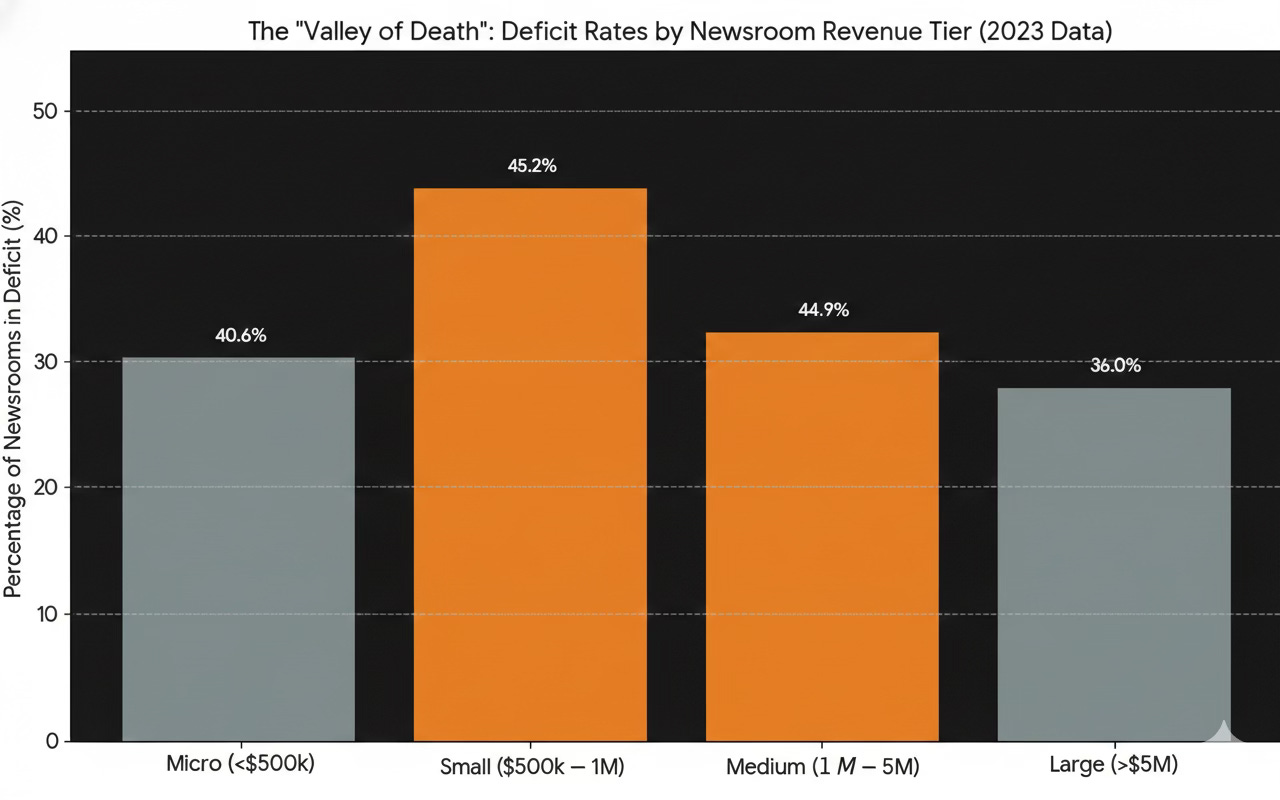
To ground this, I analyzed the most recent verified 990 data. The numbers tell a different story than the glossy industry reports.
As the data shows, we are facing a “Valley of Death” for newsrooms trying to scale. Nearly 45% of newsrooms between $500k and $5M in revenue finished the year in a deficit. This is exactly the zone where organizations scale their overhead (hiring Major Gift Officers and “Coordination” staff) for whales before their recurring revenue base is stable.
The median newsroom holds just $266,094 in net assets. That’s barely eight months of runway if a major donor pulls back. Bigger isn’t better; bigger often just means a higher floor to fall from
The Construction Sequence
Most newsrooms are building in reverse. They hire a Major Gifts Officer before they’ve poured the foundation.
Think about it the way a software startup would. You can build for 10,000 people paying $20 a month (the Pyramid), or you can land one enterprise client paying $200,000 (the Pillar). The Enterprise Whale looks efficient, but it means that one client now owns your roadmap. You stop building what the community needs and start building whatever that one CEO demands. When they leave, you’re holding a bloated staff you can no longer afford.
The sequence should go:
Establish brand trust and editorial independence.
Build the pyramid of recurring members covering your basic costs (rent, insurance, core payroll).
Hire for growth, not survival. Only then does the Major Gifts Officer make sense.

The Bottom Line
The Sustainability Paradox is this: the very things we do to “save” ourselves might be making us more fragile. The big check feels like a lifeline. Often, it’s debt with good PR.
Stop chasing the pillar. Start building the pyramid. It’s slower and harder. But it’s the only way to ensure that when the “big check” disappears, the newsroom doesn’t go with it.
What do you think? Are we professionalizing our fundraising at the expense of our community roots? Let me know in the comments.
P.S. — Did this analysis provide you with a breakthrough strategy? If so, please consider making a one-time tip to support the deep research and analysis that goes into every Backstory & Strategy post.
Additionally, if you found this post helpful, please restack it and share it with your audience. This spreads the word and keeps me writing the types of content you enjoy.