
Your Resume, Not Your Tax Return
Why relying on your 990 is a missed opportunity for your nonprofit newsroom, and how a simple impact report can build the trust that drives support.

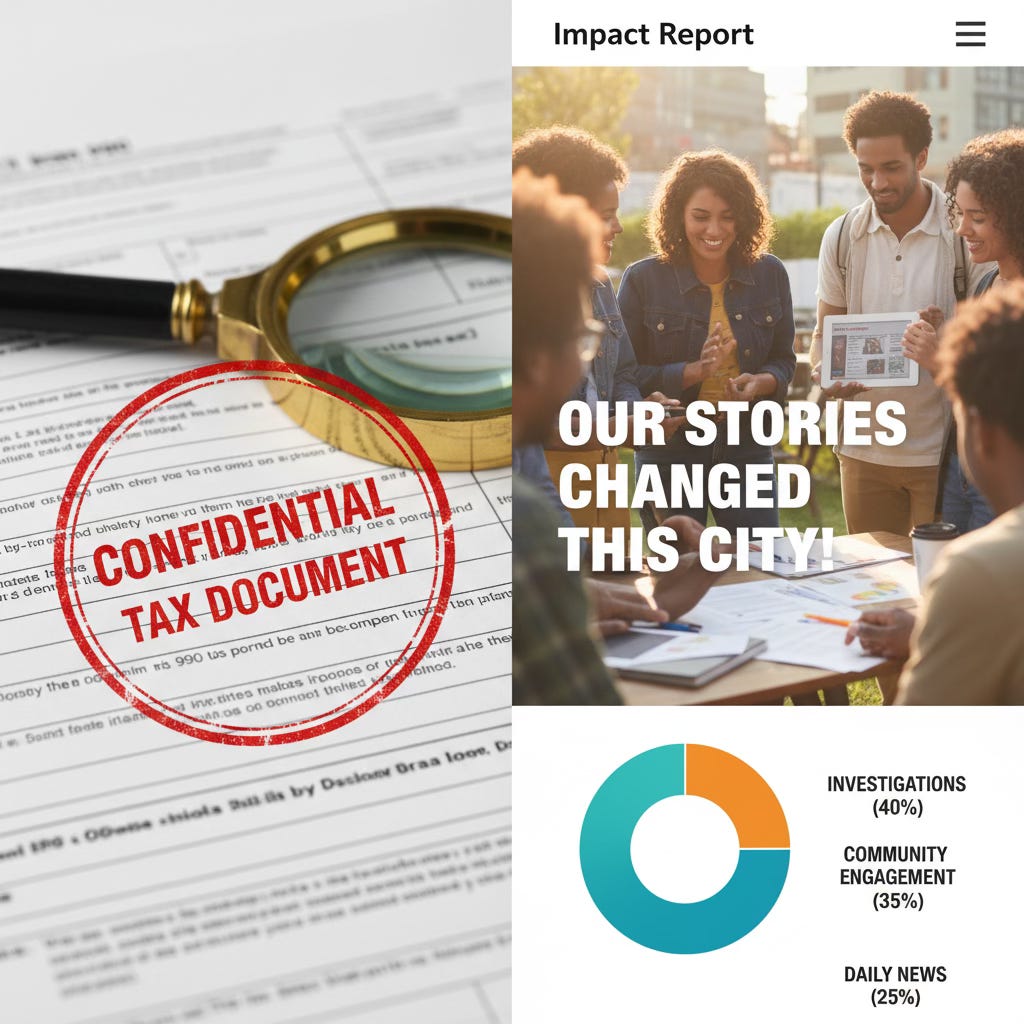
Years ago, working at Lehigh Valley Public Media, we spent weeks—what felt like months, honestly—on our annual report. But we did it because it was our anual and impact report. It was our chance to tell funders and supporters and community members not just what we did but how we did it and where the money went.
So when I went on dozens of nonprofit news sites recently, I was surprised to not find one impact report. They were just pointing people to their 990s.
I know, I know. It’s a pain. If you’re running an investigative newsroom there are ten things you should be doing instead of this. But let me tell you what you’re missing when you skip it.
The Problem with Letting Your 990 Do the Talking
1. You’re Answering the Wrong Questions
A 990 tells the IRS how you spent your money. An impact report tells your supporters why it mattered. When donors are deciding whether to trust a nonprofit, 53% say the most important signal is “accomplishments shared by the organization,” not financial ratios. Your 990 can’t tell the story of the investigative series that led to local policy change or the community listening sessions that shaped your coverage.

2. You’re Ignoring the Trust Gap
You’re leaving trust on the table when it’s already in short supply. Give.org found that while 73% of people say trusting a charity is essential before they donate, only 19% of people actually “highly trust charities.” That gap is significant. Here’s the kicker: transparent nonprofits that report on their work pull in 53% more in contributions than those that don’t. When you skip an impact report and point people to your 990, you’re showing up to a job interview and handing over your tax return instead of your resume.
3. You’re Out of Step with Modern Expectations
Donors today, especially younger supporters and foundation program officers, expect accessible, narrative reporting on your performance. They want to understand the context of your impact, not hunt for it in IRS schedules. When nonprofit news organizations don’t report on their impact, they aren’t being humble. They’re making it harder for readers to grasp their value and harder for funders to justify continued support.
4. You’re Sending an Unintentional Signal
It sends a signal that you don’t think your work is worth explaining. If you’re not taking the time to make the case for your impact, why should anyone else? This matters especially for mission-driven journalism, where so much of what you do is invisible until suddenly it isn’t—until the story breaks, the policy shifts, or the community shows up. You have to connect those dots. Otherwise, silence doesn’t read as humility. It reads as uncertainty.

Why This Is Critical for Nonprofit News
We’ve established that all nonprofits should do this. But why is it even more important for a tiny, local news organization?
First, you face a unique credibility challenge in an era of historic lows in media trust. Your work is often slow-burn, investigative, and hard to measure. An impact report is your chance to make the invisible visible. It’s how you show that a six-month investigation led to policy change or that a community listening project shaped your coverage priorities.
Second, it’s about accountability to your community. If you’re asking them for financial support, they deserve to know what that support produced. An impact report says: Here’s what we did with your trust and your money. Here’s how it mattered.
Finally, creating the report provides internal clarity. It’s a chance to step back from the daily grind, see the whole picture of your work, and remind yourselves why it matters.
What Makes a Great Impact Report
The good news is you don’t have to hire a designer or an external firm. You just need to be intentional.
Tell stories, not just statistics. Yes, include your metrics. But pair them with narrative. “Published 47 investigative stories” is fine. “Published 47 investigative stories, including a series on housing violations that led the city to create a new enforcement task force” is better.
Design it to be skimmable. Use headers, pull quotes, bold text, and white space. A reader should be able to grasp your impact in two minutes.
Show, don’t just tell. Use photos, pull quotes from community members, and screenshots of your work. Visuals make the work tangible.
Be transparent, not dense. Include financials, but use a simple pie chart for revenue and expenses. Don’t make people hunt through spreadsheets.
Make it accessible. Put the report on your website as a dedicated page or a downloadable PDF. Don’t make people dig.
As for tools? Canva, Google Slides, or even a well-formatted Word doc will work. Clarity and honesty matter more than polish. A thoughtfully crafted PDF from a two-person shop on fumes is the best trust-building tool you have.

Impact Reports vs. Annual Reports
I’ll admit it: at Lehigh Valley Public Media our impact and annual reports were the same document. And that’s fine—it’s 100% better than doing neither.
But if you have the capacity, it’s strategic to separate them.
An Annual Report is comprehensive. It’s the whole picture: full financials, board rosters, donor lists.
An Impact Report is targeted. It hones in on outcomes and answers the question: what did we achieve and who did it matter to?
Separating them allows you to be nimble. You can release a mid-year impact snapshot or a report after a big investigation. It turns a year-end obligation into a year-round strategic tool to keep your funders and community engaged.
That’s the real secret: an impact report isn’t just a document. It’s the story of your value, and you are its best storyteller.
What’s the biggest barrier for your organization when it comes to impact reporting—time, resources, or just not knowing where to start? Let’s discuss in the comments.
P.S. - If you found this post helpful, would you please consider restacking it and sharing it with your audience?
This spreads the word and keeps me writing the types of content that you have enjoyed.