
Chicago Is Ready for the Raids. Is Your City?
As ICE raids sweep the nation every city needs a safety supply chain. Here is how to build yours this week.

I’ve been thinking a lot about Minneapolis lately. Journalists there have been running around in circles. They’ve been busy. Ever since the federal surge hit in December, reporters have rushed to cover the situation. The problem is that many of them lacked the basic equipment needed to stay safe. The gas masks. The helmets. The gloves.
They didn’t have enough equipment to sustain their work either. If their camera got knocked out of their hands, then what?
It’s been hectic. Chaotic even. Every action has been reactive. And that is exposing a flaw in our infrastructure.
Journalism is slow to adapt. Especially when it comes to products. We cannot let that happen again.
If news in Minnesota is any indication, the vans will be coming to your city next. The Trump administration has already promised as much. Other sanctuary cities will be targeted. Philadelphia. New York. Detroit. Los Angeles.

“The vans are coming,” we hear journalists saying. “Are you prepared if they come to your city?”
I’m not sure your newsroom is.
As LA Public Press editor-in-chief Michelle Zenarosa wrote after months of covering ICE operations: "What does federal attention mean for our safety? For our sources? That's the calculation foreign correspondents make in conflict zones. Now it's what local journalists are making in American cities."
You might be asking: “Who relies on freelancers? Doesn’t the local paper have staff for this?”
The honest answer is no.
The days of the deep newsroom bench are over. When ten raids happen simultaneously across a city, the two staff reporters at the daily paper can’t be everywhere. The people filling that gap—the ones live-streaming the arrest or verifying the tip—are freelancers and independent news creators.
They are the surge capacity for our entire information ecosystem. And unlike the staff reporters, they are out there without a corporate safety net.
Journalist safety can no longer be a charity case. It is a supply chain problem. If you wouldn’t send a photographer to the Super Bowl without a lens don’t send a creator to a raid without a vest.
I’m a former newsroom editor. I’ve sent reporters into uncertain conditions before. But now I look at these breaking situations through a product lens. And all I see is failure.

The good news is, Chicago sees the problem. And we have a network ready to follow their lead.
This network is vast. The Council on Foundations has served as a guide for these philanthropies for 75 years. They support over 1,000 member organizations with a mandate to “co-create solutions that will lead to a better future for all.”
We see this mandate in action already. There are 15 community foundations leading Press Forward chapters around the country. There are 20 more that have built hyper-local Community News Funds.
They are already actively supporting local journalism. Now we just need them to add a safety layer.
These groups understand that investing in local journalism doesn’t start with waiting for disasters to happen. It means preparing for them before they happen.
The Chicago Headline Club operates what I would consider a dream product squad called the Essential Equipment Fund. Made of journalists, librarians, and product aficionados, they’ve pioneered a way to serve freelance journalists before disasters strike.
Here’s how it works. A freelancer applies. They prove they are a working journalist. And is awarded up to $500 to buy a bulletproof vest or a gas mask. Then gets back to work.
Day 1-3. Not months.
This is the MVP we need in every major city in America today.
Instead of meetings, you can just copy this, paste it, and deploy.
If you are a newsroom leader or a foundation executive, this is your open-source project. Copy it. Edit it. Deploy it. Start keeping people safe tomorrow.
Part 1: The Fund Blueprint
Copy and paste this into a Google Doc. This is your manual.
Objective: Create a safety equipment fund for independent journalists.
The Mechanics
The Fund will provide micro-grants for journalists to buy safety equipment up to $500 per person per calendar year.
Target turnaround time is 10 business days. (During times of heightened surge activity target is 48 hours.)
Eligibility Criteria Keep eligibility simple. There are three criteria an applicant must meet.
Status: Freelancer, independent contractor, or independent news creator. (Full-time staffers are not eligible).
Proof of Work: One published article or verified post from the last 6 months or an assignment letter.
Local Focus: Must be living in [INSERT CITY] AND documenting civic unrest/public safety.
Approved Expense Example List (This is not an all inclusive list. It’s just a start.) You’re not funding production. You’re funding safety.
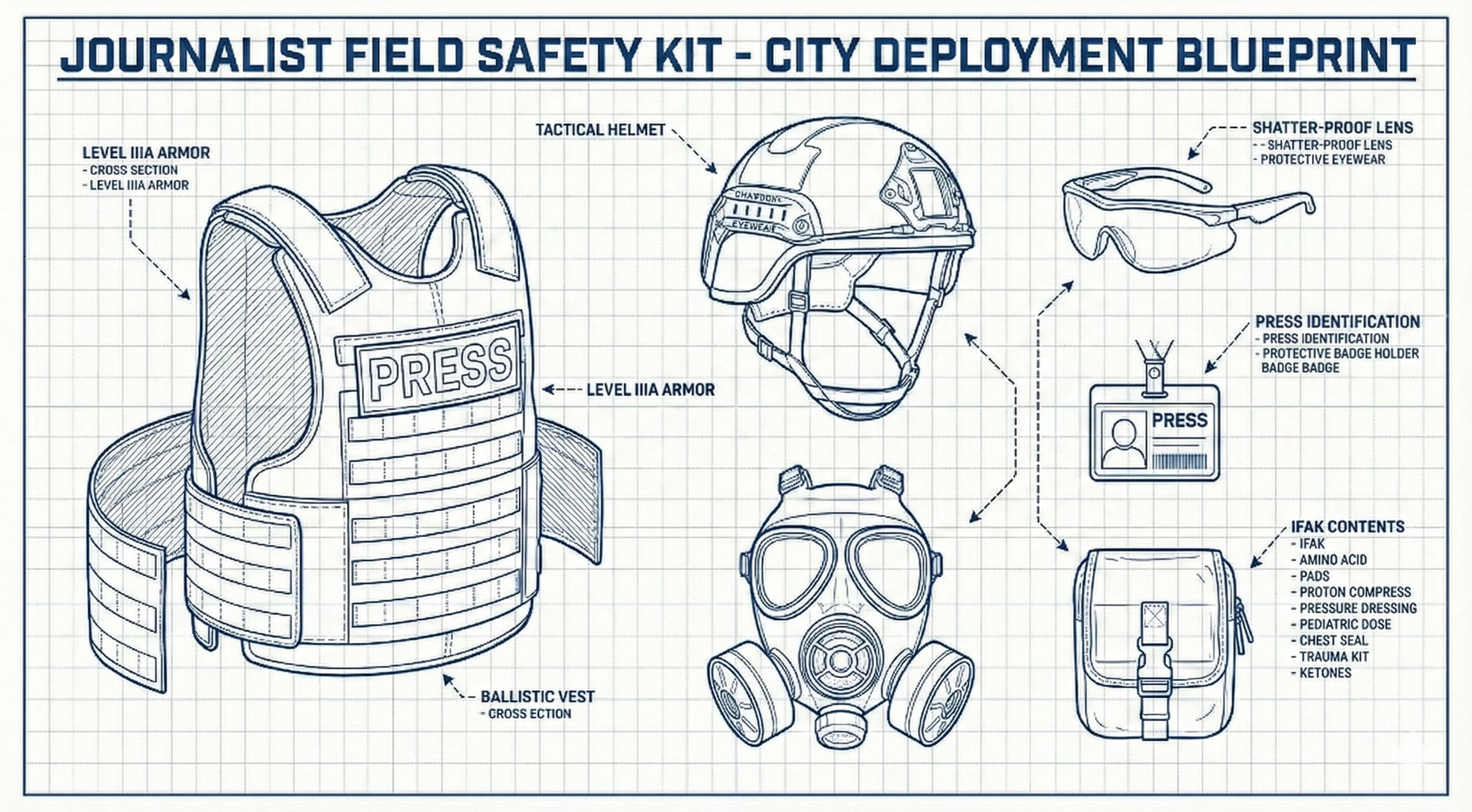
Yes: Bulletproof vests. Helmets. Respirators. Eye protection. Press badges. Accessory gear (battery packs, etc.)
No: Cameras. Lenses. Drones. Computers. Travel expenses. Per diems.
The Approval Process: You’re not creating a board. Create a 3-person “Safety Cell” to approve requests via Slack. You want 1 photojournalist on there who understands the equipment. An editor who knows the applicants in your city. And an admin who can cut a check.
Part 2: The Email
Now that you have your protocol, you need money to power it. Email this to your local Community Foundation or major donor tonight and schedule it to send tomorrow morning.
Subject: Proposal: Safeguarding [CITY]’s information flow.
Dear [Name],
Because you care about our city’s civic health, I am asking you to help solve a critical problem. One that will determine whether or not our city has eyes and ears on the ground during the next federal surge.
Right now, journalists aren’t equipped to safely document what’s happening. I’m sure you’ve watched the crisis unfold in other cities. When FEMA shows up the journalists who bear the burden of documentation aren’t staff writers. They are freelancers and independent news creators.
And unlike staff reporters, they don’t have corporate insurance paying for safety equipment.
A standard safety kit in journalism includes:
Bulletproof vest
Gas mask
Helmet
Respirator
Eye protection
Press badge
Thank God most cities don’t consider this essential equipment. But if we did, how much would a safety kit cost a freelancer?
About $500.
For many creators paid by the post or article that is cost prohibitive. So what happens if journalists can’t get the gear they need? If they choose not to document federal raids in our city? Where will we turn to live-stream information?
Unlike natural disasters, federal raids can be predicted. We have time (sort of) to react.
We are proposing creating a “[City Name] Journalist Safety Fund” that will provide micro-grants for independent journalists to buy safety equipment. We’re patterning it off the already successful Chicago Headline Club fund.
Safety funds should be part of a community foundation’s commitment to sustainable local journalism. After all, information is healthcare. Right?
15 of Press Forward’s 41 chapters are already community foundations. Another 20 have created Community News Funds. Safety equipment is the logical next step.
All we’re looking for right now is a small seed grant to get started. $5,000 can go a long way. With that, we hope to:
Provide full safety gear to 10 independent journalists.
Create the protocol for approving requests. (We’ll learn this as we go.)
Give the creator community something they can tangibly use to protect themselves while covering these important stories.
We can use the network Press Forward has built to quickly vet applicants. All we lack is the funds to protect them.
Can we spare 10 minutes tomorrow to discuss this opportunity?
Best,
[Your Name]
The 10 Minute Drill
If you run a newsroom in a sanctuary city, give me 10 minutes of your time tomorrow.
Grab your DirecTV remote and close your eyes. Visualize a federal surge hitting your city at 6 AM tomorrow.
When you open your eyes and get back to work, ask yourself these two questions.
If a creator came to me right now and needed $500 for safety gear, could I get that purchase approved ASAP?
If you said no, you’re not ready.
When my reporters enter a danger zone, do they have a lawyer’s phone number tattooed on their forearms?
If you said no, you’re not ready either.
…but you can be.
The Chicago model has already laid the groundwork. I built the template above to make it easy.
Now it’s time to act.
⚡️ Make the connection
Do you know a Program Officer at your local Community Foundation? Do you know a board member at your local SPJ chapter?
Forward the email to them.
Don’t just share it on LinkedIn. Send it to the specific person in your city who can write the check. If you get a “yes” from them, let me know in the comments so we can celebrate the win.
P.S. — Did this analysis provide you with a breakthrough strategy?
If so, please consider making a one-time tip to support the deep research and analysis that goes into every Backstory & Strategy post.
Additionally, if you found this post helpful, please restack it and share it with your audience. This spreads the word and keeps me writing the types of content you enjoy.