
The Last Mile: Paper Paul Didn't Need a GoFundMe. He Needed a Road.
The story of a 40-year-old South Dakota newspaper and the infrastructure that never found it.

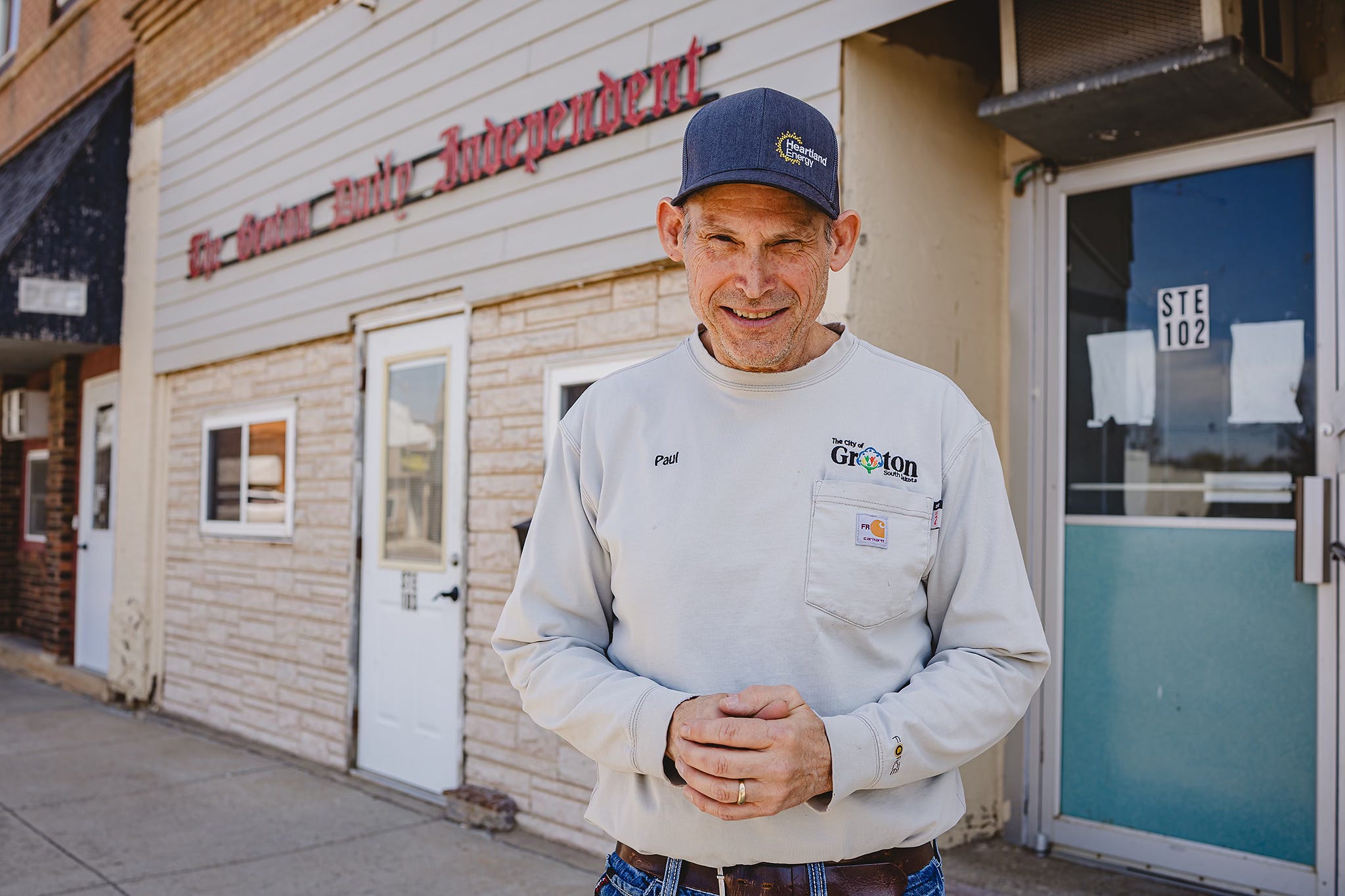
One newspaper. One town of 1,355 people. Zero support from the major journalism organizations. A GoFundMe was launched the same week we were all talking about infrastructure plays. This is what the last mile looks like when it finally has a name.
A Quick Disclaimer: These thoughts are mine alone. They don’t necessarily reflect the official position of my colleagues or the leadership at the American Press Institute. While my work at API deeply informs how I see the industry, Backstory & Strategy is my space for thinking out loud and poking at the frameworks we all have to navigate.
Last Wednesday, a regional outlet in South Dakota reported that one of the oldest newspapers in the state was asking for community help through a GoFundMe.
The paper is the Groton Independent. It’s located in Groton, South Dakota, a town of about 1,355 people. The publisher is Paul Kosel. Locally, everyone knows him as “Paper Paul.” He bought the paper back in 1986 when he was fresh out of South Dakota State. He’d called the state newspaper association just to ask which papers were for sale. He was a young man with a plan.
Nearly 40 years later, he’s still the one running the show. He also runs a daily email edition called the Groton Daily Independent. He launched that in 1999 after a storm rolled through town the day after his weekly had already gone to print. He realized he didn’t want to wait a whole week to report the news. So, he published online instead. That move made the GDI the first weekly newspaper in South Dakota to have a daily online presence. Today, it hits about 200 inboxes every single morning.
Paul does it all. He livestreams local sports and compiles the legal notices. He covers the city council meetings and prints the weekly edition in-house. He also works for the city of Groton as its technology specialist. And in a detail that feels uniquely rural, he runs the town’s mosquito control program.
In 2025, Heartland Energy gave the GDI its Community Spark Award. The local officials who nominated him called the paper “essential to the well-being of our community.”
And yet, last week, Paper Paul had to launch a GoFundMe
The Specimen
I’ve spent months writing about the Last Mile problem. I’ve used metaphors about logistics and analogies about the mental health industry. I’ve pointed out that even our best-designed resources aren’t finding the people who need them most.
The Groton Independent is what that argument looks like when it has a face.
I spent time this week looking for any evidence that a major journalism support organization had ever touched this paper. I looked for grants, program cohorts, sustainability audits, fellowships, or memberships. I checked the usual names: LION Publishers, INN, API, Knight, Press Forward, Report for America.
I found nothing. Not a single thread.
This isn’t a failure on Paul Kosel’s part. He isn’t the one who didn’t show up. The infrastructure failed to find him. These reasons aren’t accidents, and they are worth naming precisely because they are built into the way we work.

The Three Walls
Wall One: The For-Profit Problem. The Groton Independent is a for-profit, family-owned business. That single fact excludes it from the vast majority of philanthropy-backed programs that dominate the journalism support landscape. INN is a nonprofit network. Most fellowships and grant programs are structured around 501(c)(3) eligibility. The for-profit independent press is where most of the small-town weeklies in this country actually live, but they fall through the floor of a system designed around a completely different organizational model.
Wall Two: The Conference Circuit. I wrote back in March that JSOs are reaching a self-selecting sample. We are talking to the people who show up at conferences, apply for grants, and respond to the right newsletters. Paul Kosel is the structural inverse of that profile. He works a day job at city hall and files a paper before the sun comes up. He isn’t in the right Slack channels. He didn’t apply to a sustainability cohort because he didn’t know one existed. He isn’t on the email list because he’s busy running a town’s mosquito control program.
Wall Three: The Geography. Groton is in Brown County, South Dakota. It’s one of the most reliably West Nile-prone counties in the state, which is why Paul’s second job matters so much to the community. But Groton isn’t in a “Knight city.” It isn’t in a “Press Forward priority region.” There is no philanthropic density within a hundred miles of his desk. The infrastructure we built to “reach local newsrooms” wasn’t actually built with Groton in mind. It was built with cities in mind and then dressed up in universalist language.
He Is the Physical Coordination Layer
This is the part that should sting.
Last week, I argued that journalism doesn’t need more content. It needs a Physical Coordination Layer. It needs a tangible, geographic touchpoint where citizens encounter information in their daily flow. I was writing about bookstores and reporters with desks in cafes.
Paul Kosel already built that. He did it from scratch with no help.
He shows up to the football games and calls the plays while he runs the camera. He livestreams the graduation ceremonies. He is physically present and embedded in a community that calls him by a nickname. The GDI isn’t just a newspaper. It is the physical coordination layer for civic life in Groton. The city even links to it directly from its municipal website.
He did everything right. The road just doesn’t exist behind him.

The GoFundMe Is the Symptom
Paper Paul quietly launched that GoFundMe on February 28th. It took two weeks for a single regional news story to be written about it. That story finally ran on March 12th, which happened to be the same day I published my piece about the Barnes & Noble “Physical Coordination Layer.”
I don’t think that’s a meaningful coincidence. I think it’s meaningful timing. We are having a serious, growing conversation about the infrastructure gap in local journalism. We are writing strategic frameworks and proposing civic residencies and modeling efficiency plays.
Meanwhile, a 40-year-old newspaper run by a man who built everything we say we want to see is asking for help on a crowdfunding platform.
Watch the math on the page, though, because it tells its own story. For two weeks, the goal sat at just $900. Think about that. One of the state’s oldest newsrooms was essentially a four-figure repair bill away from the edge, and for fourteen days, the world didn’t blink. Once the community noticed, the goal nudged to $1,100, then $1,300, then $1,800. By 10:35 AM today, it moved to $2,800.
This isn’t the behavior of someone running a calculated capital campaign. It’s the behavior of a man who is fundamentally uncomfortable asking for help. He’s doing the internal math in real-time—calculating the next paper shipment, the next postage increase, or the next repair. He isn’t asking for “growth capital.” He’s asking for survival maintenance. Even at $2,800, we are talking about a figure that wouldn’t cover the travel expenses for a single keynote speaker at a national media summit.
Let that sink in for a second. It isn’t $180,000. It isn’t even a capital campaign. It started as thirteen hundred dollars. That is roughly the cost of a single booth at a journalism conference. It’s about half of what some organizations spend on catering for a single meeting about sustainability.
Their plea is worth reading in full, but these two sentences tell you everything: “We are not asking for help to pay ourselves. We both work full-time jobs outside the newspaper.”
They aren’t asking to be made whole. They are asking for help with printing costs and postage. They’ve already solved the labor problem the only way a town of 1,355 can. They absorbed it personally across two households and two full-time jobs. They are carrying 143 years of combined institutional history on their backs.
I donated. I didn’t do it as a journalist covering a subject. I did it as someone who has spent months arguing that this field’s job is to find the Paper Pauls before they have to ask. The least I could do was show up when he did.
But a personal donation isn’t a structural solution. It’s just charity filling a gap that infrastructure was supposed to prevent. We can’t crowdfund our way to a healthy local news ecosystem. We have to build the road so the next Paper Paul doesn’t have to launch a campaign just to buy a few more weeks of ink.
The Myth of Community Apathy
I’ve seen a few comments floating around suggesting that it’s a “shame” the local community isn’t supporting the paper enough to keep it solvent. That take is not only wrong, but it’s also lazy. It misses the reality of rural market economics entirely.
The Groton Daily Independent has roughly 200 daily email subscribers. The weekly print edition reaches another 200. In a town of 1,355 people, that means Paul has a direct relationship with a massive chunk of his total possible market. If the New York Times or the Philadelphia Inquirer had that kind of per-capita penetration, we wouldn’t be talking about a “crisis” in journalism. We’d be building statues to their marketing teams.
The community is doing their part. They are reading, they are subscribing, and right now, they are donating. But a town of 1,355 people cannot carry the skyrocketing costs of print, postage, and tech infrastructure alone.
This isn’t a story about a community that stopped caring. It’s a story about a community that is punching way above its weight class to keep its “physical coordination layer” alive while the national infrastructure that is supposed to help them scale is looking the other way.
The No-Pile, Personified
In my Last Mile piece, I wrote about the “no-pile.” These are the hundreds of newsrooms that apply for grants or fellowships and get turned away each year because they don’t quite fit the criteria or the funding runs out. I argued then that a rejection shouldn’t be a dead end. It should be a warm handoff to a resource that actually works for them.
Paul Kosel never even made it to the no-pile. He never applied because he was never in a position to know the door existed.
The no-pile at least implies some level of contact. It means someone in the infrastructure saw your name, even if they couldn’t help you. Groton never made contact. Not once.
That is the truest version of the last-mile failure. It isn’t the newsroom that applied and was declined. It’s the newsroom that is doing the work in total darkness, unaware that there is a whole industry built to “support” them, while that same industry wonders why it can’t find its way to places like Brown County.

A Different Question
I don’t know if Paul Kosel wants a sustainability audit or a grant. He might not want any of it. He might prefer to keep doing what he’s done for four decades: build something real and figure it out himself.
But I’d like him to have been asked. I’d like the system to have tried to find him before he had to turn to GoFundMe.
The question I keep coming back to isn’t how we help this one paper. It’s how many Grotons are out there. How many Paper Pauls are operating in isolated, invisible newsrooms right now? They are doing exactly the work we claim to care about, yet they have never been touched by the infrastructure we’ve spent ten years building.
That number is not small. Until we decide that finding those people is our problem to solve, we’re just building a better conference for the newsrooms that already know we exist.
Do you know a Paper Paul in your state? I want to hear about them. Drop a comment or hit reply. I’m trying to build a picture of exactly where the road ends.
I’m building a map of where the road ends. If this email was forwarded to you, or if a colleague shared this in Slack, consider subscribing to get these daily strategic insights directly in your inbox.