
Journalism’s Customer Problem
What the 2026 Nieman Lab predictions quietly reveal about why newsrooms keep getting stuck.

Nieman Lab does annual predictions in December. It’s smart people predicting things. Clever people like to make big claims.
The package is designed to let you pick and choose. You click the headlines that match your job or your worries. You ignore the rest. That is how the web works.
But I read all of them — at least as of December 15th.
And when you read them all at once, you stop seeing individual predictions. You start seeing the lack of connecting tissue.
This year’s collection quietly diagnoses why journalism keeps knocking itself out.
The problem is not artificial intelligence. It is not the platforms or the trust collapse. Those are symptoms.
The issue is far simpler than that.
Journalism has lost track of who the customer is.
If you try to serve six different customers who are in conflict, you cannot build a sustainable system.
The clues are all in the inconsistencies
The fun of reading the 2026 predictions is seeing how many different pictures of success can be drawn. And how those pictures cannot actually coexist.
Garry Pierre-Pierre points to immigrant networks already doing local news better than newsrooms. This looks like WhatsApp groups. It looks like neighbors helping neighbors parse a letter or a policy change. They have success metrics centered on usefulness. They have laser focus on who their customer is.
Allissa Richardson imagines “algorithmic witnessing.” Archives built with AI to preserve stories that power would prefer not to remember. Success in that world is measured in memory and accountability. The customer is both the community being documented and the future researchers who will study that history.
Then you get the vertical video predictions. These assume success is a following that follows the individual journalist more than the newsroom. The customer becomes the person scanning Instagram or TikTok.
The agentic journalism piece pushes even farther. It says our work should be designed for AI systems to ingest and redistribute. Success is getting captured when someone asks ChatGPT a question. The customer is the algorithm.
Then there is JOMO. These are the people who feel joy in not knowing. Journalism is not solving a problem for them. It is causing stress they are happier not experiencing.

These are not different approaches to the same problem. These are not different routes to the same success. These are different businesses with different definitions of value.
The six customers journalism is trying to serve
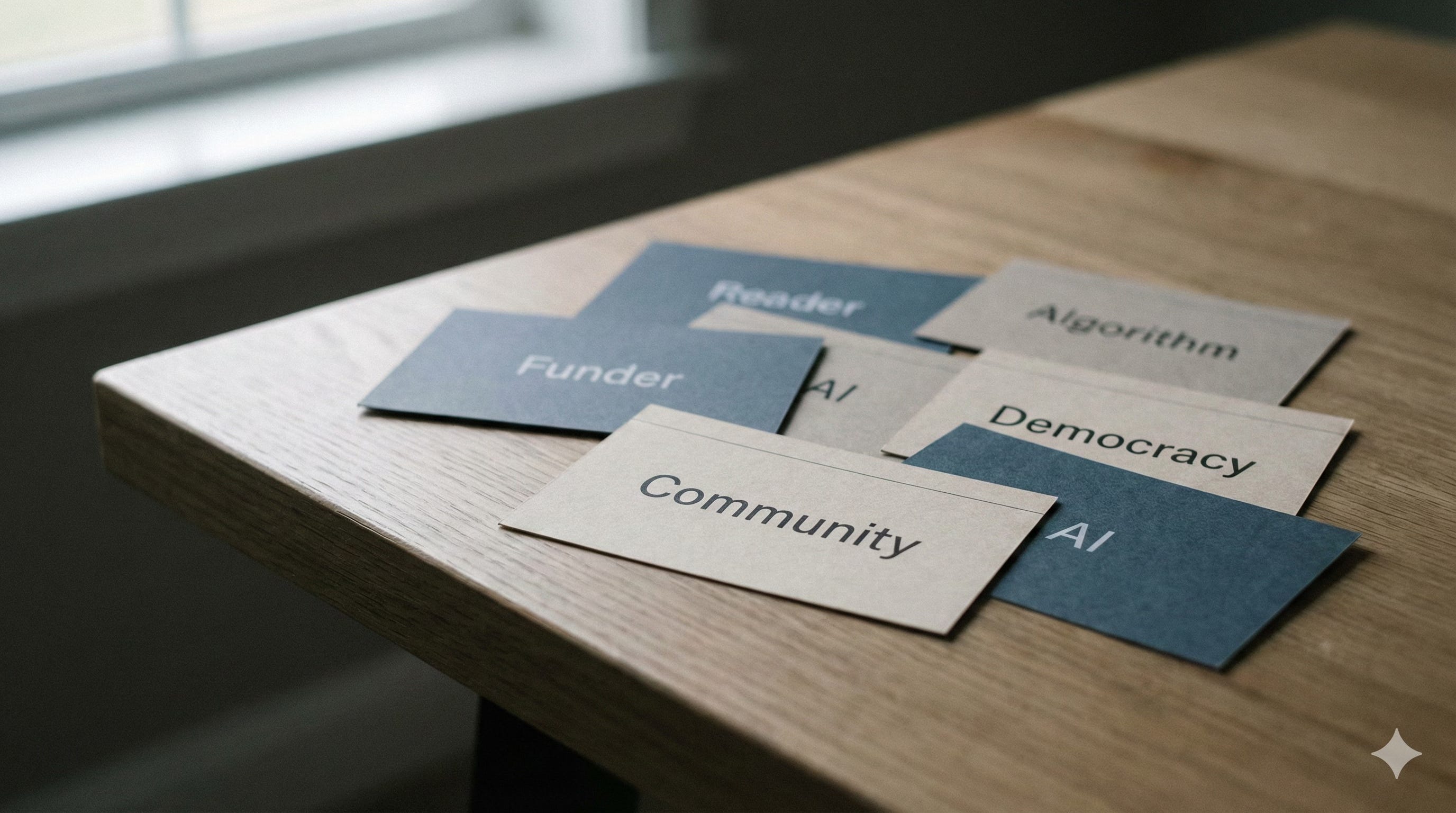
This is what all this adds up to. If you run a newsroom today, these are the six “customers” you are told to serve.
Philanthropic funders. They want impact, equity, and community transformation. They will pay money for work that matches their program goals. Their goals do not always align with the community’s needs.
Individual readers and members. They want to use useful, clear, convenient information. They might subscribe, but only a few outlets have a viable scale model to go that route.
The wider community. They want clarity more than articles. They want help negotiating systems. They use information to stay alive. They may value the work deeply, but still never pay for it.
Platform algorithms. They want engagement and viral potential. They will distribute your work and also take the entire audience relationship. They do not pay, and they change the rules whenever they want to.
Democracy and society. This is the civics class answer. Journalism exists to support informed citizenship. It is essential work. It has no revenue model.
AI systems. They want structured data and clean formats. They will use your work heavily. Will they pay? Open question.
You cannot optimize for all six. They measure success differently. They force contradictory decisions.

Why this is bigger than AI or platforms
We love to argue about AI replacing journalists. We love to argue about paywalls and platforms. Those are real issues. This is the issue above those issues.
Pierre-Pierre’s informal networks are not scared of AI or platforms. They know their customer. They serve people in the moment who need help. They deliver that help in whatever form reaches and helps the people. It might be a text. It might be a phone call. They are not trying to please both funders and algorithms simultaneously.
The New York Times also knows its customers. Paying subscribers. Every decision runs through that. That clarity gives them license to make hard choices.
Most newsrooms have the opposite problem. They are trying to serve everyone. The product of that is a product for no one.

The implication for strategy
This should be alarming for nonprofit leaders. The tension shows up every day.
Your funder wants community transformation stories. Impact metrics with clean logic models. Evidence of accountability.
Your community wants to know why their rent went up. They want to know which school board candidates know about special education. They are not trying to scale impact on democratic processes. Their needs are urgent and personal.
These can align. They often do not. And when they do not, you feel the tension in every editorial meeting.
Pierre-Pierre’s networks are not constrained by those competing demands. They serve the community and nothing else. It’s not sustainable as a journalism job. It is sustainable as a service because the value is so clear.
The trap of survival
I know why we do this. I know why we try to serve all six.
It feels safer.
If you pick one customer, you risk losing the revenue attached to the others. If you tell a funder “that is not our focus,” you leave money on the table.
Serving everyone feels like a survival strategy. It feels like you are just being smart and opportunistic.
But as I wrote earlier this year, mission drift doesn’t always look like a mistake. It often shows up dressed as smart strategy.
It starts with a grant here and a partnership there. It feels like progress. But six months later, you realize you have created so much internal friction that your own staff struggles to explain what the organization actually does anymore.
By trying to protect every revenue stream, you dilute the product until it is essential to no one. You are not building a business. You are managing a decline.

The question nobody wants to answer
The 2026 predictions raise one question you cannot skip.
If you had to pick one customer, who would it be?
You cannot say all of them. You cannot say it is complicated. You cannot say diversified revenue solves this problem.
One customer. One value metric.
Pierre-Pierre’s piece shows what clarity on that question looks like. The networks are not professional journalism. They are far more effective as information services.
If professional journalism cannot approach that effectiveness while also paying people to do the work, then we have to ask a harder question. What is the value proposition of the institution?
Where do we go from here?
The predictions don’t answer that. They point right at it.
Journalism’s crisis is not primarily about technology. It is not primarily about money. It is a crisis of identity.
Until we answer “who is our customer?” we will keep trying to serve everyone. We will keep serving no one. We will keep pretending there are no tradeoffs.
The informal networks know who they serve. The successful subscription businesses know who they serve. The newsrooms in the middle are still trying to hold the whole world up at once.
Maybe 2026 is the year we stop pretending that is possible.
For newsroom product builders
If you build products for newsrooms, this lands on your desk as well.
Are we helping newsrooms pick a customer? Or are we giving them more ways to put off the choice?
Can one metrics framework demonstrate value to funders, communities, subscribers, and democracy?
What if the honest answer is simple? Pick your customer. We will measure the value for that customer.
The Impact and Trust Platform at API hits this head-on. We are moving beyond generic analytics to help newsrooms measure success against specific goals. We can provide the evidence of value, but you have to provide the clarity of purpose. The difficult question isn’t ‘did it work?’ The difficult question is ‘value to whom?’ That answer changes everything.
If this resonated or rattled something loose, share it with someone who has sat in those same editorial meetings. The clarity we keep avoiding is the clarity most newsrooms need. And if you disagree with the premise, I want to hear that too. The sharpest parts of this newsletter come from the conversations that follow.
P.S. — Did this analysis provide you with a breakthrough strategy?
If so, please consider making a one-time tip to support the deep research and analysis that goes into every Backstory & Strategy post.
Additionally, if you found this post helpful, please restack it and share it with your audience. This spreads the word and keeps me writing the types of content you enjoy.
💯 spot on. It's why I haven't covered the Nieman predictions 'feature' myself - a truly exceptional analysis that's given me one or two things to ponder on.
This was well done and broken down clearly. I like your bullet points on who the customers are. Kind of a rationale to keep print going, even if it’s secondary to digital. The print forces more traditional and time-proven curation.