
The Infrastructure Nobody Told You About
A new FBI budget request reveals that NSPM-7 is no longer just a memo. For independent journalists without institutional backing, that changes the calculus.

A Note on Intent: I don’t typically “do” politics or policy in this space, and we can deal with the fact that this piece might not sound like my usual fare. But this isn’t about partisanship—it’s about how the infrastructure of government communication is evolving and what those structural shifts mean for journalists, newsrooms, and the public’s access to timely information.
As always, these thoughts are mine alone. They don’t necessarily reflect the official position of my colleagues or the leadership at the American Press Institute. While my work at API deeply informs how I see the industry, Backstory & Strategy is my space for thinking out loud and poking at the frameworks we all have to navigate.
I track these policy shifts closely, but the plumbing of federal budgets is complex. If you see a detail I’ve missed or have a different reading of the NSPM-7 framework, please report the error and let me know. Accountability starts here.
Last week, most of journalism’s support ecosystem was focused on tariffs, newsroom layoffs, and the latest round of philanthropic portfolio reviews. Nobody sent an alert about the FBI’s 2027 budget request. I didn’t see it until it started circulating on social media yesterday, and I follow this space closely. That gap is not incidental. It’s the story.
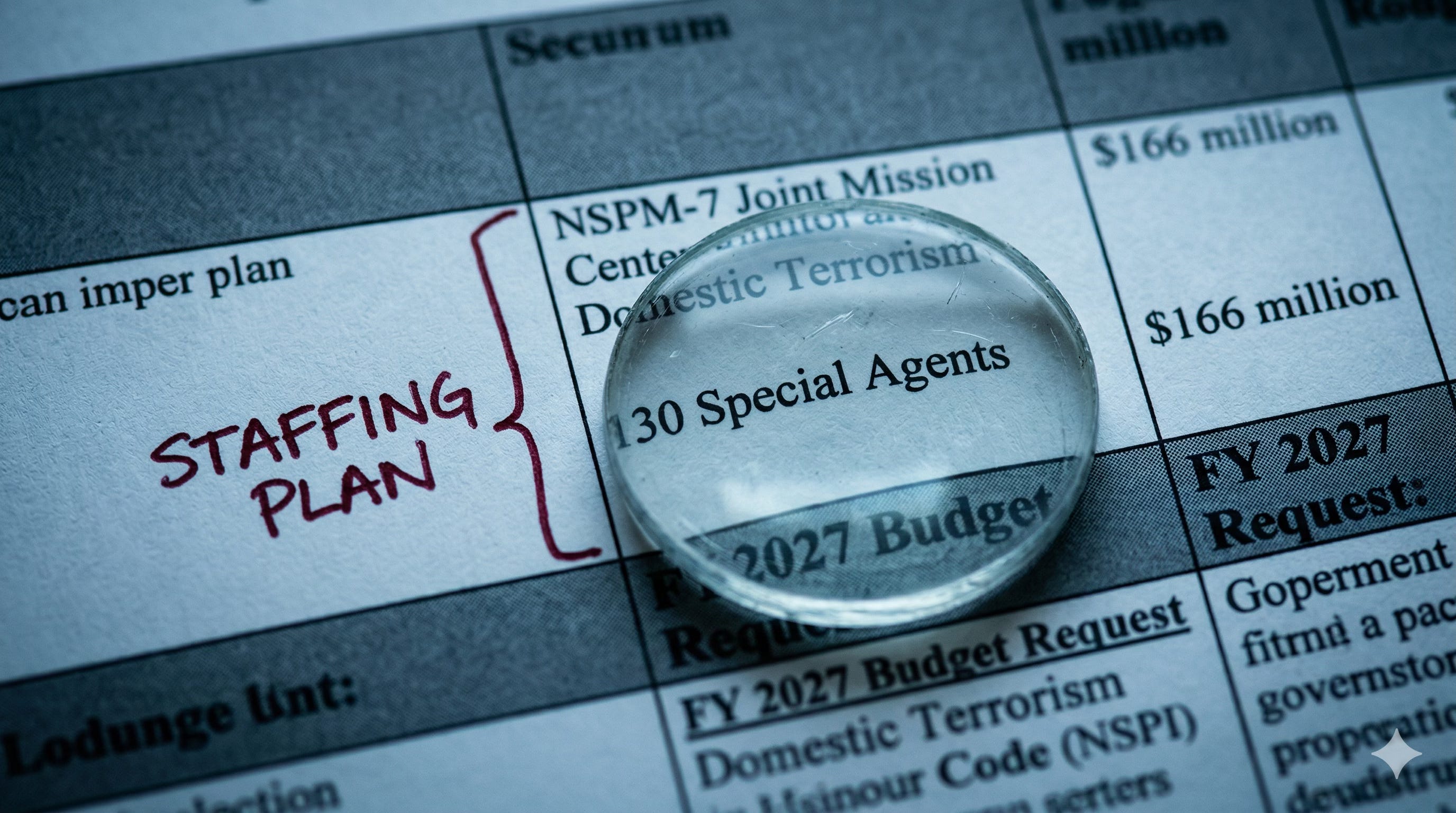
Buried in the Justice Department’s budget submission to Congress is a funding request for something called the NSPM-7 Joint Mission Center. The center brings together personnel from ten federal agencies with a mandate to proactively identify networks and prosecute domestic terrorists and related criminal actors. The FBI is asking for $166 million and 328 positions to implement it, including 130 special agents. This is not a memo. It is an organizational infrastructure with a budget line, a staffing plan, and an interagency command structure. It is being built right now.
NSPM-7 itself is the National Security Presidential Memorandum Trump signed in September 2025, titled “Countering Domestic Terrorism and Organized Political Violence.” The civil liberties community noticed it immediately. The organizations whose job is to support and protect independent journalists largely treated it as someone else’s story. That is worth sitting with for a moment, because the budget document specifies exactly the kinds of views the center is designed to investigate: anti-capitalism, anti-Americanism, extremism on migration and race, and hostility toward traditional American views on family, religion, and morality. The FBI’s own budget language says these views are “commonly” associated with the violent conduct it is targeting. That is a remarkably wide net, and it is now funded.
Consider what that framing does to ordinary journalism. A reporter investigating financial conflicts of interest in a local government contract is doing accountability reporting. Under the mission center’s operating logic, that same work can be reframed as hostility toward American institutions. A freelancer documenting the use of surveillance technology by a federal agency is covering government oversight. The same work can be characterized as anti-American agitation. These are not hypothetical stretches. They are the predictable output of a mandate that turns ideological categories into investigative criteria, and then funds 130 special agents to act on them.
The legal critique of NSPM-7 is well-established. The ACLU and a cohort of prominent national security lawyers have noted that the memo creates no new crimes and that labeling a group a domestic terrorist organization carries no additional legal consequences under current federal statute. That analysis is correct as far as it goes. It does not go far enough for independent journalists.
Here is the structural problem the legal critique does not address. An investigation does not need to result in a prosecution to be effective. A subpoena, an IRS audit, a FARA inquiry, or a simple visit from a Joint Terrorism Task Force agent is expensive, time-consuming, and reputationally damaging. For an established newsroom, those costs are absorbed by institutions designed to absorb them. There is general counsel, a board, donor relationships that pre-date the scrutiny, and a communications infrastructure to manage the narrative. For an independent journalist publishing a newsletter from their home office, those same costs are potentially fatal to the enterprise.
This is the part of the NSPM-7 story that has not been told in the journalism support context. The risk profile for solo creators is structurally different from the risk profile for institutions, and the difference is not just a matter of scale.
There is a constitutional argument here that deserves naming. Legal scholars and civil liberties advocates including the ACLU’s National Security Project have identified NSPM-7’s most vulnerable aspect as its pre-crime investigative framework: the use of ideological indicators to open investigations before any act of violence has occurred. That structure has deep problems under the First Amendment. Using a person’s expressed views about capitalism or immigration policy as a predicate for a federal investigation is viewpoint-based surveillance — the government targeting people not for what they have done but for what they believe and publish. The Supreme Court has consistently held that viewpoint-based government action is the most constitutionally suspect form of First Amendment violation, because it allows public officials to put their thumbs on the scale of public debate in their own favor. NSPM-7 does not need to survive that scrutiny to cause damage. Investigations opened under its authority will proceed while legal challenges work through the courts, and for an independent journalist without institutional support, that timeline is not academic.
Think of it as the prenuptial problem. The partnership agreements now being promoted across the journalism support ecosystem as a path to sustainability are appealing on their face. The creator gets institutional credibility, shared audience infrastructure, and revenue support. The newsroom gets voice, reach, and the kind of trust a brand alone cannot manufacture. What these agreements almost never address is what happens when the association draws government scrutiny.
Does your current partnership agreement or freelance contract have a "prenuptial" clause? I’m curious to hear from creators and newsroom counsel alike: are we actually talking about legal indemnification yet, or are we still just talking about CPMs? Drop a note in the comments.
The newsroom’s lawyers are the newsroom’s lawyers. This is not a criticism of institutional counsel — it is a description of how legal representation works. Their mandate runs to the institution. It does not extend to affiliated creators, and no amount of goodwill changes that structural fact. Organizations like the Reporters Committee for Freedom of the Press have built programs specifically to fill this gap for freelancers and independents, and those programs matter. But they are not a substitute for contractual protection negotiated before a partnership begins. If the fastest path to resolution requires creating distance from a creator whose coverage of a politically sensitive beat, or whose grant history with a foreign-funded foundation, drew the original attention, that is a path the institution’s counsel is entirely free to recommend. Cutting the creator loose may not just be legally permissible. In some circumstances it may be legally advisable. The institution’s lawyers are not acting in bad faith when they reach that conclusion. They are doing exactly what they are supposed to do. The creator simply was never their client.

Here is where the prenuptial analogy becomes concrete. Most creator-newsroom contracts include indemnification language. Read it carefully, because it almost certainly runs in one direction. The creator indemnifies the newsroom against claims arising from the creator’s content. The newsroom does not indemnify the creator against government investigations triggered by the association. In a divorce, that clause determines who gets the house. In a federal investigation, it determines who pays the lawyers. Right now, in virtually every partnership agreement circulating in this ecosystem, the answer is the creator. Nobody put a reciprocal clause in the contract because nobody thought to ask for it, and the newsroom’s attorneys had no reason to raise it. That is exactly the moment when the absence of a prenuptial becomes legible.
The creator, in that scenario, is alone. They have the institutional association on their resume and none of the institutional protection when it matters.
This is not an argument for despair, and it would be wrong to suggest that the press freedom community has been asleep. The Reporters Committee for Freedom of the Press has been doing serious, specific work on exactly these issues. Its attorneys have filed amicus briefs in active FARA cases, arguing that the statute applied consistent with its textual sweep would cover constitutionally protected journalism. It has published detailed legal analysis of FARA’s threat to the press, tracking the ways in which prosecutorial theories in recent cases are legally indistinguishable from ordinary newsgathering. It operates a 24-hour legal defense hotline available to working journalists including independents, and runs programs specifically designed to provide pro bono assistance to freelance and independent reporters. The Freedom of the Press Foundation provides digital security training and legal referrals calibrated to journalists operating without institutional support. State press associations offer varying levels of legal assistance depending on jurisdiction. These resources are real, they are staffed by people doing consequential work, and they are worth knowing about.
They are also, in aggregate, nowhere near sufficient to absorb the demand that a 10-agency joint mission center with 130 dedicated special agents could generate. And there is a gap the existing infrastructure does not yet fully address. Federal shield law protection for journalists is unsettled, and solo creators occupy the most ambiguous position in that landscape. A creator served with a subpoena demanding source information has significantly weaker protection than a staff journalist at an established newsroom, and in some jurisdictions may have none at all. That gap compounds every other vulnerability this piece has described. The distance between what the press freedom community has built and what would be needed is itself an argument for why journalism philanthropy should be treating creator legal exposure as an infrastructure problem rather than an individual misfortune — and for why the organizations already doing this work deserve substantially more resources than they currently receive.

The FARA dimension adds a layer of complexity that most creators have not considered, though the actual exposure depends heavily on the specifics. The Foreign Agents Registration Act has a genuine press exemption, and accepting subscriptions from foreign readers almost certainly creates no legal exposure under any reasonable reading of the statute. The press exemption was written to cover exactly that kind of transaction. The harder cases are the ones that come up routinely in the creator economy: a grant from a foreign journalism foundation, a speaking fee from an international conference, a content partnership with a European media organization. None of those arrangements is inherently problematic, and for most creators working with reputable international partners, FARA registration is unlikely to be required.
The risk is not that FARA applies cleanly. The risk is that it doesn’t apply cleanly, and that ambiguity has a price. The critical lever DOJ has traditionally used in FARA cases is intent. The question is not just whether foreign money changed hands. It is whether the creator was acting at the direction or in the interest of a foreign principal. For a large institution, that question gets answered by compliance counsel before the relationship begins. For a solo creator operating without legal infrastructure, demonstrating that their editorial judgment was not shaped by a foreign funder — even when it obviously wasn’t — can mean a six-figure legal bill before anyone gets near a courtroom. The chilling effect does not require a prosecution. It requires only that the creator understand the cost of defending an ambiguous fact pattern against a motivated prosecutor in an enforcement environment NSPM-7 has deliberately made more aggressive.
None of this means independent journalists should stop covering difficult beats, stop accepting foreign subscribers, or stop entering newsroom partnerships. It means those decisions now carry a different risk calculus than they did a year ago, and the infrastructure that is supposed to support independent journalism has not caught up to that reality.

The partnership agreements being developed and celebrated across this ecosystem are almost uniformly silent on legal exposure, cost-sharing in the event of government scrutiny, and the respective obligations of institutional partners when an affiliated creator becomes a target. The conversation about creator sustainability focuses on revenue models, audience ownership, and editorial independence. It does not focus on what happens when a federal agency with 130 new special agents and a 10-agency joint mission center starts working through its list.
The NSPM-7 Joint Mission Center is operational. The legal infrastructure protecting the people most likely to need it is not. That is not an abstract concern about civil liberties. It is a design flaw in the architecture journalism philanthropy is currently funding, and it is worth naming before someone finds out the hard way.
If you know an independent journalist, a newsletter creator, or a journalism funder who needs to see the 2027 budget math, please pass this along. This isn’t a story that should stay in a vacuum—the infrastructure only gets built if we’re all looking at the blueprints.
Nothing in this piece constitutes legal advice. If you are an independent journalist with concerns about your specific situation, the Reporters Committee for Freedom of the Press operates a 24-hour legal defense hotline at 1-800-336-4243.