
Too Big to Fail: A Financial Blueprint for Saving Local Journalism
The risk-based framework that could have prevented the news desert crisis was sitting in plain sight. It’s time we borrowed it.

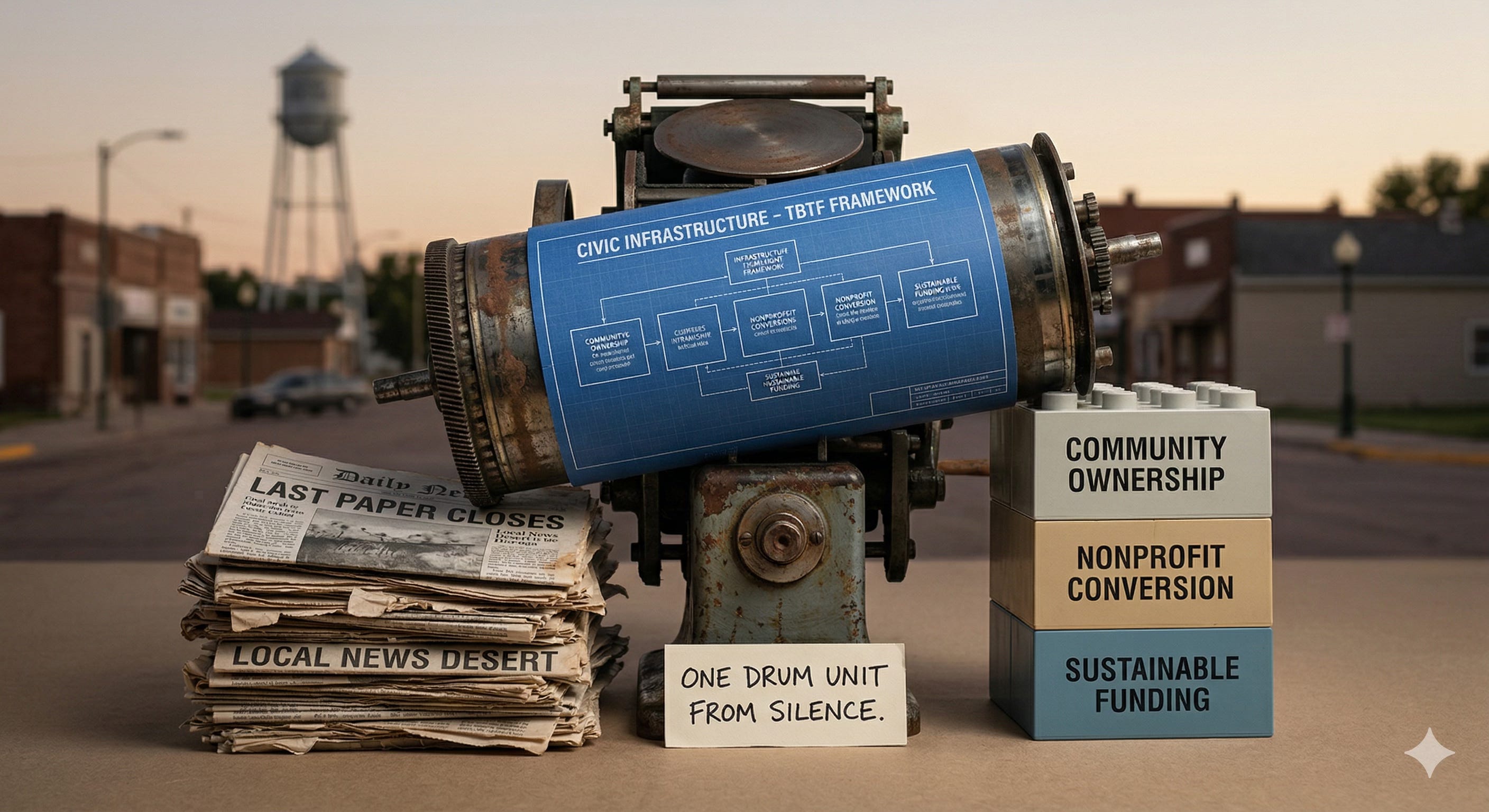
The phrase “too big to fail” entered the public vocabulary during the 2008 financial crisis. It described institutions so deeply embedded in the functioning of the broader system that their collapse would trigger cascading damage well beyond their own walls. The government intervened not because those institutions deserved saving, but because the system could not absorb their failure.
That is a risk-based argument. It is not a quality argument. It is not a reward argument. It is a structural argument about what the ecosystem cannot afford to lose.
The journalism field has spent fifteen years building a different kind of argument. We have debated which newsrooms deserve investment, which markets show promise, and which organizations demonstrate the capacity to scale. We have called it many things. The most honest version, the one the field finally said out loud this month, is picking winners.
Picking winners is a capacity-based filter. It selects for organizational sophistication, grant-writing fluency, conference presence, and existing infrastructure. It asks: which of these can we make excellent?
Picking winners asks which organizations deserve to grow. Too big to fail asks which organizations the system cannot afford to lose. Those are not the same question, and they do not point at the same newsrooms.
And the news desert crisis is what happens when you spend fifteen years asking only the first one.

The Filter We Didn’t Build
Too big to fail is a risk-based filter. It doesn’t ask who deserves investment. It asks whose failure the system cannot absorb. While a bank is too big to fail because its collapse triggers a global recession, a community weekly is too big to fail because its collapse triggers a local truth recession.
The criteria are not complicated. The first question is non-substitutability: if it closes, does anything else perform this function for this community? The second is civic embeddedness: is it structurally woven into how the community actually functions? The third is isolation: is it the only meaningful news presence in a specific place or for a specific population? The fourth is reconstructibility: if it closes, can it realistically be rebuilt?
Those four criteria capture the most visible forms of TBTF eligibility — geographic isolation and community isolation. But there is a third mode that the criteria alone don’t fully surface. An organization can operate in a market with abundant journalism and still be the only entity performing a specific civic function — statewide accountability, Indigenous community coverage, rural health reporting — that no other institution would replicate if it were to disappear. Geographic isolation and community isolation are the most legible forms of irreplaceability. Functional isolation is the quietest and often the hardest to rebuild once it is lost.
Apply those honestly, and the sorting happens fast.
One Drum Unit From Silence
Paul Kosel has published the Groton Independent in Groton, South Dakota, for nearly forty years. He runs a daily email edition. He livestreams local sports. He covers city council. He prints the weekly in-house. He also works for the city as its technology specialist and runs the town’s mosquito control program. The city links to his paper directly from its municipal website.
When I spent time looking for any evidence that a major journalism support organization had ever touched the Groton Independent, I found nothing. Not a grant. Not a cohort. Not a membership. Not a sustainability audit. The infrastructure the field spent a decade building had never made contact with one of the oldest newspapers in South Dakota.
In February, “Paper Paul” launched a GoFundMe. The goal started at $900.
He clears every TBTF threshold. His failure isn't just a business closing. It is the deletion of a community's record. His press is currently one drum unit away from silence. In a modern newsroom, a technical glitch is a support ticket; for Paul, the drum unit — the literal cylinder that transfers toner onto the page — is the mechanical heartbeat of the town’s information. If it fails, the ink has nowhere to go.
He failed every picking-winners threshold because he isn’t built to scale; he is built to endure. That gap is not an accident. It is the architecture of the system producing its intended output.

What the Counterfactual Looks Like
The question worth sitting with is: what happens if the field had applied a TBTF filter in 2008, when the crisis was visible but the damage was not yet irreversible?
The closure math changes first. A TBTF framework would have identified papers caught in private equity debt spirals before closure as irreplaceable civic infrastructure, and created intervention mechanisms — structured acquisitions, nonprofit conversions, community ownership transitions — rather than watching them disappear and calling it a market outcome.
Preservation would have replaced reconstruction. Rebuilding trust from scratch in a news desert is expensive and inefficient. You are reconstructing audience, institutional knowledge, and community relationships that already existed. TBTF logic pushes toward stabilizing existing institutions rather than replacing them after the fact, and preservation is dramatically cheaper than reconstruction.
The philanthropic dollar would have gone further. The field spent real resources in the 2010s funding new outlets in markets that already had struggling ones. A TBTF filter forces an uncomfortable question: are we funding something new because the existing institution is genuinely inadequate, or because it is easier to build something grant-friendly than to save something that doesn’t fit our model? That question was rarely asked. The answer would have redirected significant capital.
The for-profit wall would have been challenged earlier. Almost every intervention mechanism the field built was structured around 501(c)(3) eligibility. A TBTF framework is indifferent to organizational form. It asks about civic function, not tax status. That single shift would have kept for-profit community weeklies like the Groton Independent inside the support system rather than invisible to it.
And the data infrastructure would exist. TBTF requires knowing what you are protecting. It would have forced a genuine census of civic journalism function across every community — a map that, fifteen years later, still does not fully exist. If it had been built in 2010, the field would have known where Paper Paul was in 2012, not 2026.
Chicago and the Civic Stress Test
The power of a TBTF filter is that it functions in a news desert like Groton and in a saturated market like Chicago simultaneously. That matters, because the field has treated those as separate problems. They are not.
Chicago has approximately 145 news organizations. A TBTF filter sorts them by replaceability, not quality — and those are not the same thing. The field has been treating them as if they are.
City Bureau, Block Club Chicago, The TRiiBE, and South Side Weekly clear the threshold because they cover communities the legacy players have systematically deprioritized for decades. Close any one of them and you lose the only consistent accountability journalism in specific neighborhoods. WBEZ and WTTW clear it for different reasons — public media with deep civic infrastructure, emergency broadcast function, and no realistic substitute. Injustice Watch and Chicago Reporter clear it on specificity: specialized accountability journalism on criminal justice and race that nobody else does systematically.
Axios Chicago does not. It serves a well-resourced audience that has multiple alternatives. Neither does Crain’s, whose readers have Bloomberg, the Wall Street Journal, and the Tribune’s business desk. Good journalism, in both cases. Not irreplaceable journalism. The distinction matters enormously, and a rigorous TBTF filter applied to all 145 organizations probably protects somewhere between 20 and 35. Not because the others don’t produce valuable work, but because TBTF protection is specifically about irreplaceability.
The Tribune is the genuinely hard case. In the 2008 financial crisis, banks were forced into stress tests to prove they held enough capital to survive a crash. A TBTF framework for news would require a Civic Stress Test. If an institution wants the protections of being Too Essential to Exit, it must prove it still holds the civic capital to perform its function.
The Tribune has spent twenty years hollowing out the coverage — local courts, municipal desks, neighborhood beats — that would make it irreplaceable. You cannot claim the status of essential infrastructure while actively dismantling the pipes. Civic capital has measurable proxies: the reporter-to-resident ratio, the breadth of the municipal beat map, the consistency of neighborhood presence over time. An institution that wants TBTF protection should have to show its work. When a legacy paper fails its Civic Stress Test through sustained disinvestment, it should no longer be treated as a protected asset, but as a distressed one ready for a forced community-led acquisition.

Beyond Moral Hazard
Critics of this framework often point to moral hazard — the idea that a safety net encourages reckless gambling. But the Groton Independents of the world aren’t failing because they made risky bets on subprime derivatives. They are failing because the digital ad market moved to Menlo Park.
There is a second moral hazard worth naming directly: the fear that a TBTF framework becomes a bailout for the hedge funds and private equity firms that hollowed out local news in the first place. It shouldn’t, and it doesn’t have to.
Protecting these outlets isn’t about writing a check to Alden Global Capital. It’s about saving the utility, not the owner.When a newspaper that clears the TBTF threshold is being mismanaged or strip-mined by extractive ownership, the intervention isn’t a rescue of the balance sheet — it’s a forced transition to community ownership. The framework protects the civic function. What happens to the current ownership is a separate, and considerably less sympathetic, question.
Protecting these outlets isn’t subsidizing mismanagement; it’s maintaining a public utility — like a bridge or a water main — that the market no longer finds profitable to build, but the public cannot live without. We aren’t bailing out the bankers. We’re keeping the lights on in the town square.

The Reckoning
TBTF is a before framework. Its entire logic depends on intervening before failure, not studying failure after the fact. The field built extraordinary diagnostic capacity and applied almost all of it retrospectively.
The University of North Carolina research estimates that roughly 2,500 newspapers have closed since 2005, and approximately 200 counties in the United States now have no local news coverage at all. A meaningful fraction of those closures happened in communities where the paper was genuinely irreplaceable. They closed anyway. Because no one was applying that measure.
If the field had applied this filter in 2008, we would have a support system that knew Paper Paul’s name before he had to launch a GoFundMe. The framework existed in finance. Nobody thought to borrow it.
That is still true today. The question is whether the field borrows it now, while there are still papers worth saving, or whether we wait for the next round of closures and study those too.
The road still needs to be built, and the first step is deciding which roads matter most. That decision requires a filter. We have one now. We just haven’t used it.
Is there a newsroom in your region that would clear the TBTF threshold? One that is genuinely irreplaceable, civically embedded, and operating without meaningful support from the journalism infrastructure? I want to hear about them. Drop a comment or hit reply.
Strategy isn’t just about what we build; it’s about what we choose to save. If you want more deep dives into the frameworks shaping the future of journalism, join the community by subscribing.
If you found this framework useful, please share it with your network.
A Note on Accuracy I’m committed to accuracy and transparency. If you see a factual error or a nuance I’ve missed in this piece, please let me know.