

A Quick Disclaimer: Backstory & Strategy is a personal, independent publication. The views, analysis, and commentary expressed here are strictly my own and do not represent the official position, strategy, or endorsement of the American Press Institute, its leadership, or its board. This is my personal space for analyzing the media landscape, testing new frameworks, and thinking out loud.
Long before I spent nearly 30 years in newsrooms, I planned meetings for group psychotherapists.
We thought of ourselves as a traveling circus. Every year, we’d roll into a different city for four days, and thousands of professionals would turn out for the mixers, the continuing education programs, and the panels. For the attendees, it was fun. For the staff, it was pure exhaustion.
Even the years we were “home” in New York City took a toll. The days were never-ending, and by the time the meeting was over, so were we. I remember taking the subway home after one particularly long stretch, so exhausted that I kept bumping into people as I walked down the street.
It was an odd early job for a future editor, and it taught me something I didn’t fully appreciate until much later. Group therapists build their work on an idea, the psychiatrist Irvin Yalom called universality, one of the therapeutic factors in his textbook on group psychotherapy. It’s the relief that comes from discovering that the problem you thought was yours alone is shared by the person sitting across the circle. Nobody gets that from a pamphlet. You get it from being in the room.
Everything we did was built around connection. That held for the continuing education classes we scheduled and gave credits for, and for the panels discussing the latest approaches and modalities.
A good professional conference does the same thing for an industry. It puts the lonely operator in a room with people who have the same problem, and sometimes with the one person who has already solved it. Journalism is about to find out what happens when it stops doing that.
Was this forwarded to you, or shared in Slack, Teams or on LinkedIn? Subscribe to Backstory & Strategy and get the hard calls on journalism economics and strategy in your own inbox, free.
The Rooms Are Closing
On Nov. 10, the Online News Association announced that it is pausing its in-person events and won’t hold a conference in 2027. Its long-time staff, five people according to Nieman Lab, are leaving the organization this month. In September, LION Publishers said it is getting out of the big-conference business for now, even though its summit drew more than 400 people a year. RTDNA replaced its 2026 conference with a traveling series of meetups, virtual town halls, and sessions embedded in other groups’ events, and says it doesn’t expect to bring the conference back in the same form.
OpenNews has gone into what it calls emergency mode, and the future of SRCCON is an open question. The three-year-old Organization for Accessible Journalism is shutting down entirely. That’s a lot of empty ballrooms in a very short span.
The reasons are the ones you’d guess. As Nieman Lab laid out, venues, hotels, and airfare cost more, while newsroom travel and professional development budgets have shrunk, and sponsors and funders have pulled back. ONA’s Niketa Patel put it plainly in her announcement: before the pandemic, the conference was the organization’s biggest source of revenue, and together with grants, it sustained ONA. That is no longer true.
LION’s Chris Krewson made the sharpest version of the case for walking away. Every dollar spent on hotel food and conference Wi-Fi, he told Nieman Lab, is “money I can’t spend on programs that make publishers’ businesses stronger.”
He isn’t wrong, and I want to give that argument its full due before I argue with it. A food and beverage minimum is not a mission.
But like a lot of people, I never went to conferences for what happened in the meeting rooms. I went for the conversations in the hallway and at the bar. It was a chance to catch up with colleagues I might not have seen in years, and to meet people I didn’t know yet. I was lucky enough not to be one of the attendees hoping to land a new job, but for plenty of people, that was a big part of the point, too.
ONA’s own leader said as much from the stage this spring. Opening ONA26 in Chicago, Patel told the room that the industry’s turnaround “happens in rooms like this one,” in the table talks and hallway conversations that spark new ideas. She asked the crowd to welcome its 434 first-time attendees, exactly the newcomers who haven’t built their networks yet. Seven months later, there is no next room.
Paper Paul Was Never at ONA
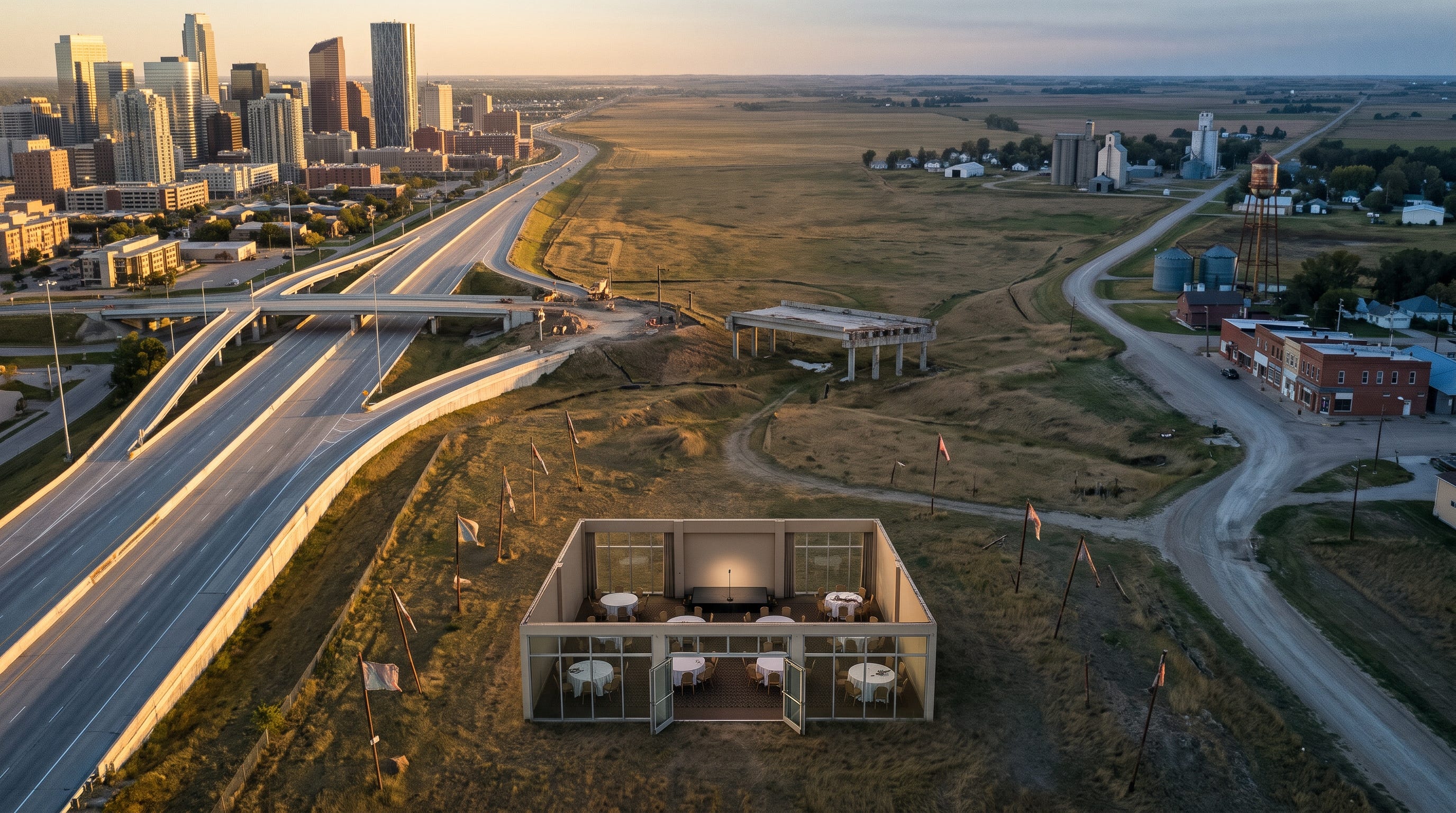
In March, I wrote about journalism support’s last-mile problem. The newsrooms our field knows best are the ones that show up at conferences, apply for grants, and answer newsletters, and that’s a self-selecting sample, not a constituency. Two weeks later, I wrote about Paul Kosel and the Groton Independent in Groton, South Dakota, who had launched a GoFundMe to keep the paper going. My argument was that the support system’s biggest failure isn’t money, it’s delivery. Paper Paul didn’t need a GoFundMe. He needed a road.
So here’s the honest complication. Paul wasn’t in Chicago for ONA26. Neither were most of the one- and two-person shops in the counties that keep showing up on news desert maps. Most of the big national conferences served the middle of the field: urban digital nonprofits, funded startups, mid-size metros, and the support organizations themselves.
LION’s summit came closest to the edge. It was built for independent local publishers, a membership that has long skewed toward one- and two-person operations. Even so, as I noted in March, LION’s 457 members are a small slice of the 8,000 to 10,000 newsrooms out there. Now the summit is gone too, and LION itself wrote that it may be some time, if ever, before it can convene its whole community again. And when I wrote about Paul, the conference circuit was one of the three walls standing between him and every support organization that never found him.
If I told you the edge of the industry just lost its conference, I’d be wrong. What it lost sits further upstream, and that is exactly why it matters more than it looks.
The Middle Mile
Broadband people talk about three layers. There’s the backbone, the big national trunk lines. There’s the last mile, the connection that actually reaches the house. And in between there’s the middle mile, the regional network that carries the signal from one to the other. Spend all the money you want on the last mile. Without the middle, the signal never arrives. Rural broadband experts have called the missing middle mile the biggest barrier to affordable service in rural areas.
Journalism support has the same layers. The backbone is national funders, research centers, and platforms. The last mile is Paul. The middle mile is everyone in between: state press associations, regional collaboratives, consultants, trainers, product people, and the staff of the support organizations. Those are the people who filled the conference hotels. They came home with a tactic, a template, and a phone number, and they carried it out to newsrooms that never bought a badge.
When the middle mile degrades, the last mile gets worse even for people who never touched it directly. Three things break.
The relay slows down. A good practice used to travel from a session in Chicago to a collaborative director’s notebook to a weekly in South Dakota. Remove the first stop, and it stays where it started.
Support organizations lose their feedback loop. The hallway was where support groups heard what practitioners actually needed, unfiltered. Without it, programs get designed around what funders ask for instead of what newsrooms say. It’s what I’ve called proxy empathy: deciding what people need by thinking about them instead of hearing from them. Lose the hallway, and it gets worse.
The long-distance ties go first. The relationships most likely to disappear are the ones between people who are far apart but working on the same problem. That happens to describe the rural publisher and the person who could help her almost exactly.
What a Hurricane Revealed
That last claim isn’t a hunch. We have unusually good evidence for it, courtesy of bad weather.
In late August 2012, Hurricane Isaac forced the American Political Science Association to cancel its annual meeting in New Orleans, two days before it was set to open. The program was already printed. Roughly 3,000 presenters had planned to be there. Three economists, Raquel Campos and Fernanda Leite Lopez de Leon at the University of Kent and Ben McQuillin at the University of East Anglia, saw a natural experiment and tracked what happened to the research those people produced afterward.
Drawing on data covering more than 17,000 academics, they found the cancellation cut the likelihood that an attendee would go on to write a paper with another attendee by about 16 percent. The collaborations that went missing weren’t random, either. They were disproportionately between academics at institutions far apart from each other whose work was closely related. The pairs who did team up without having met there tended to publish in lower-ranked journals, about five places lower on average.
The authors’ conclusion is the line I keep coming back to. Conferences, they wrote in The Economic Journal, de-cluster the network. They take people out of their home clique and put them next to the stranger who is working on the same thing. That isn’t a one-off finding. A separate 2014 study, cited by Northwestern researchers, found that 16 percent of collaborators who don’t live in the same city met at conferences.
Now swap political scientists for publishers. The person in Groton and the person in a Denver collaborative who has already solved Groton’s problem are, in the language of that study, distant and closely related. They are precisely the pair a gathering exists to introduce, and precisely the pair that never meets once it’s gone.
We’ve Seen This Movie
Industries have stopped convening before, and the endings rhyme.
The video game industry’s E3 ran for 28 years and was the show everyone had to attend. It didn’t die because people stopped caring about games. It died because Nintendo, Sony, and Microsoft figured out they could run their own showcases on their own schedules for less money. When the major publishers declined to show up for 2023, the Entertainment Software Association canceled that year’s show, and that December, it ended E3 for good. Its explanation, roughly, was that companies now had their own ways to reach fans and business partners.
COMDEX, the giant computer show, packed Las Vegas with as many as 200,000 people in the mid-1990s. Its decline is usually traced to 1998, when IBM, Dell, Intel, and AMD skipped buying booth space. The last Las Vegas show, in 2003, drew about 40,000. The organizers treated the 2004 cancellation as a pause and promised a 2005 show. Then they canceled 2005, too. It never came back, and CES absorbed what was left.
Journalism has its own version, and some of you were there. The American Society of News Editors convention was once a genuine industry event, and every fourth year, the editors met in Washington alongside the publishers’ association. ASNE and APME voted to merge in 2018, forming the News Leaders Association the following year. The NLA canceled its 2020 conference, and in late 2023, its members voted to dissolve. Sunshine Week went to the Brechner Freedom of Information Project. The awards became the Poynter Journalism Prizes. The programs found new homes. The room where the field met as peers did not.
The common thread is who paid. Each of these events ran on money from the industry’s biggest players rather than on what attendees spent themselves. When those players decided the show was optional, it was over. In gaming, the big players were the exhibitors. In journalism, they’re foundations and platforms.
What Fills the Room
Something always replaces a dead conference. It just comes back in pieces, and each piece has an owner.
Funder-hosted convenings. This is journalism’s version of the publisher showcase. Some of them are excellent. But the host sets the agenda, and the guest list tends to follow grant relationships. The people already connected keep meeting each other.
Smaller, leaner events. These are the survivors. IRE and NICAR are still meeting in Denver in March, because people pay to learn skills they use the following Monday. ISOJ is heading into its 28th year after cutting costs, partly by changing venues, and it benefits from being small.
Sessions embedded in someone else’s event. RTDNA’s traveling model is efficient. It also turns a host into a guest at other people’s gatherings, working inside an agenda it didn’t set.
Slack groups, listservs, and newsletters. Information moves through these just fine. New relationships mostly don’t form there.
Add those up, and you get a field whose network grows more clustered at exactly the moment it needed to spread out. The well-connected keep finding each other. The people at the edge, who used to get at least a secondhand connection through the middle mile, lose even that. It’s the last-mile problem again, just showing up in a different place.
The Value Was Never the Ballroom
Here’s where I think Krewson and I end up closer than it first looks.
Researchers at Northwestern, led by Emma Zajdela and Daniel Abrams, studied how new teams form at scientific conferences, both in person and online. What predicted a new collaboration wasn’t the venue. It was whether people were put into assigned discussion sessions together, and that worked at virtual meetings as well as in-person ones. At the in-person events, people who interacted in groups of two to four were eight times more likely to form a new collaboration than those who skipped the small-group discussions.
One caveat worth naming: these were small gatherings of about 50 scientists each, built specifically to spark collaboration, not 3,000-person expos. That’s part of the point. And what didn’t travel online was the unplanned stuff. Zajdela’s team traced the difference to the informal interaction during breaks and meals that virtual meetings lacked, and a broader review of the research found networking repeatedly fared worse on virtual platforms. The hallway and the bar matter. They’re just the part you can’t schedule.
So the expensive part of a conference, the room block and the catering minimum, was never where most of the value lived. The value lived in deliberate, well-designed mixing of people who wouldn’t otherwise meet. That part is cheap. We just kept buying it bundled with a hotel.
Rural broadband offers a precedent. In 1996, 15 local telephone cooperatives and companies in North Dakota founded the Dakota Carrier Network, a shared middle-mile network that connects each owner’s last-mile lines to the backbone. Nobody waited for a national carrier to build it for them.
If someone set out to rebuild journalism’s middle mile on purpose, it might look something like this:
Small cross-market cohorts of six or eight people, matched by the problem they’re working on rather than by who funds them.
Regular virtual sessions with assigned small groups, which the research suggests work.
One in-person regional day a year, hosted by a press association or a university, where the unplanned encounters can happen.
Entry by application rather than invitation, so the guest list isn’t a copy of the grantee list.
Funding treated as infrastructure, like a road, rather than as event sponsorship that gets renegotiated every year.
That last bullet matters most, so let me be direct about who has to act on it.
For years, a lot of foundation support for journalism conferences looked like event sponsorship. A logo on the lanyard, a reception with the program officer’s name on it, a commitment renegotiated every year, and easy to drop when priorities moved. Then priorities moved, and that is exactly what happened. If the middle mile is infrastructure, the big national foundations need to fund it the way they fund infrastructure: multiyear, pooled across funders, and committed before anyone signs a hotel contract.
The second half of the ask is harder. Fund the road, but don’t own the guest list. A field gathering is valuable because nobody’s grant officer decides who gets through the door. If the replacement for ONA and LION is a calendar of funder-hosted convenings, the field keeps the clustering problem and just gets better catering. The money should go to the organizations closest to the edge, like state press associations, regional collaboratives, and universities, and they should set the agenda.
Practitioners and support organizations aren’t off the hook, either, and I’m not writing this from the sidelines. API, where I work, runs summits of its own. The field has too many overlapping gatherings chasing the same sponsorship dollars. If foundations step up, the rest of us owe them fewer, better convenings and real evidence that they work.
Who Builds the Road Now
The industry didn’t lose a perfect middle mile this fall. It lost an expensive, imperfect, overcatered one that served the middle of the field better than the edges. Plenty of people won’t miss the rubber chicken.
But Paul’s road ran through those ballrooms, even though he never walked into one. Somebody he’ll never meet learns something in a breakout session, passes it along to someone at the state newspaper association, the same association Paul called back in 1986 when he went looking for a paper to buy, and eventually it reaches Groton. That’s the kind of chain that’s breaking.
So who builds it? Funders pay for it, as infrastructure, for years at a time. The organizations closest to the edge run it. And the guest list belongs to the field, not to whoever wrote the check. The alternative is what we’re drifting toward now: funder calendars deciding who gets to meet whom, and everyone acting surprised when the same people keep meeting.
When I was planning those meetings for therapists, we called ourselves a traveling circus because we went to a new city every year. The journalism circus is packing up its tents. Unless somebody builds the road, a lot of towns are never going to see it again.
Where did your middle mile run? Tell me about the conference hallway conversation that changed how your newsroom works, or the Paper Paul in your state who never got the invitation. Drop a comment or hit reply. I read every one, and I’m building a picture of where the road ends.
If this one landed, restack it or forward it to someone deciding next year’s convening budget, whether that’s at a newsroom, a support organization or a foundation. That’s exactly the room this argument needs to reach.