

A Quick Disclaimer: Backstory & Strategy is a personal, independent publication. The views, analysis, and commentary expressed here are strictly my own and do not represent the official position, strategy, or endorsement of the American Press Institute, its leadership, or its board. This is my personal space for analyzing the media landscape, testing new frameworks, and thinking out loud.
Yesterday afternoon, I had 45 minutes with a room of about 50 news leaders at a closed-door retreat on AI and leadership, held under the Chatham House Rule. My job was to move them from diagnosis to readiness, and I’d built a tool for the session, the Leadership Move Stress-Tester, to help do it. At some point, I had to explain how I’d built a working app at all without writing code or calling in an engineer, so I reached for a construction metaphor I’d been carrying around in my head for months.
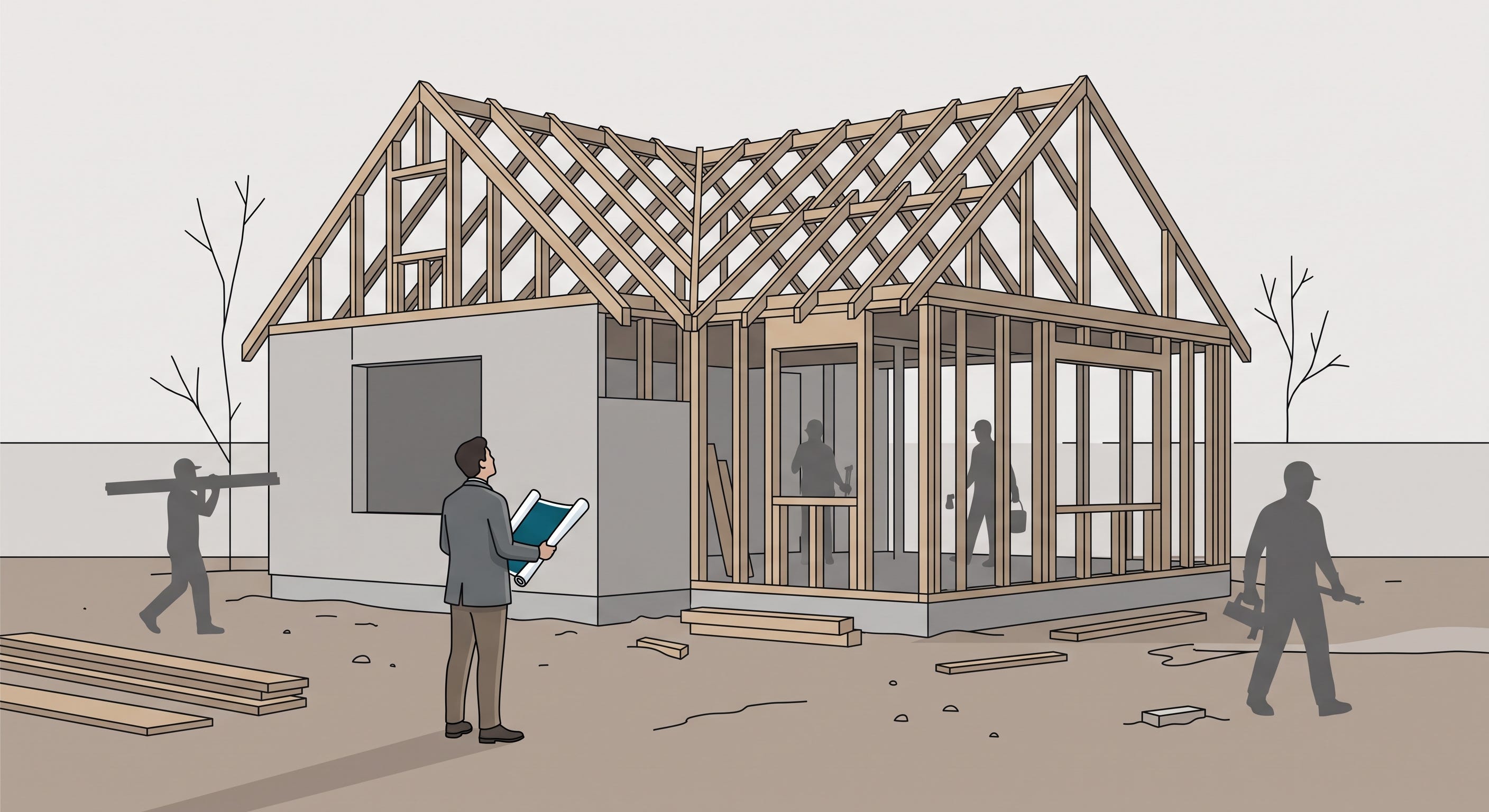
AI was my general contractor. I was the owner.
One attendee told me that, like a lot of leaders, they’d cycled through a number of analogies for AI. Intern. Assistant. None of them stuck. The general contractor did.
I’ve been thinking about why that landed, and it comes down to a quiet truth: it answered the question every leader in that room was actually carrying. Not “what can this thing do?” but “what’s still my job?”
Backstory & Strategy is about the business decisions behind the journalism. If that’s your kind of construction project, subscribe.
The contractor runs the subs
Here’s how I put it in the room. Base44, the platform I built on, acted as the general contractor, managing the subcontractors behind the drywall: the database, user authentication, server logic, AI model calls, and interface layout. I never called any of them directly. And the whole crew came at the cost of a platform subscription, not a developer’s salary, which is a very different budget conversation than most newsrooms are used to having.
What I did was stand on site every day. Move that outlet. Don’t finish that wall yet. Every change was a saved version, so when I broke something, and I broke plenty, I rolled it back. Then I showed the work to a couple of colleagues, to a tester who’d never seen it, and I carried what they told me back to the contractor.
Most of the metaphors we use for AI in newsrooms are about capability. It’s an intern. It’s a copilot. It’s a tool. Each of those answers the question of what AI can do, and each one, if you’re honest, leaves the leader slightly off stage. A general contractor answers a different question, which is who’s responsible for the house. Anyone who has lived through a kitchen renovation already knows the answer. The contractor builds it. The owner lives in it.
To be fair, the tech world has been describing AI agents as orchestrators handing work to subcontractors for a while now, so I’m not claiming the blueprint. What I’d argue is that the interesting part of the metaphor was never the contractor. It’s the owner, and almost nobody is talking about what the owner’s job turns into once the subs get this fast.
The Whole Kitchen Had Muscle Memory. So Did the Whole Newsroom.

A Michelin-chasing chef told his staff that excellence lives in the whole kitchen's muscle memory, not in any single station. Newsrooms built theirs around search and social, and the craft underneath (reporting, verification, judgment) is the part that survives when the menu changes.
What the owner can’t hand off
When the subs speed up, the owner’s work doesn’t shrink. It concentrates. In my experience, it comes down to four things.
Knowing what you’re building. A contractor will build exactly what you describe, quickly and efficiently, and if your description is vague, you’ll get a fast, efficient, wrong building. But the fix for vagueness isn’t a 40-page AI strategy, which was the other idea that landed in the room yesterday. What you need is a clear line of sight: what’s in the way, the next step, and the one after that. “We need an AI strategy” isn’t a blueprint. “Our metro desk is buried in public-records requests, so first we test a tool that drafts them, and then we decide whether it earns a second room” is something a contractor can actually price. Most newsrooms I talk to are still somewhere between those two sentences, closer to the first.
Being on site. The homeowner who never visits gets the house they deserve. In newsrooms, that’s the leader who hands AI to “the digital person,” asks for a quarterly update, and disappears. The reason I could build anything worth showing was that I looked at it every day and had opinions. Here’s what that looks like in practice. An early version of the Stress-Tester told a colleague who was testing it that they were wrong. They weren’t. I just hadn’t asked the right question. No subcontractor was going to catch that, because nothing was broken. The house was built to spec. The spec was wrong, and the only person who could see it was the one standing in the room. Taste doesn’t delegate. Neither does knowing what your audience will and won’t forgive.
Signing off on the inspection. Your name is on the permit. In our business, that’s the masthead, and it doesn’t come off because a machine wrote the first draft. A real contractor carries insurance, signs a contract, and can be held liable when the job goes wrong. AI is none of those things, which is exactly why the inspection falls to you. Verification, editing, and a second set of eyes are the building inspector, and that job doesn’t get smaller because the subs got faster. If anything it gets bigger, because the risk isn’t that the work is obviously bad. It’s that it looks finished. Researchers at Microsoft and Carnegie Mellon found that the more knowledge workers trust an AI tool, the less critical thinking they apply to its output.
Controlling the change orders. Anyone who’s renovated knows the four most expensive words in remodeling are “while you’re at it.” In media tech, it’s five: “can it also do X?” Every one carries a real cost in vendor contracts, licensing terms, data you didn’t mean to share and staff time nobody budgeted. Good owners approve change orders on purpose. They also keep the old drawings, so they can undo the ones that didn’t work.
The owner’s walkthrough
If you’ve got an AI conversation on the calendar next week, and odds are you do, here are five questions worth answering before you walk in. None of them are technical.
Can you name what’s in the way, your next step and the one after that, plainly enough that a contractor could price it? If the answer has the word “leverage” in it, keep going.
Who’s on site, and how often? Name a person. Not a committee, and not “IT.”
Who inspects the work, and can they fail it? An inspector who can’t stop the job is just a spectator with a clipboard.
Who approves the change orders? Somebody should have to say yes before “can it also do X” becomes a contract.
Can you roll it back? If a tool goes sideways on a Friday night, what does undo actually look like?
Score yourself honestly and you’ll land in one of three places. You’re the owner, on-site with the drawings in hand. You’re the absentee homeowner, who’ll find out what got built when the bill arrives. Or you’re the person who hired a cousin’s friend because he was available and seemed confident, which describes more AI vendor decisions than any of us would like to admit.
Know a leader who’s been the absentee homeowner on an AI project? Forward this one. Gently.
The job you already had
Here’s what I didn’t say in the room, but probably should have. None of this is new. Knowing what you’re building, showing up, owning the result, and saying no to scope creep is just leadership. It’s the job every editor and publisher signed up for long before anyone typed a prompt.
AI didn’t change the owner’s job. It took away the excuse that we were too busy swinging hammers to do it.
What metaphor do you use when you explain AI to your investors, board or your team? And which one makes you wince? Tell me in the comments.