

A Quick Disclaimer: Backstory & Strategy is a personal, independent publication. The views, analysis, and commentary expressed here are strictly my own and do not represent the official position, strategy, or endorsement of the American Press Institute, its leadership, or its board. This is my personal space for analyzing the media landscape, testing new frameworks, and thinking out loud.
I had barely sat down for the start of Kol Nidre when the woman behind me leaned forward and said, loudly enough for a few rows to hear, “Great, now I can’t see a thing. How rude.”
I am five foot eight on a good day. And this was synagogue, not a Broadway show. Or was it?
If this is the kind of thinking you want more of, subscribe. Backstory & Strategy is free, and every piece is built to be used, not just read.
Over the course of the service, I watched about 200 people do exactly what was asked of them. They stood when told to stand and sat when told to sit. Now and then, someone offered an “amen.” Up on the bimah, the people leading the service mostly looked out at the congregation with the polite, slightly glazed expression of a team that has run the same play many times. Nobody seemed unhappy. Nobody seemed especially there, either.
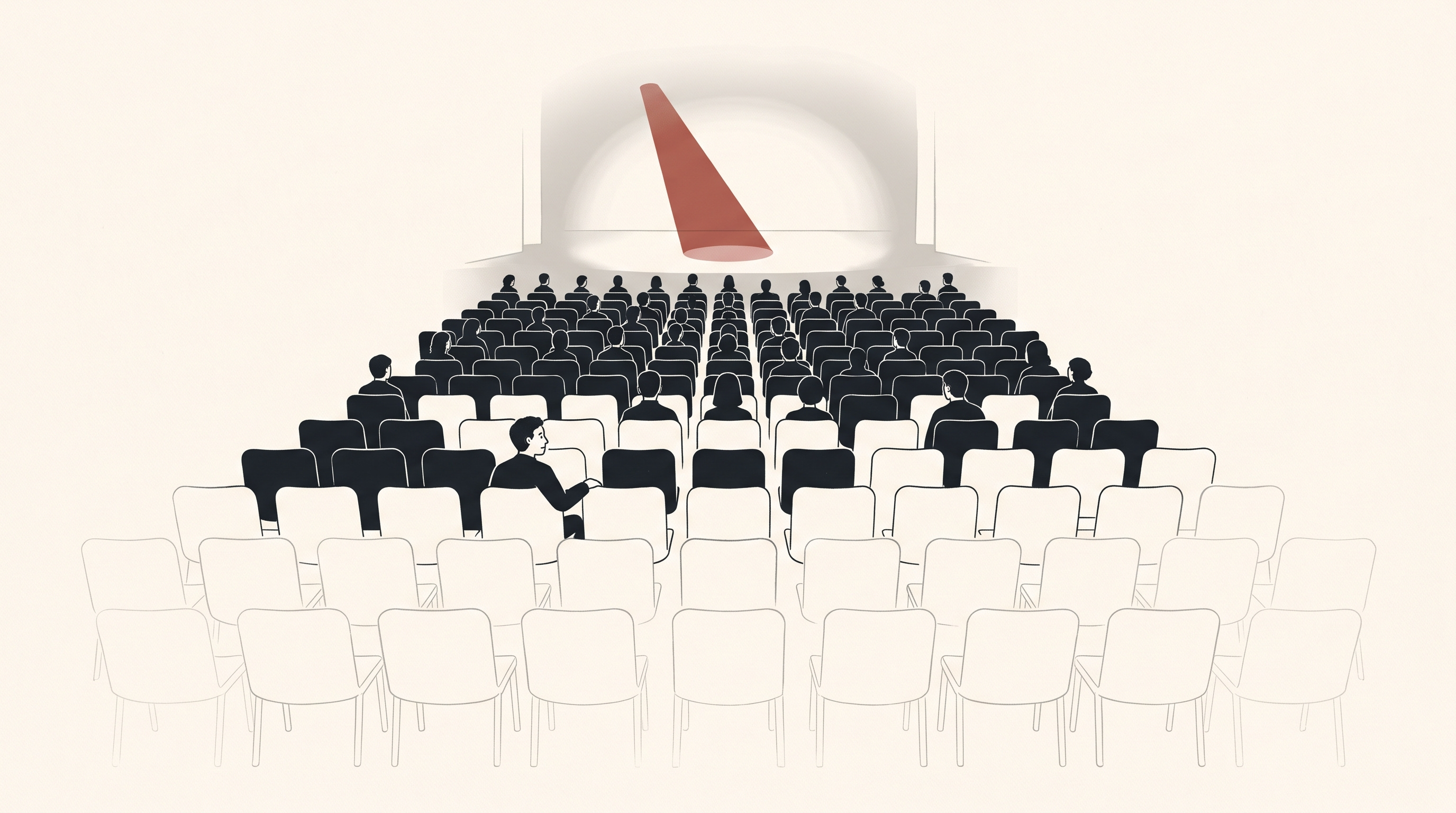
On the way out, I caught myself eavesdropping. Person after person stopped to say how lovely the choir sounded, or how beautifully the cellist had played. I didn’t hear a word about the rabbi’s sermon, or the readings, or even the fast most of us had just begun. Put that next to the woman who couldn’t see, and a picture starts to form. Somewhere along the way, a room built for taking part had become a room for watching. People came to be moved by a performance, and they judged it the way you’d judge any show.
Here’s the part that stuck with me. That room once held a thousand people. Then 700. Then 500, then 400. Today, maybe 200, on the holiest day of the Jewish year, the one built around taking an honest accounting of yourself.
Nobody in that room needed me to explain what that decline means. But I couldn’t stop wondering whether anyone had ever asked the people who left why they did. Or, for that matter, what the people who stayed were hoping to find.
To be fair, someone has asked, at least nationally. When Pew surveyed Jewish Americans in 2020, the most common reason infrequent attenders gave for staying away was that they aren’t religious, cited by two-thirds, followed by simply not being interested (57%) and expressing their Jewishness in other ways (55%). That last answer matters. More than half of the people who stopped showing up didn’t stop caring. They just found somewhere else to put it. But a national survey can’t tell you why the families in that particular room stopped coming. Pew Research Center
I write about journalism, not religion. But somewhere in the middle of Kol Nidre, my mind wandered to local news, and to the outlets I spend my days trying to help.
The Transaction Problem

Young reporters don't struggle to build sources just because the mentors are gone. The deeper problem is a skill the industry has never taught at any level, and a few ways newsrooms can start manufacturing it on purpose.
What the Numbers Can’t Tell You
Consider what that congregation actually knows about the people in the seats. It knows how many came. It knows roughly who came last year, and it can tell you, to the person, who stopped coming. What it almost certainly can’t tell you is what any of them were hoping for when they walked in, or what would have kept the ones who left.
Local news is in the same position, and it has better instruments. Newsrooms can tell you which stories got read, how far down the page people scrolled, which newsletter got opened and which one didn’t. Some can tell you who gave and who lapsed. That is a lot of information about what people did. It is very little information about why.
And the two get confused constantly. A pageview is a person showing up. It doesn’t tell you whether they were moved, bored, angry, or just killing time before a meeting. A subscription is a person in a seat. It doesn’t tell you whether they’re reading every day or paying out of loyalty to a name on a masthead. Standing when asked and sitting when told looks the same from the bimah no matter what’s happening in the pew.
News went through the same shift the sanctuary did. Somewhere along the way, readers became eyeballs and traffic, an audience to be measured rather than a community to be part of. The room is getting quieter here, too. According to this year’s Reuters Institute Digital News Report, the share of people who say they’re extremely or very interested in news has dropped from 59% to just under 46% since 2021, while casual or passive news users grew from 16% to 25%. The Jan Post
Then there’s the part that’s hard to say out loud. When an institution shrinks, the explanation tends to arrive before the investigation. In the sanctuary, it’s that people are less religious these days. In news, it’s that the internet changed everything. Both statements are partly true, which is what makes them so comfortable, and neither one is a substitute for going to the people who left and asking what they were looking for.
Know an editor, publisher, or development director whose room is getting quieter? Send this their way. The worksheet works best when two people run it together.
The Best Research I Ever Did
The best audience research I ever did didn’t look like research. When I was at Philly.com, we ran live chat rooms during Phillies and Eagles games, and thousands of people would pile in to cheer, groan, and argue about the bullpen. Nobody came for information. The score was on their TV. They came to be with other fans and to feel like part of something bigger than their living room. But because they were already there, and already talking, we could ask them what they wanted from us. The answer surprised me a little. They didn’t just want each other. They wanted our sports reporters and bloggers in the room too, answering their questions and arguing back. So that’s what we gave them. The belonging they were looking for included the people doing the journalism.
Most newsrooms still work from the podium: we publish, they receive. Those fans wanted something closer to membership, and membership only works when it runs both ways.
The Audience Exit Interview
So what would it look like to actually ask? Call it an exit interview for your audience. It fits into two weeks and doesn’t need a research budget.
1. Pull a short list of people who left. Choose 25 to 30 lapsed subscribers, former donors, or newsletter unsubscribes from the past year. Mix long-timers with people who left quickly, because they probably left for different reasons.
2. Pick the right person to make the calls. That shouldn’t be the fundraiser or the marketing lead, since anyone carrying a quota will hear a pitch opportunity instead of an answer. It shouldn’t be anyone who’ll get defensive, either. The editor who answers “what would have kept you?” with “did you see our five-part series on the water board?” has stopped listening. Pick a board member, a retired staffer, or anyone whose only job is to be curious and write down what they hear.
3. Ask one question, then three follow-ups. Start with “What were you hoping to get from us when you signed up?” Then ask:
What changed?
What would have kept you?
Where do you get that now, if anywhere?
Don’t argue, and don’t explain what you’ve been working on lately. Just take notes.
4. Sort what you hear, honestly. I suspect most answers land in two piles. Some people wanted information, a reliable account of what’s happening in their town. Others wanted to belong, to feel that the place they live has a shared story and that they’re part of it. Sometimes the shared story they want to be part of includes you. Those are different needs, and they call for different products.
Watch for a third group, too: people who wanted very little from you, until something small tipped them out. An expired credit card, one headline that rubbed them wrong, a price that went up a dollar. Those small exits add up. When the Reuters Institute studied news subscriptions, at least a third of subscribers had cancelled or renegotiated their price in the previous year, with tight budgets and a sense that they weren’t using the subscription enough among the main reasons. Plenty of people want a low-demand, high-meaning relationship, a place to show up, be quiet, and feel connected to something larger. Their passivity isn’t the failure. The failure is not being able to tell someone content in their seat from someone quietly on the way out. Press Gazette
5. Hold the piles up against your dashboard. This is the uncomfortable step. Most local news is built for the first group and measured as though it were serving the second. Clicks, scroll depth, and open rates tell you whether information got delivered. They say nothing about whether anyone feels connected to you, which is why a room can empty out without the dashboard ever flinching. If the people you called mostly came for belonging and everything you track is about information, you’ve found your gap.
6. Change one thing, then tell them. Take the most common answer and act on it. Then go back to the people you called and tell them what you did. A few may come back. All of them will remember that someone asked.
📋 Want to run this in your newsroom? Download the free two-page worksheet, with the call script, a call log, and a sorting guide for what you hear.

The People Still in Their Seats
Then run a shorter version with the people who stayed. The ones still in their seats are the only ones who can tell you what’s holding them there.
I keep thinking about the woman behind me. Her complaint was petty, but it told me something. She had come to see. Whatever she wanted from that service, she thought it depended on the view, and nobody had ever asked her, or anyone else in that room, what they were actually there for.
That’s the question for every institution watching its room get quieter. Not how do we fill the seats, but what did the people in them come looking for, and did we ever bother to find out? Two weeks and thirty phone calls is a small price for the answer.
Have you ever called the people who left? What did they tell you, and did it change anything? Tell me in the comments. I read every one, and the best answers may shape a follow-up piece.