
The Two Words That Keep Ideas Alive
How a rule from improv comedy can quietly change how teams think

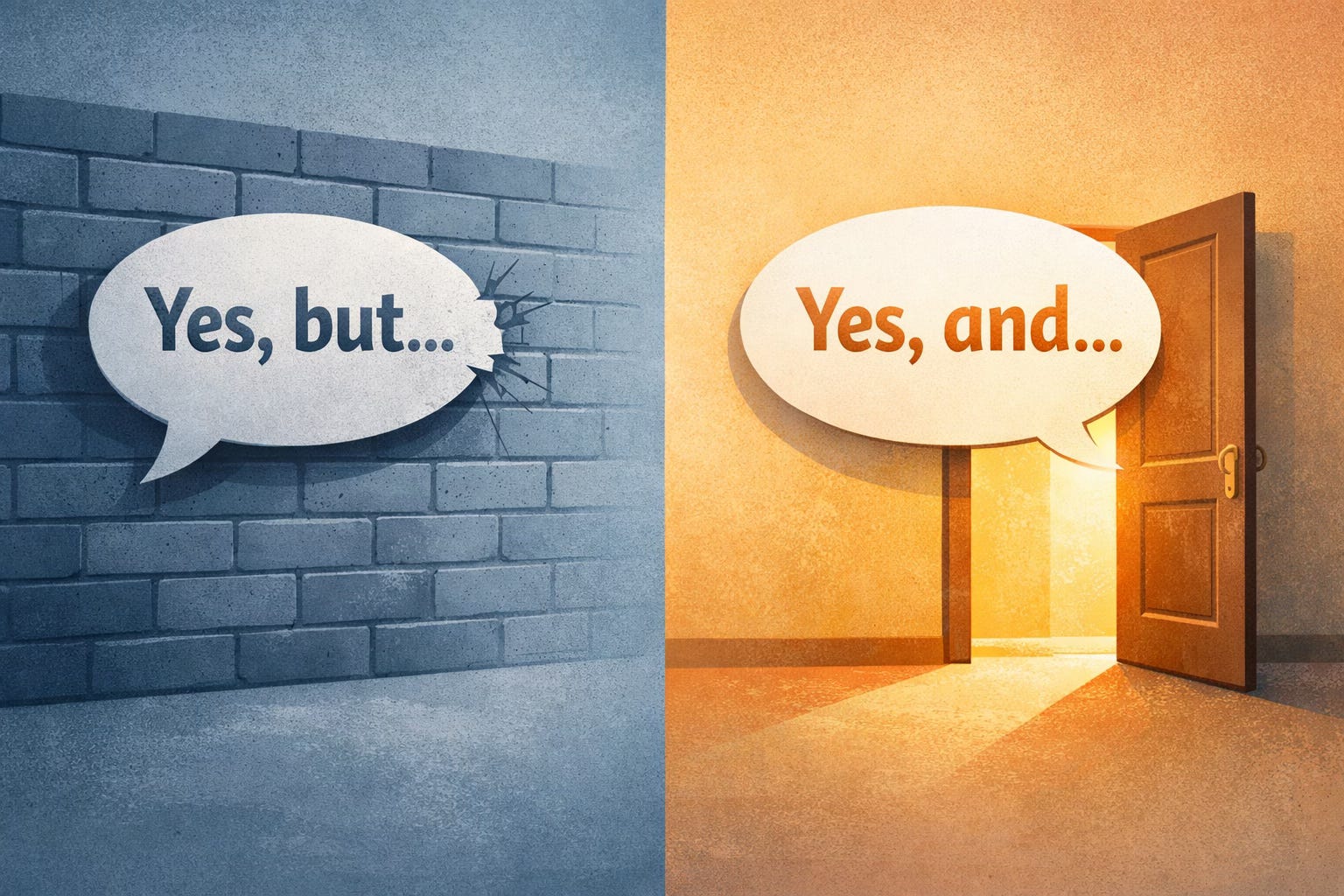
Every workplace has a phrase that quietly shuts things down.
Sometimes it sounds reasonable.
Sometimes it even sounds supportive.
But the moment it lands, the energy in the room shifts.
The phrase is:
“Yes, but.”
Most of us have heard it in a meeting before.
Often we’ve said it ourselves.
Someone offers an idea.
Someone else raises a concern.
And just like that, the conversation moves on.
The idea never really gets a chance.
Someone raises a concern.
Everyone nods.
The meeting moves forward.
It’s a small moment, but it happens in offices every day.
Language like this shapes how organizations think, often more than strategy documents ever will.
I was reminded of that in a meeting yesterday.
My boss at the American Press Institute, Robyn Tomlin, responded to something I said with a simple phrase:
“Yes, and.”
It was quick.
Almost throwaway.
But the effect was immediate.
The conversation opened up instead of shutting down.
And it reminded me just how powerful those two words can be.
Because they come from an unexpected place.
Improv comedy.
If you’ve ever taken an improv class, you learn a rule almost immediately.
Never say no.
Instead you say:
Yes, and.
Your scene partner says,
“Captain, the spaceship is leaking oxygen.”
You don’t respond with,
“That’s not a spaceship.”
You say:
“Yes… and I think the leak started after we passed Saturn.”
The scene continues.
The moment stays alive.
The story grows.
Improv actors learn this pretty quickly.
If you block the idea, the scene dies.
Workplaces do the same thing.
We just don’t call it blocking.
The phrase that used to drive an editor crazy
I once worked in a newsroom where a particular phrase could set off an editor almost instantly.
All someone had to do was say:
“It is what it is.”
A reporter would file a story, lean back in the chair, and say it with a shrug.
“It is what it is.”
Not defensive.
Not sarcastic.
Just a quiet signal that the story was finished.
The editor hated it.
Not the story.
The phrase.
If someone said it, he would practically explode.
Because to him the phrase meant something dangerous.
It meant the thinking had stopped.
The reporting wasn’t going deeper.
The story wasn’t getting better.
The conversation was already over.
“It is what it is,” in his mind, was the editorial equivalent of giving up.
At the time I thought he was overreacting.
Now I’m not so sure.
Because that phrase carries a kind of finality.
It tells everyone in the room the story is finished.
This is the version we’re living with.
Nothing more to see here.
And once that tone enters the conversation, curiosity tends to disappear pretty quickly.
Which is exactly the opposite of how good work usually happens.
Good work almost always begins with something incomplete.
A rough idea.
A thin story.
A first draft.
The real progress starts when someone says something like:
“Yes… and what else could this be?”
What “yes, and” actually does
People sometimes hear “yes, and” and assume it means agreement.
It doesn’t.
It means accepting the idea long enough to explore it.
You’re not saying the idea is perfect.
You’re saying something simpler.
Let’s see where this goes.
In improv, that keeps the scene alive.
In organizations, it keeps possibilities alive long enough for the thinking to improve.
Because most ideas arrive unfinished.
Some are good.
Some are not.
Most are simply early.
Many of the best ideas you’ll ever see start out as mediocre ones that someone helped make better.

Why teams fall back on “yes, but”
There’s a reason many organizations default to “yes, but.”
It isn’t malice.
It’s caution.
Managers are trained to spot problems.
Budgets are real.
Deadlines are real.
So the instinct becomes identifying the flaw as quickly as possible.
Sometimes that instinct is useful.
But when it shows up too early, the creative process never really gets started.
“Yes, but” works well when it’s time to make a final decision.
It’s much less useful when an idea is still forming.
A small experiment
You don’t need an improv class to try this.
Just pay attention in your next meeting.
When someone proposes something, especially something unfinished, notice the first reaction.
Often it’s evaluation.
Try a different response.
Something simple.
“Yes… and what might that look like if we started small?”
Or:
“Yes… and who else should be part of that?”
Or even:
“Yes… and what problem would that solve?”
Something interesting happens when you do this.
People keep thinking out loud.
Ideas stretch a little further.
The conversation becomes collaborative instead of defensive.
The surprising part
Using “yes, and” doesn’t eliminate criticism.
In many cases it produces better criticism.
Because when people feel heard, they stay engaged long enough to refine the idea.
Instead of this:
Idea → Rejection → Silence
You get something closer to this:
Idea → Expansion → Refinement → Decision
The final answer might still be no.
But the thinking along the way improves.
And sometimes the idea that survives that process turns into something nobody expected when the conversation began.
One small question
Before your next meeting, notice something.
When someone introduces an idea, listen for the first response.
Very often it will be:
“Yes, but.”
The concern might be valid.
The risk might be real.
But when evaluation arrives before exploration, the idea rarely gets the chance to grow.
Try a small experiment.
Replace the instinctive response with something slightly different.
Yes… and.
Not forever.
Just long enough for the thinking to continue.
Because most ideas don’t fail because they were terrible.
They fail because someone said “yes, but” before the conversation had time to get interesting.

Before your next meeting, listen for ythe first response when somone shares an idea.
Is it “yes, but”?
Or, “yes, and”?
I’d be curious what you notice.
If you found this post helpful, please restack it and share it with your audience. This spreads the word and keeps me writing the types of content you enjoy.