
Are You Mozart or Beethoven?
Stop waiting for a savior and start pouring the foundation.

A Quick Disclaimer: The following thoughts are my own and do not necessarily reflect the official position of my colleagues or leadership at the American Press Institute. While my work at API deeply informs my perspective on the industry's challenges, Backstory & Strategy remains my space for "thinking out loud" and poking at the frameworks we all navigate.
We don’t call them “Patrons” anymore. We use cleaner, corporate labels like Owner, Board Chair, or Philanthropist—but the power dynamic hasn’t shifted an inch since the 18th century.
If you’re working in media today, you have to ask yourself a hard, uncomfortable question: Whose garage are you parked in?
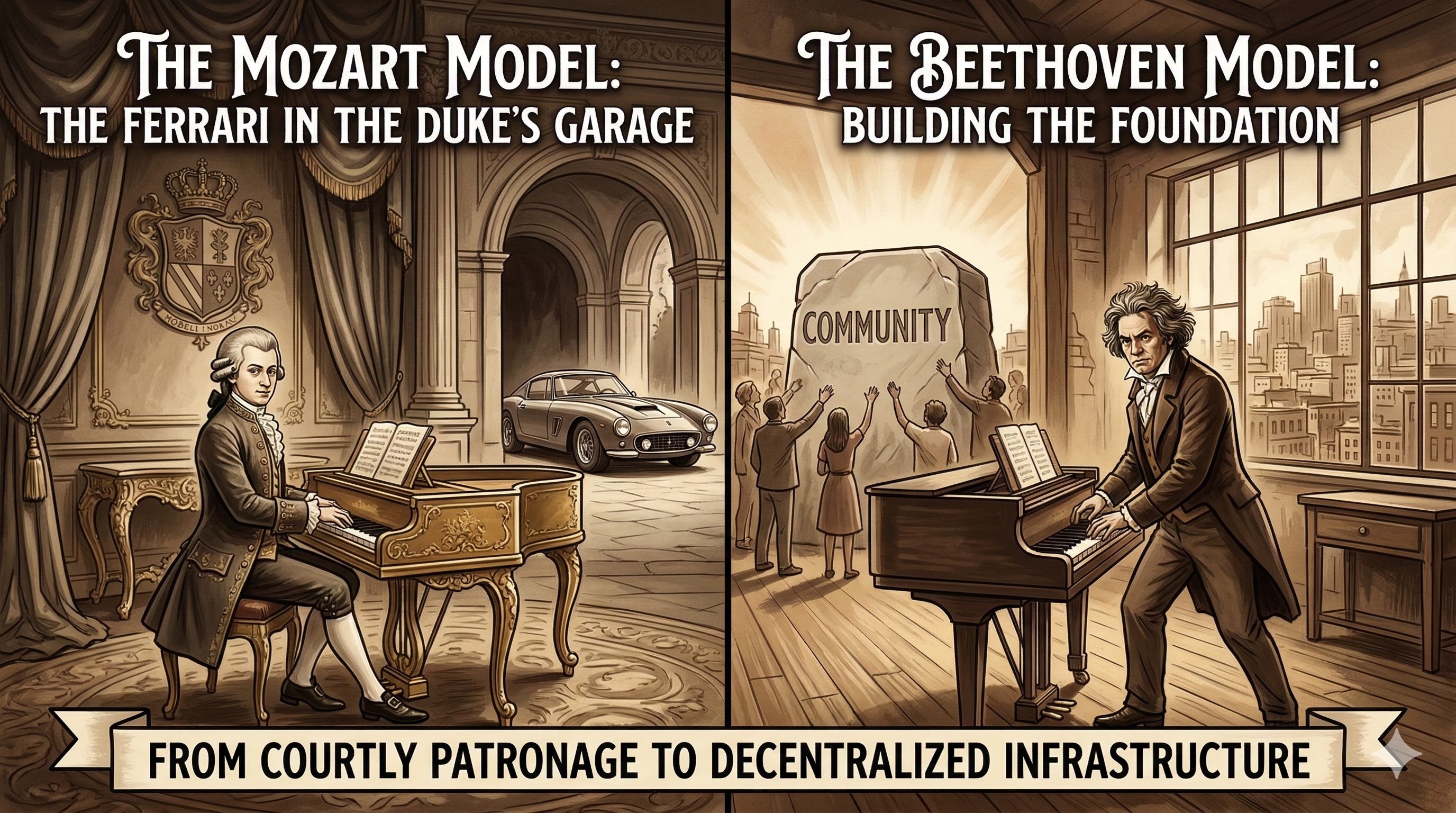
The Mozart Model: The Ferrari in the Duke’s Garage
Mozart was the ultimate high-status dependent. He was brilliant, expensive, and technically a servant. He lived on the “One Big Check” model—provided by an Archbishop who expected the music to serve the status of the court.
It’s a shiny life—until it isn’t.
Patronage is a temporary reprieve, not a business model. When we rely on the benevolence of billionaires or the specific whims of foundations, we aren’t building a civic utility; we’re just building a dependent class. This is the “Ferrari” approach to a career: you are the driver of a magnificent machine, but the car and the garage belong to someone else.
We are seeing the results of this dependency in what some are calling the “Vichy era” of legacy media—a period where editors and executives, fearful of upsetting the Patron’s political or corporate interests, pre-emptively pull their punches. It is a state of “anticipatory compliance.” The independence of the journalist becomes just a loan that can be called in the moment a “dissonant chord” becomes inconvenient for the owner.

The Influencer Dilemma (or, Why They’re Winning)
This is where the “Influencer Dilemma” gets interesting. We spend a lot of time criticizing creators for their “lack of standards,” but we’re missing the structural win.
While the “best” journalists are acting as courtiers—waiting for a Patron’s permission to speak—influencers have already moved into the Beethoven model. They don’t have one Duke; they have a thousand small ones. They’ve traded the prestige of the “court” for the stability of the “crowd.”
Of course, the tradeoff for that freedom is often a lack of institutional guardrails—the crowd can be as fickle as any Duke and far more prone to chasing the loudest lie. But the irony remains: the creators we look down on for being “unprofessional” are often the only ones with the structural freedom to be honest. They don’t have to worry about the “One Big Check” disappearing because they never relied on it in the first place.
The Beethoven Model: Building the Foundation
Beethoven saw the collapse of the old court system and realized he needed to stop begging for permission. He didn’t want one master; he wanted a hundred. He was the original “independent”—pivoting away from the whims of a single Duke and toward a decentralized infrastructure of small subscriptions and commissions.
He didn’t wait for a savior. He built his own foundation, brick by boring brick.
By diversifying his funding, he bought his own independence. He didn’t have to ask the Duke if a symphony was “too long” or “too loud.” He built a system that survived because it was funded by the people it actually served—not by a single ego looking for a tax write-off or a political shield.

Professionalizing the Transition
The real work isn’t about abandoning legacy institutions; it’s about helping them transition. True independence requires Professionalized Infrastructure. It’s about building the gritty systems—the product strategies, the revenue models, and the technical stacks—that allow a newsroom to function as a utility rather than a luxury item.
This moves the focus from the “One Big Check” to the “Ten Thousand Small Ones.” We don’t need more saviors; we need to help the newsrooms we have build the roads they need to be truly free.
So, look at your own work. Are you building a utility, or are you just driving the most expensive item in someone else’s garage?
If you found this post helpful, please restack it and share it with your audience. This spreads the word and keeps me writing the types of content you enjoy.