
The Empty Aisle: Why Journalism's Biggest Beat Doesn't Exist
The thing that determines how people vote is also the thing they most need help navigating day to day. And almost no one in news is covering.

The thing that determines how people vote is also the thing they most need help navigating day to day. And almost no one in the news is covering it that way.
Sixty-two percent of American voters say grocery prices are a major problem for their family. Not a concern. Not something they’ve noticed. A major problem. Gas is at 60 percent. Healthcare at 55. Housing at 52.
These are not niche anxieties. This is the dominant experience of American life right now. And when you ask people what matters most heading into the 2026 midterms, 43 percent name economic issues before anything else. Inflation alone, at 26 percent, ties with threats to democracy as the single most cited issue in the country.
The audience is telling us—in every poll, every focus group, and every angry comment section—exactly what they need. They need help navigating an economy that feels like it’s working against them. They need someone on their side of the kitchen table.
Right now, we aren’t even in the room.
A Quick Disclaimer: Backstory & Strategy is a personal, independent publication. The views, analysis, and commentary expressed here are strictly my own and do not represent the official position, strategy, or endorsement of the American Press Institute, its leadership, or its board. This is my personal space for analyzing the media landscape, testing new frameworks, and thinking out loud.
The Weather Report Problem
Here is what economic coverage looks like at most news organizations in May 2026.
The Bureau of Labor Statistics releases the April CPI report. Headline inflation hits 3.8 percent, the highest since May 2023. Food prices are up 3.2 percent year over year. Beef has surged 14.8 percent. Food at home jumped 0.7 percent in a single month—the biggest monthly gain since August 2022. Mortgage rates are pushing toward 6.7 percent on a 30-year fixed. The Iran war has spiked oil above $100 a barrel, gasoline is averaging $4.50 a gallon nationally, and real wages just went negative for the first time in three years.
CNBC runs a chart. NBC builds a grocery price tracker. The Associated Press writes a story quoting an economist who says it could get worse.
All of it is accurate. Almost none of it is useful.
What we have built, across the industry, is economic journalism as a weather report. Here is today’s number. Here is what went up. Here is an expert saying the storm might continue. It tells people what happened to them. It does not tell them what to do about it.
The gap between “beef is up 14.8 percent” and “here is how to restructure your weekly grocery spend when protein costs spike” is enormous. The gap between “mortgage rates hit 6.7 percent” and “here is a framework for deciding whether to buy, wait, or rethink your housing strategy entirely” is where an entire beat should live.
Almost nobody is filling it.

Where the Audience Actually Goes
When journalism leaves a need unmet, the audience doesn’t sit around in the dark. They find light somewhere else.
Right now, that means Reddit threads where strangers swap grocery substitution strategies. It means TikTok creators with varying degrees of financial literacy explaining what the Fed rate hold means for your car payment. It means Facebook groups where neighbors share tips on which gas stations are cheapest this week. The information is crowd-sourced, unverified, sometimes wrong—and often infinitely more useful than anything a traditional newsroom publishes.
This isn’t an audience sophistication problem. It’s a market signal. When institutional newsrooms won’t give people the basic layout of the land, they do exactly what any rational person does: they build their own map. They route around us.
The problem isn’t just that we’re losing those interactions. The problem is the conclusion people draw when we offer only diagnosis without navigation. They don’t think, “Wow, this newsroom lacks the resources to help me.” They think, “This newsroom doesn’t care about people like me.” That quiet realization is devastating, and it corrodes trust far beyond economic coverage.
I wrote recently about how crisis messaging in journalism depresses the behavior it intends to stimulate. The economic version of that dynamic is specific and measurable. When every story frames inflation as an unstoppable force, the implicit message is helplessness. A newsroom that says, “beef is up 14.8 percent and here are three protein strategies to hold your weekly budget steady” is doing something fundamentally different than one that says, “beef is up 14.8 percent and economists warn it could get worse.”
The first builds agency. The second builds anxiety. Both are accurate. Only one actually helps.
If you’re finding this valuable, consider subscribing to Backstory & Strategy. It’s free, it lands in your inbox, and it’s the kind of analysis you won’t find in industry trade press.
The Proof We Already Have
Here is the part that should make this argument sting: We already know this works. We watched it work. And then we walked away from it.
During COVID, journalism became a utility almost overnight. Newsrooms built vaccine eligibility trackers. They mapped testing sites. They created interactive tools that told you where to find a mask, where to get a free test, which pharmacy had appointments available this week. The Texas Tribune and ProPublica built a guide to navigating the state’s unemployment system—not a story about unemployment, but a step-by-step tool for the person sitting at home trying to figure out how to file a claim. A reporter at the Tallahassee Democrat became a one-woman vaccine hotline, fielding hundreds of calls and texts from seniors who needed someone to walk them through eligibility rules and online forms.
That wasn’t story mode. That was utility mode.
I saw it firsthand. I was at PBS39 in the Lehigh Valley when Pennsylvania went into lockdown in March 2020. We launched a daily half-hour program called Community Update on Coronavirus, airing live on TV and rebroadcast on our NPR station, WLVR. It wasn’t a newscast in the traditional sense. It was a tool. Medical experts, business owners, government officials, and school leaders came on to answer real questions from real people.
When vaccines became available, we walked viewers through eligibility. When unemployment claims jammed, we brought on people who could troubleshoot the process. When schools went remote, we helped parents navigate what that actually meant for their kids. We revived the program when cases surged again in December 2020 and kept it running through June 2021.
We weren’t just reporting on the pandemic. We were helping people get through it. And the audience knew the difference.

The Business Case Nobody Made Permanent
Here is where the argument moves from the newsroom to the spreadsheet, because the data from that period is unambiguous.
The audience responded to utility journalism with the two things the industry has been chasing for a decade: trust and money.
On the commercial side, local TV news viewership didn’t just tick up; it surged. Among 18-to-34-year-olds—the demographic the industry had largely written off—local news viewership increased 162 percent by the third week of March 2020. That wasn’t a rounding error. That was a generational reversal. Adults 25 to 54, the primary advertising demographic, were up 78 percent. Viewership in Hispanic and Asian households jumped 42 percent and 62 percent, respectively. The audiences showing up were younger, more diverse, and more engaged than anything local TV had seen in years. And 83 percent of adults said they trusted their local news stations over national networks or cable.
They didn’t show up because they were bored and flipping channels. They showed up because local news was being useful to them in a way it hadn’t been before. Utility earned their attention. Nothing else had.
On the nonprofit side, the story was just as clear. Nearly two-thirds of nonprofit news outlets saw increases in individual giving during 2020, and 60 percent saw foundation support grow as well. The number of small-dollar contributors jumped nearly 50 percent in a single year, web traffic increased 43 percent, and newsletter signups rose 36 percent. INN’s researchers pointed to the increase in service journalism as a key driver of this growth—the very shift toward utility that drove the trust and the traffic.
These are not ambiguous signals. Every metric we use to measure organizational health—audience size, demographic diversity, trust, donations, subscriptions, and engagement—moved in the right direction when journalism was operating in utility mode. The data doesn’t whisper. It shouts.
And then the pandemic receded, and we went right back to story mode.
The trackers came down. The eligibility tools expired. The navigation guides stopped updating. The community programs ended. Nobody looked at what had just happened and said, “We just proved that utility journalism drives trust, growth, and revenue, so let’s build permanent beats around this model.” COVID was treated as an emergency demanding a temporary response, not as a strategic revelation that should have reshaped our entire relationship with the public.
Introducing Editorial Style

Backstory & Strategy is supported by Editorial Style. Because what you stand for shouldn’t stop at the masthead. Their Integrity Series pairs minimalist typography with premium cotton. Heavyweight. Durable. Built by journalists for journalists.
What We Missed the First Time
Compare that to 2008. When the financial crisis hit, we didn’t make the utility pivot. The coverage was about the banks, the bailout, the policy debate. The New York Times and The Wall Street Journal covered the crisis brilliantly from an institutional perspective. But what was almost entirely absent was navigation for the homeowner who just received a reset notice on an adjustable-rate mortgage and had no idea what a loan modification was, how to apply for one, or if they even qualified. The person at the kitchen table was on their own.
Admittedly, 2008 was a simpler information environment. If the Philadelphia Inquirer had built a mortgage navigation tool back then, its audience would have found it. Today, the landscape is exponentially more fragmented. The audience has a hundred places to turn, most of them unvetted, many of them wrong, and some of them actively predatory.
Which means the cost of not building navigation journalism is much higher now. In 2008, the audience was simply unserved. In 2026, they are being served badly by someone else. The longer we cede that ground, the harder it becomes to reclaim.
We are now entering a third major economic moment where the exact same need exists. Inflation is eroding purchasing power. Housing costs are locking out a generation. Real wages are slipping. And for the third time, we have a choice: cover the economy as a set of facts reported from a distance, or build the beat that helps people survive it.
COVID showed us what happens when we choose utility. 2008 showed us what happens when we don’t. The question is whether we have the institutional memory to recognize the pattern.
Moment. Action. Channel.
A few weeks ago I was at Ohio University as faculty for the Kiplinger Fellowship, running a workshop called “The Last Mile” for 31 working journalists—publishers from rural Missouri, investigative producers from network news, and solo founders building newsrooms from scratch in Providence. I handed each table a real community crisis from what I call the Bucket of Chaos and gave them one rule: solve it without writing a story. Build a tool instead.
Every single table built a technology solution. Text alerts, interactive maps, push notification systems, dashboard apps. Not one table defaulted to a story.
Thirty years ago, the same exercise would have produced phone trees and library bulletin boards. What changed isn’t just the available technology; it’s how journalists think about the problem once you give them permission to think differently about it.
To test whether a newsroom is actually building a utility or just producing more content, I use a three-part framework: The Moment, The Action, and The Channel.
The Last Mile Framework
If your economic coverage can’t answer all three of these questions, you are still stuck in story mode:
Take the grocery price spike. The Moment is standing in the supermarket meat aisle. The Action is compare, substitute, and recalculate. The Channel is not a story on the homepage that the reader might see three days later. It’s a weekly email or a text alert that lands before the shopping trip starts.
Take the mortgage decision. The Moment is when the lease renewal hits the mailbox, and you have to decide whether this is the year you try to buy. The Action is running the numbers against your local market, your income, and your down payment. The Channel is an interactive tool or calculator that lives where you can find it when you need it, not a long-form feature that publishes on an arbitrary news cycle.
Take the benefits gap. The Moment is when your hours get cut, or prices push your household past an eligibility threshold you didn’t know existed. The Action is check, apply, connect—not reading a breakdown of state policy. The Channel meets you where you are, which probably isn’t a newspaper’s website at 10 AM on a Wednesday.
Every time a reader encounters coverage that describes their economic pain without helping them respond to it, the newsroom gets filed away in the same mental category as the problem itself. Story mode on pocketbook issues isn’t just insufficient; it’s a trust liability.
The Instinct Is Already There
Here is what surprised me most at Kiplinger: I didn’t have to convince anyone in that room to think this way. The moment I gave them permission to build a tool instead of write a story, they moved immediately. The instinct was there. The framework was what was missing.
That matters because the barrier isn’t that journalists don’t understand utility. It’s that the structures they work in don’t reward it.
Nobody’s editor is asking, “What tool did you build this week?” Nobody’s performance review includes, “Readers who changed a financial decision because of your coverage.” The incentives point entirely toward story production, and the metrics track reach and engagement, not impact and agency. A reporter who writes a CPI explainer that gets 50,000 pageviews is doing better, by every metric the industry uses, than one who builds a grocery budget tool that helps 500 families save $40 a week. The first reporter produced content. The second one produced a utility.
Right now, we only know how to count the first.
Know someone who’d find this useful? Forward this piece to a colleague in news leadership, audience strategy, or journalism funding. The pocketbook beat won’t get built by accident.
The Infrastructure Problem
Here is why individual newsrooms attempting this in isolation will mostly fail.
Economic navigation journalism requires a combination of data fluency, financial literacy, local sourcing, and UX thinking that most local newsrooms simply do not have on staff. The reporter who covers city hall isn’t going to build a grocery price comparison tool between city council meetings. The editor managing the politics desk doesn’t have a framework for translating Federal Reserve policy into household budget implications. These are real skill gaps, and acknowledging them isn’t an insult. It’s a design problem.
But the templates for this work are highly replicable. A grocery budget stress test built for Philadelphia can be adapted for Des Moines. A mortgage decision framework is geography-agnostic in its structure, even if the inputs are local. A benefits eligibility tracker needs state-level data, but a common architecture.
What would a pocketbook navigation toolkit actually look like?
An open-source grocery comparison calculator that any newsroom can plug local store data into.
A mortgage decision framework that walks readers through rate scenarios against local housing inventory.
A benefits eligibility screener that connects to state-level SNAP, LIHEAP, and childcare subsidy thresholds and updates automatically when income cutoffs change.
Text-alert templates that deliver localized price-shift summaries right before the weekend shopping trip.
None of these require original invention. They require someone to build the template once and make it available to every newsroom that needs it.
This is the kind of work that national journalism funders, industry associations, and university lab partnerships are perfectly positioned to back. One coordinated investment in a navigation journalism toolkit would be orders of magnitude more efficient than hundreds of newsrooms each independently trying to figure out how to localize CPI data.
The infrastructure doesn’t exist yet. But the design problem is solvable, and the demand signal from the audience has never been louder.
The Status Problem
There is an uncomfortable reason this beat doesn’t already exist at scale, and it has nothing to do with resources or skills.
Let’s be honest about the newsroom caste system: service journalism sits near the bottom. Telling people how to restructure their grocery spending doesn’t carry the same editorial prestige as interpreting the Federal Reserve. Building a mortgage decision tool doesn’t win awards in the same categories as investigative reporting. It doesn’t have the status of political analysis. It’s treated as a nice-to-have—tucked away on the lifestyle desk next to the movie reviews.
That distinction is a luxury we can no longer afford. It’s also a distinction the audience has never recognized. When 62 percent of voters call grocery prices a major family problem, the person who helps them navigate that problem isn’t doing lesser journalism. They are doing the journalism that matters most to the largest number of people.
And here is the part that should keep editors up at night: pocketbook coverage is one of the very few things a newsroom can build that does not immediately segment into red or blue readership. Groceries, gas, housing, healthcare—these are majority concerns across every partisan divide, every demographic, and every geography. In a media environment where everything polarizes on contact, a beat that serves the universal economic experience isn’t just editorially valuable. It is strategically rare.
The Convergence
The case for a pocketbook beat collapses a tension that newsrooms have been struggling with for a decade.
We like to talk about political coverage as the bedrock of democracy, and economic coverage as institutional oversight. Fine. But a pocketbook beat forces them into the same room. The thing that most determines how people vote is also the thing they most need help navigating day to day. Civic relevance and audience utility are not competing priorities. They are the exact same beat.
The engagement case writes itself. Pocketbook content is inherently recurring. Prices change. Rates move. Benefits eligibility shifts with economic conditions. Seasonal patterns affect energy costs, food costs, and childcare costs. A newsroom that builds this beat isn’t producing one-off features. It is building a reason to come back every single week—which is the exact habit every local news organization is trying to manufacture with newsletters, push notifications, and loyalty programs. The return-visit engine is already built into the subject matter. You just have to serve it.
The trust case is even stronger. When a newsroom helps you make a decision that saves you money or connects you to a program you didn’t know you qualified for, the relationship changes. It is no longer abstract. The newsroom is no longer just an institution that tells you what happened in the world. It is a tool that makes your life work better.
That isn’t a small shift. That’s the difference between a subscription and a habit.
The Edge
The Philadelphia Fed’s Survey of Professional Forecasters just projected headline CPI hitting 6 percent for the second quarter. Three months ago, the same panel said 2.7 percent. The war-driven spike in energy is rippling through food, through transportation, through shelter. Real wages went negative in April. And the forecasters who watch this for a living are raising their estimates, not lowering them.
The economy is going to be the story of the next twelve months. It is already the story of most people’s daily lives. The question is whether journalism will cover it the way the industry covers everything—as a set of facts reported from a distance—or whether someone will build the beat that actually meets people where they are.
Thirty-one journalists in a room in Athens, Ohio, already know the answer. The moment I told them to stop writing stories and start building tools, they didn’t hesitate. The instinct is there. The permission is what’s missing.
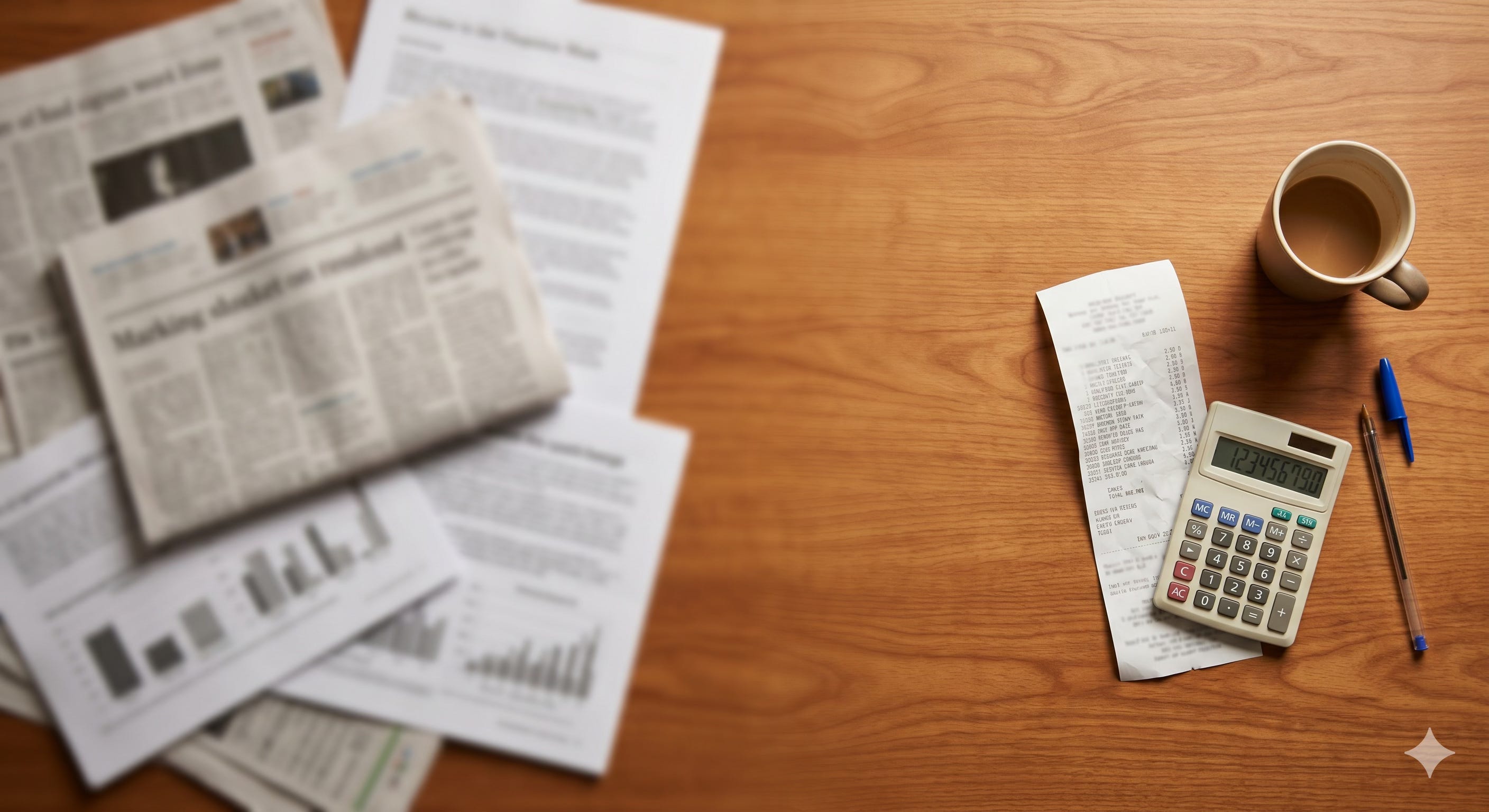
The audience is sitting with a grocery receipt in one hand and a mortgage statement in the other, waiting for someone to help them make sense of the math.
The audience is ready. The framework is there. The only question left is who’s going to build it.
Name one newsroom that’s doing this well. Not doing economic coverage well. Doing economic navigation well. Helping people act, not just understand. I’ve been looking and my list is short. Help me make it longer.
Something wrong? If you spot a factual error or have additional context that should be reflected here, please let me know. Verified corrections will be noted in the piece.
Backstory & Strategy is supported by Editorial Style — premium apparel built by journalists for journalists. Explore the Stylebook →
Outstanding. I'm covering a story this week looking at why The SF Chronicle's weather reporting is one of its biggest converters of readers to subscribers. Why? It layers useful information on top of the forecasts such as what storms, fires, floods and heat mean for readers’ homes, commutes and safety. Includes local forecasts, live blogs, evacuation maps, weather trackers, address-level data, text alerts…In short, it's USEFUL. PS Jacob Donnelly's AMO published it.