
The Songs That Refuse to Let the System Off the Hook
From Bob Dylan to Bruce Springsteen, a tradition of music that names injustice and refuses to forget

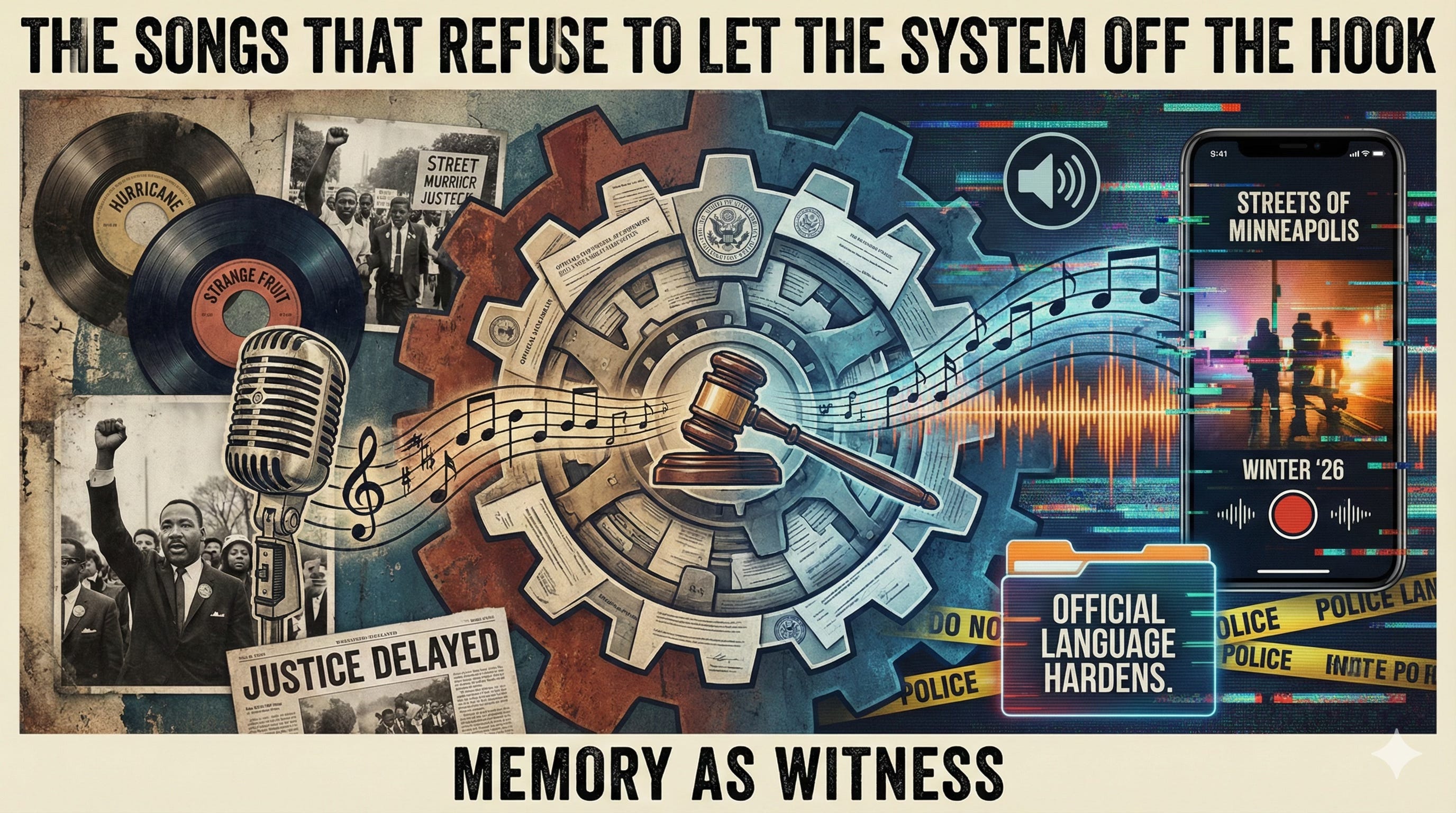
When I first heard Bruce Springsteen’s Streets of Minneapolis, I felt something in my chest constrict. It was not grief. It was recognition.
Hurricane by Bob Dylan hits me the same way every time. Not because the songs sound alike. Because they are undertaking the same moral labor.
These songs ask us to do something.
They do not accept injustice as a mistake or as humans momentarily falling short of our noblest ideals. They treat injustice as a system performing exactly as it was designed to, then asking us to accept the result as tragic, but inevitable.
These songs bear witness. They do not entertain.
The Songs-as-Witness tradition
Hurricane contains countless names, dates, and places. Dylan layers fact upon fact until it crowds out the tune. Listeners do not finish the song feeling like they heard a performance. They finish it feeling as if they have seen a file assembled by someone who has grown tired of our capacity to deny that repetition eventually becomes justification.
Dylan makes the villainy systematic. In Hurricane, there is not just one bad actor. There is the system itself. The way it protects its own. The way process grants immunity. The way injustice becomes institutionalized.
Springsteen uses names in Streets of Minneapolis too. He spells them out plainly, without adornment. Alex Pretti. Renée Good. Trump. DHS. Miller. Noem. He even names the lie itself.
“Just don’t believe your eyes.”
But Dylan and Springsteen are not trying to do the same thing.
Dylan names names to right a wrong. Hurricane is written with resolution in mind. Set the story straight. Reverse the verdict. Make it right.
Springsteen names names to fight erasure.
He is trying to interrupt the same cycle while it is still in motion. He is writing against our ability to forget while language is being softened, while deaths are being converted into policy positions, press releases, and footnotes.
He is writing against inevitability.
It is not subtle. It is pointed. The lyrics repeat the names again and again. We will remember them.
Demanding that people remember names is not demanding that justice adapt. It is demanding that culture transform.

An American tradition
This tradition of demanding more than justice demands of us runs deep in American music. Songs that insist on witness rather than simply requesting attention.
Springsteen stands with Strange Fruit by Billie Holiday, Mississippi Goddam by Nina Simone, and Ohio by Crosby, Stills, Nash & Young. Each rejected the comfortable distance American pop music often places between life and death.
Strange Fruit did not ask listeners to imagine injustice. It showed them bodies hanging from trees and dared them to look away.
Mississippi Goddam was built on impatience. Simone understood that “go slow” was not prudence. It was strategy. Delay consequence long enough and it becomes indistinguishable from never.
Ohio was written days after the shooting it describes. It offered no deference to process. It demanded truth before time could soften it.
Each of these songs carries the same demand. See injustice for what it is, without the gift of ambiguity.
Streets of Minneapolis honors that tradition while extending it.

Why Springsteen, and why now
There is particular power in speaking from inside the American story. Springsteen does not critique from the margins. He writes from the center.
When Springsteen indicts the country, he does so from the voice of the worker, the patriot, the believer. The betrayal cuts deeper because it comes from someone who once gave voice to the myth itself.
We did not mishear him. The myth misled us.
American Skin (41 Shots) places procedural language beside human loss and refuses to let the listener resolve the contradiction.
Youngstown exposes economic violence. Loyalty demanded. Labor consumed. Abandonment once usefulness expires.
Streets of Minneapolis recognizes something true about where we find ourselves now.
Invisibility is no longer enough to guarantee safety. Information exposes. But exposure no longer guarantees consequence.
If we did not know Pretti was dead before, we do now. We have footage. Eyewitnesses. Statement after statement confirming what many already suspected. And still the gears grind forward. Paperwork accumulates. Official statements harden into language. Bodies pile up while the machine keeps humming.
Even the title refuses isolation. These were not events on a single street. These were streets. A grid. A pattern.

Memory is not justice
There was a time when Dylan could believe exposure might lead to accountability. Show enough people the lie and they would demand justice.
That world no longer exists.
Now we live with constant exposure. Outrage flares and fades. Memory erodes.
Songs can do something video cannot. Songs ritualize memory. They move events from the news cycle into the culture itself.
Kendrick Lamar’s Alright reads less like catharsis than survival. Hope is not the destination. It is what you grip while waiting.
Childish Gambino’s This Is America makes the horror feel designed. Breakdown becomes routine. Chaos becomes choreography. Not malfunction, but feature.
None of these songs tell us how it ends. They never have.
What they do instead is remind us what we are fighting over when we ask how it ends.
Hurricane says this is wrong, and here is why.
Streets of Minneapolis asks something harder.
What happens after we know?
If you want to hear the songs referenced in this piece, I put them together in a short playlist here.
P.S. — Did this analysis provide you with a breakthrough strategy?
If so, please consider making a one-time tip to support the deep research and analysis that goes into every Backstory & Strategy post.
Additionally, if you found this post helpful, please restack it and share it with your audience. This spreads the word and keeps me writing the types of content you enjoy.